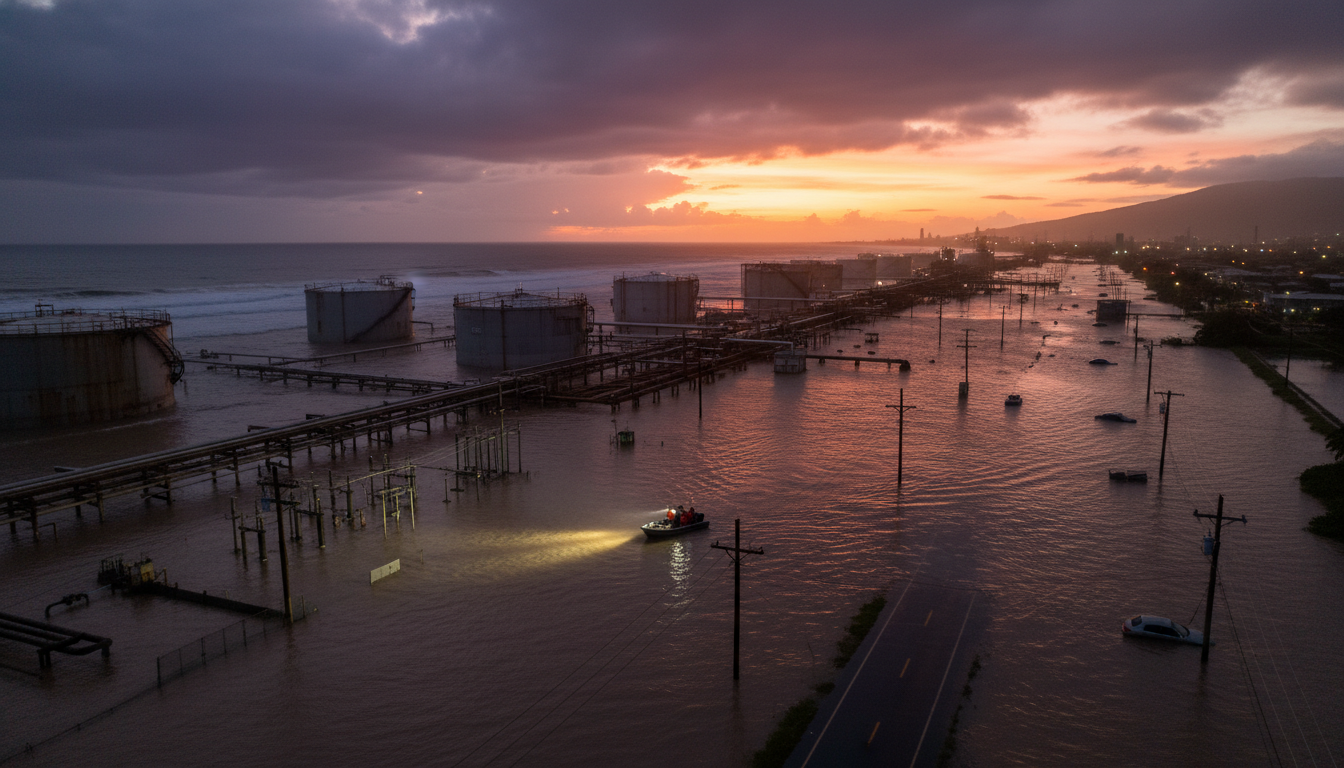
Hawaii’s Floodwaters: A Stark Warning for Energy Infrastructure Investors
The recent catastrophic flooding on Oʻahu’s North Shore serves as a potent, localized case study for global energy investors. While geographically distinct, the events in Hawaii vividly underscore the escalating operational risks and economic disruptions posed by extreme weather to critical infrastructure worldwide. For those deploying capital across the energy sector’s intricate supply chains and assessing long-term demand stability, this incident highlights fundamental vulnerabilities in preparedness, response, and the often-underestimated financial ramifications of a rapidly changing climate. The interplay of unprecedented meteorological intensity, aging infrastructure, and challenges in emergency communication protocols offers crucial lessons for evaluating investment resilience in an increasingly volatile world.
The Rising Cost of Climate Risk and Infrastructure Vulnerability
Hawaii’s experience with its recent deluges offers a chilling glimpse into the future of climate-induced operational risks. The island recorded an astonishing 2 trillion gallons of rain within a single month, with some localized areas experiencing up to 3,000% of their historical average for that period. This deluge, dramatically exceeding initial National Weather Service forecasts for March 19, points to the increasing unpredictability and intensity of weather events. From an investment perspective, such unpredictability directly translates to heightened operational risk across all sectors, including energy production, distribution, and consumption. The intense scrutiny on the 120-year-old Wahiawā Reservoir, also known as Lake Wilson, currently owned by Dole Food Co. and slated for transfer to state control, further illuminates the systemic risk posed by aging infrastructure when confronted by modern climate extremes. Investors must increasingly factor the cost of infrastructure hardening and the potential for catastrophic failure into their long-term models, recognizing that these are no longer ‘black swan’ events but increasingly probable scenarios.
Market Volatility and the Echo of Local Disruption
While the Hawaii floods represent a localized crisis, their underlying implications for infrastructure resilience and demand stability resonate across the broader energy market. As of today, Brent Crude is trading at $94.95, marking a significant 5.06% increase for the day, with WTI Crude similarly robust at $87.27, up 5.67%. This current upward trajectory follows a notable dip in Brent prices over the past two weeks, which saw it drop from $112.78 on March 30 to $90.38 on April 17. The daily volatility, underscored by today’s climb, is a constant reminder of the market’s sensitivity. Even regional infrastructure failures, by disrupting local economies and consumer activity, can contribute to overall market jitters, especially when they highlight systemic vulnerabilities. The challenges faced by Honolulu officials in issuing timely evacuation orders for areas like Waialua and Haleʻiwa on March 20, where many residents were already struggling through chest-deep water, demonstrate how unpreparedness can amplify economic disruption. Investors need to consider how such events, even if geographically contained, signal potential disruptions to demand centers and logistical pipelines in other, more energy-intensive regions, adding an unpredictable layer to price formation, as seen with gasoline prices at $3.03, up 3.41% today.
Navigating Emergency Response and Governance Risks
The official response to the Hawaii floods, characterized by debates over communication protocols and resource allocation, offers a critical lens for assessing governance risks in investment landscapes. Department of Emergency Management Director Randal Collins’ defense of decisions, emphasizing the multifaceted nature of evacuation orders beyond simple stream gauge readings, highlights the complexity. However, the Honolulu City Council’s rigorous questioning of what critics termed delayed evacuation orders and insufficient public updates points to a significant area of concern for investors. Slow or ineffective governmental responses to crises can amplify economic disruption, prolong recovery timelines, and erode investor confidence in a region’s stability. Managing Director Mike Formby’s acknowledgment of the “political tightrope” walked by decision-makers, weighing premature evacuations against delayed action, further illustrates the inherent challenges. For investors, these insights are crucial for evaluating the long-term viability of assets in regions susceptible to extreme weather, as the effectiveness of local governance directly impacts the speed and cost of recovery, and by extension, asset value and operational continuity.
Forward Outlook: Integrating Climate Resilience with Market Fundamentals
For investors asking about the future trajectory of oil prices, such as “is WTI going up or down” or “what do you predict the price of oil per barrel will be by end of 2026,” the Hawaii floods provide a critical piece of the puzzle that extends beyond traditional supply-demand metrics. While upcoming events like the OPEC+ JMMC Meeting on April 20 and the full OPEC+ Ministerial Meeting on April 25 will undoubtedly shape global supply strategies, and EIA and API Weekly Petroleum Status Reports (April 21, 22, 28, 29) will offer crucial inventory insights, the increasing frequency and intensity of climate-related disruptions demand equal attention. These localized infrastructure vulnerabilities, as exposed in Hawaii, can introduce unpredictable shocks to both demand and supply chains, even if not directly impacting major production hubs. A potential output adjustment from OPEC+, for instance, could tighten global markets, but if major demand centers are simultaneously grappling with climate-induced infrastructure failures, the resulting market dynamics become far more complex. Savvy investors are now integrating climate resilience assessments alongside traditional fundamental analysis, recognizing that the capacity of communities and infrastructure to withstand and recover from extreme weather will increasingly influence long-term energy market stability and investment returns.