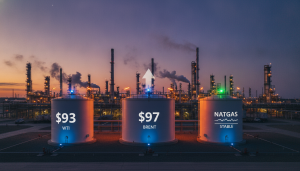
The geopolitical landscape is once again tightening its grip on global energy markets, pushing the prospect of $100 oil back into sharp focus. Recent developments in the Middle East, particularly concerning Iran’s nuclear program and its implications for regional stability, have reignited fears of supply disruptions. While the market’s immediate reaction has been somewhat measured, with Brent Crude currently trading at $93.92, up 0.73% today, and WTI Crude at $90.48, climbing 0.9%, the underlying tension is palpable. This slight daily uptick, however, stands in stark contrast to the significant decline observed over the past two weeks, where Brent fell nearly 20% from $118.35 on March 31st to $94.86 on April 20th. This dynamic suggests that while broader market forces have recently exerted downward pressure, the escalating geopolitical risk is now re-asserting a premium, making a sustained move towards triple-digit oil prices a very real possibility for investors.
The Hormuz Crucible and Emerging Market Dynamics
At the heart of the current crisis lies the Strait of Hormuz, a critical chokepoint through which approximately one-fifth of the world’s daily oil supply transits. The potential for disruption in this vital waterway is the single most significant factor driving the geopolitical risk premium. Reports of major oil companies and trading houses already suspending crude oil and fuel shipments that utilize the Strait underscore the seriousness with which the industry is taking these threats. While no direct targeting of oil fields or facilities has been confirmed, the mere possibility of such actions, or a full-scale closure of the Strait, sends shockwaves through the market. Today’s market snapshot, with Brent at $93.92 and WTI at $90.48, reflects a market that is pricing in a degree of this risk, but perhaps not yet the full extent of a worst-case scenario. The significant retreat in Brent prices from late March highlights a previous period where the market may have been complacent or focused on other demand-side narratives. Now, with tensions escalating following the conclusion of diplomatic talks, investors are recalibrating their risk assessments.
Navigating Uncertainty: Addressing Core Investor Questions
In times of heightened volatility, our proprietary intent data reveals a clear surge in investor questions surrounding market direction and future price outlooks. Investors are keenly asking about the trajectory of WTI and what to predict for oil prices per barrel by the end of 2026. This uncertainty underscores the complexity of the current environment, where geopolitical flashpoints intersect with fundamental supply and demand dynamics. While the immediate focus is on the Middle East, other factors such as global economic growth, inventory levels, and production decisions continue to play a pivotal role. The challenge for investors is to differentiate between the short-term noise of daily headlines and the longer-term trends that will shape investment returns. Our analysis aims to provide clarity by connecting these immediate geopolitical pressures with the structured events that will offer future market guidance.
Key Calendar Catalysts: OPEC+ and EIA Insights
Looking ahead, several key energy events on the horizon will provide crucial data points and potential catalysts for the market. The OPEC+ Joint Ministerial Monitoring Committee (JMMC) Meeting scheduled for April 21st is particularly significant. Amidst escalating geopolitical risks, the decisions made by this influential group regarding production quotas could either amplify or mitigate potential supply shortfalls. Will OPEC+ maintain its current output strategy, or will they consider adjusting policy in anticipation of, or in response to, disruptions from the Strait of Hormuz? Following this, the EIA Weekly Petroleum Status Reports on April 22nd and April 29th will offer vital insights into U.S. crude inventories, refining activity, and demand indicators. Perhaps most critically, the EIA Short-Term Energy Outlook, due on May 2nd, will provide a comprehensive, forward-looking assessment of global supply and demand balances, offering an official forecast that will be heavily scrutinized by investors seeking direction amidst the current geopolitical fog. These scheduled events, coupled with the ongoing geopolitical narrative, will significantly shape price action in the coming weeks.
The Path to $100: Scenarios and Investment Implications
The prospect of $100 oil is no longer a distant theoretical exercise but a tangible scenario driven by current geopolitical realities. While a full closure of the Strait of Hormuz would undoubtedly trigger an immediate and dramatic price spike well beyond $100, a more probable path involves a prolonged period of elevated tensions, targeted disruptions, and a cautious response from key producers. If the current standoff continues to escalate, leading to further missile launches or indirect attacks that impact regional stability, the geopolitical risk premium will continue to build. Coupled with any perceived hesitation from OPEC+ to increase supply, or tighter-than-expected inventory data from upcoming EIA reports, the current Brent price of $93.92 could easily breach the triple-digit threshold. For investors, this environment demands careful consideration of energy sector allocations. Companies with diversified assets and strong balance sheets may be poised to benefit from higher prices, while those heavily reliant on specific supply chains through vulnerable regions could face increased risk. Managing exposure and understanding the interplay between geopolitical events and fundamental market data will be paramount in navigating this increasingly complex oil market.