

The world is full of complex issues. Ordinary people cannot follow every one of them in their daily lives. Sometimes time is limited, and sometimes knowledge is. That is likely why academics and experts are needed. As professionals, they can devote their time and expertise to tackling difficult challenges. One such challenge is North Korea’s denuclearization. It is a difficult and complicated matter. But there is someone who has explored this subject with passion, expertise, and perseverance for a long time.
My review of existing studies shows that Dr. Chan Young Bang, an esteemed expert on North Korea who leads the DPRK (Democratic People’s Republic of Korea, or North Korea) Strategic Research Center at KIMEP University, has produced the most exemplary work in terms of quality and quantity. His project has both strengths and weaknesses.
Economy and denuclearization
First, his work actively brings the economy into the discussion of denuclearization. This effort is based on the idea that for North Korea, regime survival is of paramount importance and survival means not only the continuation of the regime, but also sustained economic development and general prosperity. This proposition, in turn, draws from an assessment that North Korea’s economy is dysfunctional and inefficient by nature. As an economist, he has conducted extensive research on the economy and socialism of North Korea, showing that its economic system is unsustainable (e.g. Bang 1995, 1996, 2017a, 2020a, 2022b, 2023). Thus, Bang (2017a: 20) suggests that for North Korea to achieve market-oriented reform and economic development, funding of $300 billion is required over 10 years. Specific areas where this fund can be used include the construction of infrastructure, social security policies, human resources to be sent abroad at Western-style universities, and farming, among others. That way, North Korea may have an opportunity to stand alone as an economically sustainable country. The proposal has also been presented in his later work (Bang 2020a: 124-125, 2023: 22). He also put forward the idea in public writing as well (e.g. Bang 2019, 2021a, 2021b).
Second, he offers a theoretically sound and convincing rationale for North Korea’s denuclearization. Based on James W. Davis’ (2000: 5) threat-promise framework or “cost-benefit calculus” for developing a theory of international influence, Bang (2017a: 16-17) suggests that the benefits of denuclearization must outweigh the costs of relinquishing nuclear weapons. If the costs surpass the benefits, North Korea would not denuclearize. Therefore, to realize North Korea’s denuclearization, major stakeholder nations such as the U.S. should come up with an offer that entails sufficient benefits, so that North Korea cannot refuse. He has employed this scheme and concept constantly in his academic and public writing, sometimes under a “carrot-stick” approach (e.g. Bang 2018a, 2018b, 2020a: 108, 2020b, 2023: 23, 2024b, 2025a, 2025b). This cost-benefit analysis, or CBA, has been widely used in governments and international organizations, and is believed to have been proposed initially by the French engineer and economist Jules Dupuit in 1844 (Mishan and Quah 2021: 3).
Chairman Kim is rational
Third, against ideologically-charged perceptions or biases, he treats North Korean leader Chairman Kim as a “rational” actor (e.g. Bang 2020a: 11, 2020b, 2022b). This is aligned with Hazel Smith’s (2020: 593) thought-provoking work offering a critique of the so-called securitization framework regarding North Korea that is “old fashioned in its reliance upon the use and potential of military force as the central analytical notion in foreign policy behavior.” Smith strongly urges that North Korea needs to be taken as a rational actor. If Chairman Kim is rational, he would be able to do, as Bang suggests, a cost-benefit analysis in relation to North Korea’s future. According to David W. Shin (2021), a dominant approach to North Korea would take Chairman Kim as mad, crazy, and irrational. Indeed, taking this framework, a review article on Bang’s work states that it is “flawed how the author repeatedly characterizes Kim Jong Un as a rational politician” (Nguyen 2022: 348). However, it is worth noting that there are different lines of inquiry that describe Chairman Kim as rational. This includes an assessment by a high-ranking U.S. Central Intelligence Agency (CIA) official, which was delivered at a conference at George Washington University (Cohen 2017).
Fourth, his own North Korean background and experience as a practitioner make his work unique and solid. Bang (2020a: 1-4) states in the section titled “Author’s Qualification and Rationale for the Book” that he was “[b]orn and raised on the Ongjin Peninsula, present-day North Korea.” As he points out, his North Korean background does not automatically qualify him for research on North Korea. I would say that this background serves as a strong motivation for him as a researcher.
Unique and distinguishable insights
Further, he was invited to meet with the inner circle members of the former Kim Jong-il regime. North Korea at the time was on the brink of collapse, suffering from the so-called Arduous March. More specifically, Bang (1995: vi-vii) first visited North Korea in November 1993 and had conversations with officials including the Supreme People’s Assembly Speaker Yang Hyung-sub and the Workers Party of Korea Secretary Kim Yong-sun. Then in 1996, during the peak of the Arduous March, Secretary Kim hurriedly invited him to a meeting with North Korea’s delegation in China. The country sought Bang’s (2022a: 6-8) advice on how it could overcome its social and economic crisis. In 2015, he was invited to visit North Korea and deliver a speech on the country’s dynamic economic development, which did not materialize but led him to publish another book on denuclearization and the economy (Bang 2017b). In addition, he worked as an economic advisor to Kazakhstan’s first President Nursultan Nazarbayev (Bang 2020a: 1). In his capacity as Vice Chairman of the Economic Reform Committee, Bang (1995: i, 2022a: 2) engineered the economic development of a former socialist country. This practical experience, combined with his North Korea-related background, seems to give him a unique perspective on North Korea.
Sweat will not betray
Despite the above valuable insights and distinguishable strengths of his work, Bang sometimes fails to provide sophisticated arguments and specific evidence to support his project. In other words, it would have been better if Bang’s grand strategies and pictures had been equipped with specificities.
I know that sometimes the world is unfair. One’s constant effort and sincerity do not necessarily lead to tangible and positive results. This does not mean that effort and sincerity simply evaporate. They will remain. Yes, they will remain in one’s body and spirit. The world may betray you, but sweat will not betray. Perseverance and academic integrity count. I believe that Bang and other scholars, myself included, will continue working on the subject in question. Thank you very much for your attention.
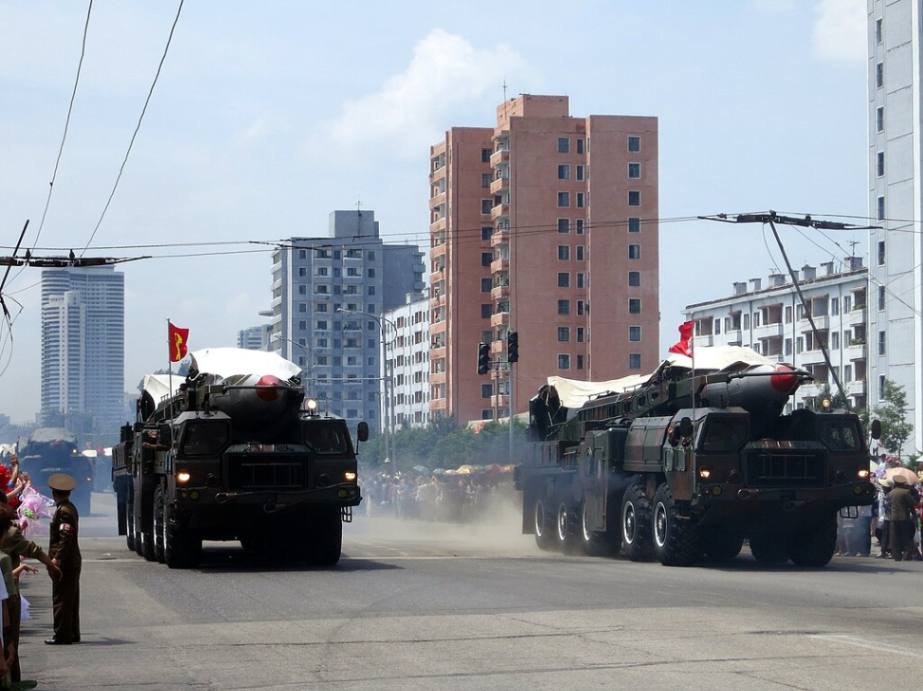
[Photo by Stefan Krasowski, CC BY 2.0, via Wikimedia Commons]
The views and opinions expressed in this article are those of the author.
Dr Sungju Park-Kang is a Research Fellow at the DPRK Strategic Research Center and Assistant Professor in the Department of Political Science and International Relations at KIMEP University, Kazakhstan. Park-Kang is also Adjunct Professor at the Centre for East Asian Studies, University of Turku, Finland. He was formerly Assistant Professor of International Relations and Korean Studies at Leiden University, the Netherlands and at the University of Central Lancashire, UK.
