Maximizing Returns: The Strategic Imperative of Offshore Asset Life Extension in the U.S. Gulf
For investors tracking the North American energy sector, particularly in the prolific U.S. Gulf of Mexico, a critical conversation is rapidly gaining prominence: the future of mature offshore assets. Operators are increasingly weighing the substantial financial implications of decommissioning aging infrastructure against the compelling economic case for extending their operational lives. This isn’t merely an engineering challenge; it represents a significant strategic pivot for capital allocation and long-term value creation in the deepwater arena.
Many deepwater facilities, initially commissioned between the late 1990s and early 2000s, are now approaching the end of their original 20-to-25-year permit periods. The Bureau of Safety and Environmental Enforcement (BSEE) mandates robust evidence demonstrating an asset’s continued fitness-for-purpose before granting life extension permits. For investors, understanding this regulatory gate and the technologies enabling compliance is paramount, as the decision profoundly impacts future cash flows and asset valuations.
The Billions at Stake: Decommissioning vs. Life Extension
The financial arithmetic driving these decisions is stark. Decommissioning a deepwater asset can incur costs stretching into the hundreds of millions of dollars. This expense not only impacts current profitability but also removes valuable production capacity, which is increasingly costly and complex to replace with new developments. Conversely, extending an asset’s life unlocks immense value from infrastructure that has already recouped its initial development costs.
Consider an asset with a $5 billion development price tag. Over its initial permit period, this capital outlay is typically recovered. Every barrel produced beyond that point carries a substantially higher margin, directly bolstering the bottom line. The financial logic for life extension is undeniably powerful, transforming a sunk cost into an ongoing revenue generator. However, this hinges entirely on the operator’s ability to definitively prove the asset’s integrity, especially its critical subsea pipeline and riser infrastructure, meets stringent safety and regulatory benchmarks. Failing to secure this proof timeously carries significant commercial risk.
Navigating Regulatory Hurdles: Proactive Integrity Management is Key
The choice between divesting via decommissioning and continuing production through life extension transcends a purely technical assessment. It is a strategic business decision, intrinsically linked to production economics, the physical condition of the assets, regulatory mandates, and the operator’s risk appetite. For many mature U.S. Gulf assets, the commercial argument for extension is robust. These facilities, optimized over decades with established production infrastructure and experienced teams, offer an efficient base for continued output. In an environment where new deepwater project costs and complexities are escalating, extending existing asset life provides a cost-effective path to sustain production without committing to entirely new development cycles.
Nevertheless, operators must satisfy BSEE that every component – from topsides to subsea infrastructure – adheres to the highest standards for continued safe operation. Permit extensions are granted exclusively to well-maintained platforms where the integrity of all elements can be unequivocally demonstrated. Subsea pipelines, risers, and flowlines frequently present the most significant challenge in this assessment. They are vital for production but exceptionally difficult to inspect and evaluate, especially under deepwater, high-pressure conditions that often preclude conventional methods. Ageing flowlines can suffer from wall loss, corrosion, and internal depositions like wax, scale, asphaltenes, or even hydrate formation – issues invisible without specialized diagnostic capabilities.
An operator approaching the permit renewal window without a clear, defensible picture of subsea pipeline condition faces a difficult situation. They cannot make an informed extension decision, may encounter delays in BSEE approval, and in the worst-case scenario, late-identified problems could be too expensive to fix or too advanced to safely address, forcing decommissioning regardless of favorable economics.
The Criticality of Proactive Planning: Years in Advance, Not Months
The principle of predictive maintenance, understanding asset condition proactively rather than reacting to failures, is well-established across engineering disciplines. Yet, in offshore pipeline management, a gap often persists between acknowledging this principle and acting on it sufficiently early. Industry experts consistently advise operators in mature basins to initiate the life extension planning process at least two years before the current permit expires, ideally even earlier.
Gathering the comprehensive baseline integrity data required for a BSEE application demands significant time. This includes identifying issues, planning and executing remediation work, and compiling the exhaustive documented evidence regulators require. All these steps must be completed well before the application window opens, not concurrently. Successful operators approach this as an ongoing program, establishing regular inspection intervals, accumulating trend data over time, and presenting a coherent, longitudinal history of asset condition. This level of evidence instills confidence in regulators and provides operators with strategic options.
The financial risk of discovering a major integrity issue with insufficient time to respond is substantial, impacting both operations and commercial viability. Furthermore, integrity data gathered reactively, merely to meet a permit deadline, tends to be less comprehensive. Snapshot data reveals an asset’s condition at one moment. Longitudinal data, built through multiple inspection cycles, offers far greater insight: how the pipeline is behaving, whether degradation is occurring, and its rate. This trend information is indispensable for constructing a credible case for life extension.
Overcoming Inspection Gaps: Where Traditional Methods Fall Short
Assessing the internal condition of a subsea pipeline in a mature deepwater field is inherently challenging. Traditional inspection techniques face significant limitations in this environment, which intensify as assets age. Conventional internal line inspection, or “pigging,” is the standard for assessing wall condition in many pipelines. However, numerous subsea flowlines in deepwater U.S. Gulf fields were either never designed for pigging or have undergone configuration changes over their operational life that render internal inspection impractical. Attempting to use conventional inline inspection tools in these scenarios risks causing the very damage operators seek to prevent.
External inspection using remotely operated vehicles (ROVs) provides valuable visual data on a pipeline’s exterior, but it cannot reveal internal conditions. Corrosion, internal deposition, and wall thinning are undetectable from the outside. Moreover, ROV-based external inspection in deepwater remains an expensive and operationally demanding endeavor. This often results in an “inspection gap” for many mature fields. Operators may possess extensive operational history and surface-level monitoring data, but lack a clear, quantified understanding of the internal state of their subsea flowlines. In a regulatory landscape demanding demonstrable integrity, this gap presents a significant vulnerability, making innovative technology solutions crucial.
Revolutionizing Subsea Diagnostics: Non-Intrusive Solutions Drive Informed Decisions
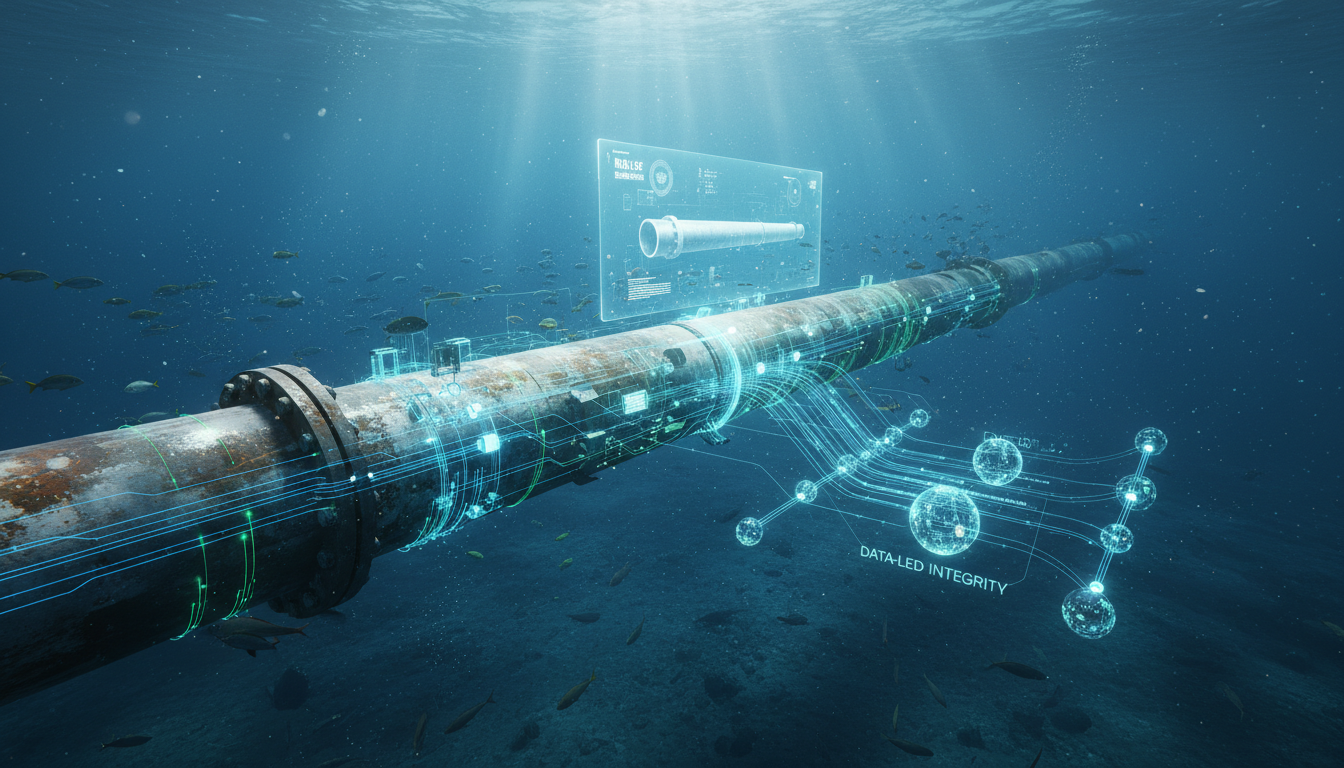
The advent of non-intrusive subsea diagnostic technology has fundamentally transformed mature asset management. Operators, who previously relied on indirect indicators or disruptive, costly inspection campaigns, can now obtain detailed, quantifiable data on the internal condition of a subsea pipeline without interrupting production, removing coatings, or modifying the pipeline in any way.
Tracerco’s Discovery™ technology, for example, was specifically engineered to overcome inspection challenges that conventional methods cannot resolve. Utilizing computed tomography – the same non-invasive imaging principle found in medical diagnostics – it allows operators to ‘see inside’ a subsea pipeline in real time, from the outside, while the pipeline remains fully operational. Deployed by ROV and clamped directly onto the pipe, this technology passes a CT beam through the pipeline wall and its contents. By measuring density variations, it produces high-resolution tomographic images. These images empower operators to quantify wall thickness, precisely identify and characterize internal corrosion, detect deposition build-up (including wax, hydrate, sand, and asphaltene), and assess overall pipeline condition with unparalleled precision in a live, deepwater subsea environment.
Globally, Discovery™ has been deployed across tens of thousands of scans. In the U.S. Gulf alone, a significant contract saw its application across a trio of major U.S. energy companies, each with diverse flowline and riser configurations across multiple platforms. This project underscores both the scalability of the approach and the escalating demand for advanced, non-intrusive subsea diagnostics. Crucially, none of these inspections require production downtime, coating removal, or pipeline modifications, representing a fundamental shift in what is practically achievable for aging assets where operational continuity and cost efficiency are paramount.
The Combined Value: Integrity and Flow Assurance Data Synergy
A less-discussed, but highly significant, advantage of advanced subsea diagnostics is the capability to generate both integrity and flow assurance data from a single deployment. Historically, these have been distinct workstreams: integrity teams focused on pipeline condition, while flow assurance teams concentrated on production efficiency and blockage management. These disciplines traditionally utilized different data, operated on different timescales, and often required separate mobilizations.
In a mature field nearing permit renewal, this separation is inefficient and potentially expensive. The condition of a subsea flowline directly impacts both its structural integrity and its flow characteristics. Deposition build-up compromising flow rates might also contribute to corrosion, while wall thinning raising integrity concerns could be linked to changes in fluid composition or production chemistry. Understanding both dimensions simultaneously from a single inspection campaign provides a far more complete and actionable picture than either dataset could offer independently.
This dual capability has delivered measurable value in U.S. Gulf projects. In one recent instance, a major operator engaged Tracerco to assess pipeline wall condition for life extension. During the same deployment, Discovery™ uncovered flow assurance issues – significant deposition affecting flow performance – of which the operator had no prior knowledge. They were able to address the problem online, without interrupting production, and what began as an integrity-focused project evolved into a long-term inspection agreement. This pattern is common: operators seek integrity data and leave with a fundamentally clearer, more comprehensive understanding of their asset than anticipated.
For operators preparing a life extension case, this integrated data picture is valuable in two ways: it strengthens the critical integrity evidence base required by regulators, and it provides superior information for production decisions, maintenance planning, and investment priorities for the extended operating period.
Framing the shift from reactive to predictive maintenance in offshore pipeline management solely as a safety or regulatory compliance obligation misses a crucial point. It is fundamentally a commercial strategy. Compared to the potential costs of unplanned shutdowns and lost production, the investment in proactive inspection and maintenance programs is modest. A non-intrusive diagnostic survey can be mobilized rapidly, executed without production impact, and completed at a fraction of the cost associated with responding to an unexpected failure.
Looking Ahead: Navigating the Mature Asset Challenge in a Evolving Energy Landscape
Effective late-life asset management in the U.S. Gulf is integral to a broader challenge facing the offshore industry amidst a global energy transition. Safely and responsibly extending the productive life of existing offshore infrastructure, underpinned by sound integrity data, allows operators to maximize the inherent value of their assets.
Non-intrusive diagnostic technology has effectively dismantled many barriers that historically complicated subsea pipeline integrity assessment in mature deepwater assets. What remains paramount is the willingness to leverage these advanced tools early and consistently. Operators who perceive integrity data as an operational asset, rather than merely a compliance expense, will be strategically best-positioned to successfully navigate the complexities of late-life asset management and secure long-term value in the dynamic U.S. Gulf of Mexico energy market.