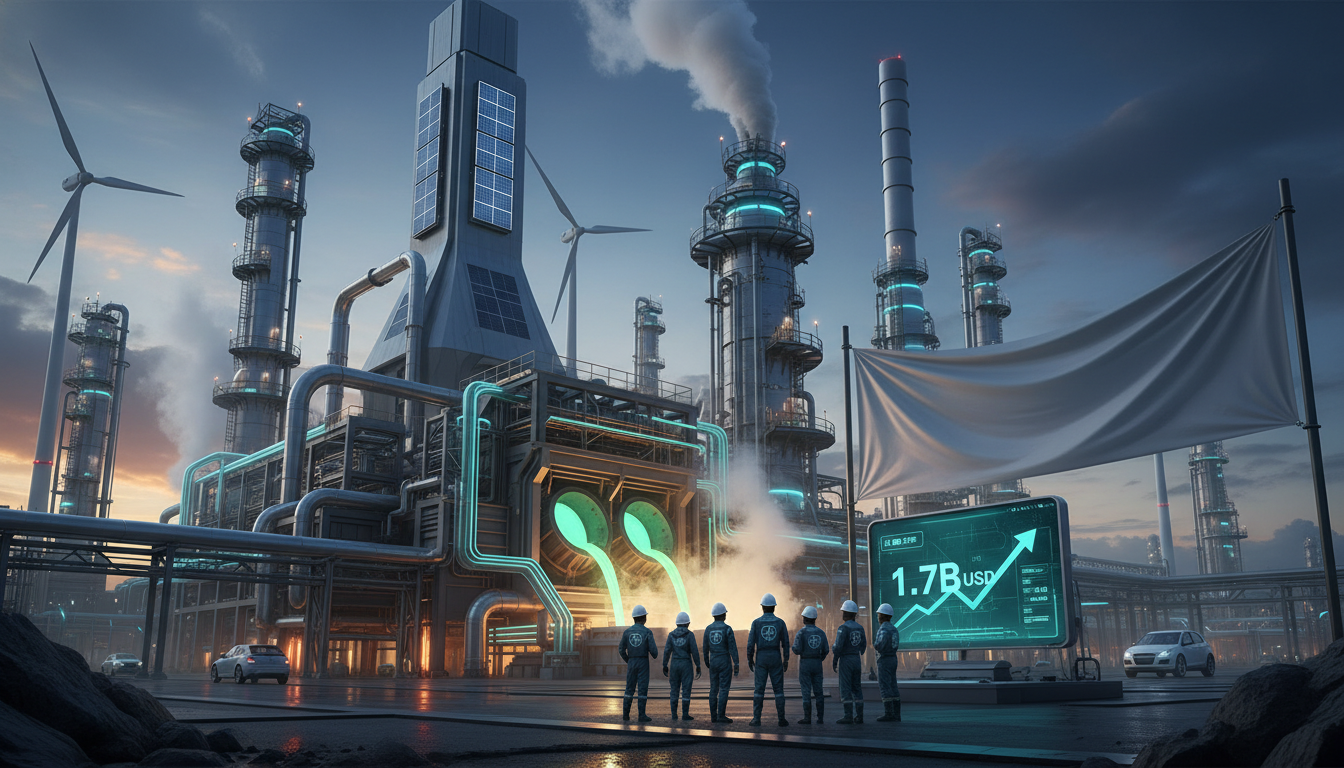
Stegra’s Green Steel Secures $1.7B Lifeline: A Bellwether for Industrial Decarbonization
A substantial €1.4 billion ($1.7 billion) capital injection into Stegra, the Swedish innovator behind the world’s first large-scale green steel production facility, marks a pivotal moment for industrial decarbonization and holds significant implications for the broader energy market. This crucial financing de-risks the completion of a project poised to redefine heavy industry, signaling robust investor confidence in sustainable materials. For oil and gas investors, this development is more than just a headline; it’s a tangible indicator of the accelerating energy transition and the evolving landscape of long-term energy demand, forcing a re-evaluation of portfolios in an increasingly carbon-conscious global economy.
De-Risking Green Steel: A Blueprint for Industrial Transformation
Stegra’s successful funding round, anchored by a formidable €250 million equity contribution from Wallenberg Investments and bolstered by a consortium including Temasek and IMAS, validates the commercial viability of green steel on an unprecedented scale. This isn’t merely a pilot project; it’s a blueprint for disrupting an industry historically reliant on carbon-intensive processes. The Boden, Sweden facility, which commenced construction in 2022, aims for an impressive annual output of 5 million tonnes of green steel. Its innovative process leverages hydrogen, produced entirely from green power sources, to meticulously remove oxygen from iron oxide, drastically curtailing CO2 emissions. Furthermore, the entire manufacturing process is powered exclusively by 100% renewable electricity, establishing a truly carbon-light operational footprint. The commitment of such prominent global investors underscores a strategic belief that the future of heavy industry lies in sustainable practices, creating a new competitive frontier that conventional energy investors cannot afford to ignore.
Market Volatility and the Energy Transition’s Undercurrents
While the long-term structural shift towards green industry gains momentum, commodity markets continue to exhibit their characteristic volatility. As of today, Brent crude trades at $95.19, reflecting a robust 5.32% surge within the day’s range of $92.77-$97.81. WTI crude also saw significant upward momentum, now at $87.05, up 5.4% from its daily low of $85.45. This strong daily performance comes after a recent dip, with Brent having trended down from $112.78 on March 30 to $90.38 on April 17, a nearly 20% correction in just over two weeks. Gasoline prices have followed suit, currently standing at $3.04, up 3.75% within its daily range of $2.99-$3.08. These price movements highlight the persistent short-term drivers in the oil and gas sector – geopolitical tensions, supply disruptions, and immediate demand fluctuations. However, the substantial investment in projects like Stegra serves as a powerful undercurrent, signaling a gradual but inevitable shift in industrial demand away from fossil fuels. Investors must discern whether today’s upward price momentum is a temporary rebound or sustainable growth, especially when juxtaposed against the backdrop of increasing decarbonization efforts across heavy industries.
Addressing Investor Sentiment: Navigating Future Oil & Gas Demand
Our proprietary reader intent data reveals a keen focus on the immediate future of crude prices, with questions like “is WTI going up or down” dominating investor inquiries this week. This short-term focus is understandable given the daily swings in commodity markets. However, a significant portion of our readership is also looking further ahead, asking “what do you predict the price of oil per barrel will be by end of 2026?” Projects like Stegra’s green steel plant, while not immediately altering the 2026 price forecast, are crucial pieces of the puzzle for understanding the long-term demand ceiling for crude oil and natural gas. As industries like steelmaking, responsible for 7-9% of global CO2 emissions, find commercially viable pathways to decarbonize, the demand for traditional coking coal and, indirectly, other fossil fuels will gradually erode. For oil and gas investors, this means balancing tactical plays on short-term supply-demand dynamics with a strategic recognition of the accelerating energy transition. The success of green industrial projects, now backed by significant capital, adds a structural layer of complexity to future oil price predictions, suggesting a future where demand growth may face increasing headwinds from clean technology adoption.
Upcoming Events and the Long-Term Energy Shift
The immediate outlook for oil and gas prices will undoubtedly be shaped by several critical upcoming events. Investors will be closely watching the OPEC+ Joint Ministerial Monitoring Committee (JMMC) Meeting, scheduled for today, April 20th. This will be swiftly followed by the full OPEC+ Ministerial Meeting on April 25th. These gatherings are critical for understanding potential supply adjustments that could either reinforce or temper the recent price gains. Further clarity on demand and supply dynamics will come from the API Weekly Crude Inventory reports on April 21st and 28th, alongside the EIA Weekly Petroleum Status Reports on April 22nd and 29th. Finally, the Baker Hughes Rig Count on April 24th and May 1st will offer insights into North American production activity. While these events primarily dictate the near-term supply-demand balance for fossil fuels, the successful funding of Stegra’s green steel project underscores a broader, long-term shift. The cumulative effect of such large-scale industrial decarbonization initiatives, while not immediately visible in weekly inventory reports or OPEC+ quotas, will profoundly influence the fundamental demand drivers for oil and gas over the next decade. Savvy investors are not just tracking the next OPEC+ decision; they are also tracking the progress of projects like Stegra, recognizing them as harbingers of a fundamentally different energy future.


