The global crude oil market continues its dynamic dance, presenting both challenges and opportunities for discerning investors. While recent weeks saw a notable retreat from multi-year highs, driven by profit-taking and shifting macroeconomic sentiment, today’s trading action signals a robust rebound. Understanding these intricate shifts requires looking beyond daily headlines and diving into the underlying data and forward-looking catalysts. At OilMarketCap.com, our proprietary data pipelines offer a unique vantage point, revealing the true pulse of the market and equipping investors with actionable insights to navigate this complex landscape.
Current Market Snapshot: A Resilient Rebound Amidst Recent Declines
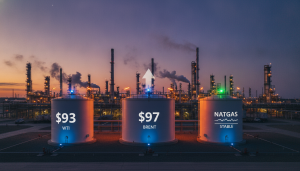
After a period of significant downward pressure, crude oil prices are showing strong signs of recovery today, April 21, 2026. As of this writing, Brent Crude is trading at $93.91 per barrel, marking an impressive 3.85% gain for the day, having moved within a range of $89.11 to $95.53. Similarly, WTI Crude has surged to $90.38 per barrel, up 3.39% from its opening, with its daily range spanning $85.50 to $92.23. Gasoline prices are also reflecting this bullish sentiment, currently at $3.13, up 2.96%.
This daily resurgence stands in stark contrast to the broader trend observed over the past fortnight. Our 14-day Brent trend data reveals a significant correction, with prices falling from $118.35 on March 31, 2026, to $94.86 just yesterday, April 20 – a substantial decline of nearly 20% ($-23.49). This period was largely characterized by profit-taking following a strong rally, coupled with concerns over global demand growth and potential shifts in monetary policy. Today’s strong rebound suggests that while the market absorbed the recent downward pressure, underlying bullish fundamentals, perhaps exacerbated by renewed geopolitical anxieties or technical buying, are reasserting themselves. Investors should view this not as a simple recovery, but as a critical inflection point, demanding a deeper analysis of the forces at play.
Navigating Upcoming Catalysts: Key Events on the Horizon
The next two weeks are packed with high-impact events that could significantly shape crude oil price action and investment strategies. Tomorrow, April 21, marks the critical OPEC+ Joint Ministerial Monitoring Committee (JMMC) Meeting. This gathering will be closely watched for any signals regarding production policy. Given the recent price volatility and the current global supply-demand balance, any hint of adjustments to existing output cuts or a reaffirmation of current strategy could send ripples through the market. A decision to maintain current cuts would likely reinforce bullish sentiment, while any suggestion of increased output could trigger a fresh wave of selling pressure.
Furthermore, the market will receive crucial data from the U.S. Energy Information Administration (EIA) with its Weekly Petroleum Status Reports on April 22 and April 29. These reports provide vital insights into crude oil, gasoline, and distillate inventories, as well as refinery utilization and import/export figures. Significant draws in crude stockpiles, for instance, could fuel further price rallies, indicating robust demand or tighter supply. Conversely, unexpected builds could cap upside potential. In parallel, the Baker Hughes Rig Count, scheduled for April 24 and May 1, will offer a granular view of North American drilling activity, signaling future supply potential. Finally, the EIA’s Short-Term Energy Outlook on May 2 will present official government projections for supply, demand, and prices, providing a benchmark for longer-term planning. Astute investors will be closely monitoring these dates, positioning themselves to capitalize on the market’s reactions.
Addressing Investor Sentiment: What Our Readers Are Asking
Our proprietary reader intent data offers invaluable insights into the immediate concerns of energy investors. This week, a dominant theme revolves around the fundamental question: “Is WTI going up or down?” Today’s impressive 3.39% surge in WTI to $90.38 certainly leans towards a near-term bullish outlook. However, this question underscores the market’s ongoing struggle for direction following the recent retreat. Investors are clearly seeking clarity amidst conflicting signals. Our analysis suggests that while short-term price movements can be volatile, the confluence of OPEC+ decisions, inventory data, and geopolitical developments will dictate WTI’s trajectory in the coming weeks. The current rebound could be a technical correction, or it could be the start of a renewed uptrend if global supply concerns persist.
Another frequently asked question concerns the long-term outlook: “What do you predict the price of oil per barrel will be by end of 2026?” Forecasting oil prices this far out involves significant variables, but our analysis points to several key drivers. Global economic growth, particularly from Asia, will remain a critical demand determinant. Supply-side factors, including OPEC+’s sustained commitment to market management, the pace of U.S. shale production, and ongoing underinvestment in conventional oil projects, will heavily influence price levels. Geopolitical stability, or the lack thereof, will also continue to inject a risk premium into prices. While precise figures are elusive, our data suggests that absent a severe global recession, the structural undersupply narrative and persistent geopolitical tensions could keep crude oil prices well-supported, potentially revisiting and even surpassing the recent highs experienced earlier in the year, particularly if global inventories remain tight. Specific company performance, such as Repsol’s potential trajectory in April 2026, as queried by another reader, will naturally be intertwined with these broader market dynamics, emphasizing the importance of a holistic investment approach.
In conclusion, the crude oil market remains a landscape of compelling opportunities, but one that demands vigilance and data-driven analysis. The current rebound, following a period of profit-taking, highlights the market’s underlying resilience and the constant interplay of supply, demand, and geopolitical factors. By leveraging timely data and forward-looking analysis of critical events, investors can position themselves strategically to navigate the complexities and capitalize on the significant potential within the energy sector.