The global crude oil market has been a crucible of volatility over the past two weeks, challenging investor convictions and prompting a significant re-evaluation of energy portfolios. While the headline suggests a clear downward trajectory, driven in part by ongoing discussions between the U.S. and Iran, the intraday movements often mask deeper, more complex currents. Investors are keenly watching how potential shifts in geopolitical landscapes might unlock new supply, counteracting the prevailing demand narrative and creating a delicate balance that impacts everything from major producers to independent operators. Understanding the interplay of these factors is crucial for navigating what promises to be an eventful period in oil and gas investing.
Geopolitical Headwinds Drive Recent Crude Correction
The recent trajectory of crude prices has been dominated by a significant correction, with Brent crude plummeting from a high of $118.35 on March 31st to $94.86 by April 20th, representing a substantial 19.8% decline in just over two weeks. This sharp downturn can be largely attributed to the resurfacing of U.S.-Iran discussions, which, even in their nascent stages, inject a powerful element of uncertainty regarding future oil supply. The prospect of Iranian crude potentially re-entering the global market at scale, even if it remains a distant possibility, is enough to prompt a bearish sentiment among traders who fear an oversupply.
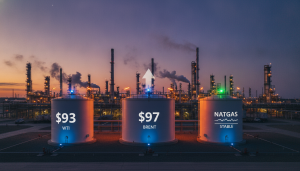
As of today, April 21st, the market shows a modest rebound after that steep decline. Brent Crude is currently trading at $93.52, posting a slight gain of +0.3% within a day range of $93.52-$93.72. Similarly, WTI Crude has seen a +0.65% increase, reaching $90.25, with its daily range spanning $89.71-$90.30. This intraday strength, however, must be viewed within the context of the preceding two-week price erosion. Gasoline futures, often a barometer of consumer demand, are trading at $3.12, down -0.32% today. While these figures represent a pause, or even a slight reversal, in the immediate downward trend, the underlying geopolitical pressures from potential Iranian supply continue to cast a long shadow, ensuring continued investor caution.
Investor Sentiment: Seeking Clarity Amidst Uncertainty
Our proprietary investor intent data paints a clear picture of a market grappling with profound uncertainty. This week, we’ve observed a surge in queries reflecting a desire for immediate directional insight, with questions like “is WTI going up or down?” frequently surfacing. This isn’t just about short-term trading; it underscores a broader anxiety about crude’s trajectory and its impact across the energy sector. Investors are not only concerned with the headline price of oil but also how this volatility translates to specific investment opportunities, with queries about individual company performance, such as “how well do you think Repsol will end in April 2026,” highlighting a granular focus on portfolio implications.
Beyond the immediate, there’s a strong appetite for forward-looking analysis, as evidenced by questions like “what do you predict the price of oil per barrel will be by end of 2026?” This indicates that while daily fluctuations are critical, investors are also positioning for longer-term trends, attempting to factor in geopolitical shifts, demand evolution, and global supply dynamics into their strategic outlook. The current environment demands a blend of tactical awareness and long-term foresight, making robust, data-driven analysis more valuable than ever for our readership.
Navigating the Immediate Horizon: Key Events to Watch
The coming weeks are packed with critical events that will undoubtedly shape crude price action and demand investor attention. Today, April 21st, the OPEC+ JMMC Meeting is a pivotal event. Any signals regarding production policy, especially in the wake of recent price declines and the potential for increased Iranian supply, will be scrutinized for their impact on global crude balances. A decision to maintain or adjust current output levels could either stabilize or further roil the market.
Looking ahead, the EIA Weekly Petroleum Status Report on April 22nd and again on April 29th will provide vital insights into U.S. crude inventories, refinery utilization, and product demand. These reports are often significant short-term catalysts. Concurrently, the Baker Hughes Rig Count on April 24th and May 1st will offer an indication of future U.S. drilling activity and potential supply growth. For a broader, more strategic outlook, the EIA Short-Term Energy Outlook scheduled for May 2nd will be essential. This report will offer updated forecasts on supply, demand, and prices, influencing longer-term investment strategies. Investors must remain agile, interpreting these data points to anticipate market shifts and adjust their positions accordingly.
Strategic Implications for Oil & Gas Investors
The current market dynamics, characterized by significant price corrections and geopolitical uncertainty, present both challenges and opportunities for oil and gas investors. The sharp decline in Brent crude over the past two weeks, from $118.35 to under $95, may be perceived by some as a “buy the dip” scenario, particularly for those with a long-term bullish outlook on energy demand. However, the looming possibility of increased Iranian supply, coupled with the ongoing OPEC+ discussions, introduces a layer of risk that necessitates careful due diligence.
Investors should consider diversifying their exposure across the energy value chain, from upstream producers to midstream infrastructure and downstream refiners, to mitigate direct commodity price risk. Companies with strong balance sheets, diversified asset bases, and a clear strategy for energy transition will likely prove more resilient. For those focused on short-term movements, the upcoming calendar events, particularly the EIA reports and OPEC+ meetings, offer potential entry and exit points. Prudent risk management, including the use of options or hedging strategies, becomes paramount in such a volatile environment. Ultimately, a deep understanding of market fundamentals, coupled with a keen eye on geopolitical developments and upcoming data releases, will be key to unlocking value in the current energy landscape.