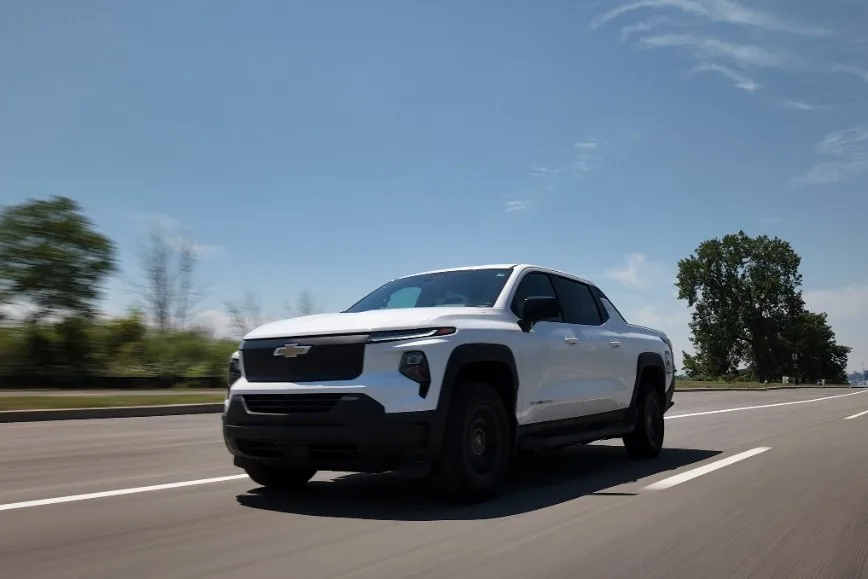
The Silverado EV Record: A Growing Headwind for Oil Investors
The recent announcement of a Chevrolet Silverado EV setting a new world record for distance traveled on a single charge – an astonishing 1059.2 miles – presents a compelling, albeit nuanced, signal for oil and gas investors. While such an achievement might seem like a distant technological marvel, it underscores the relentless progress in electric vehicle capabilities, contributing to a persistent long-term headwind against global oil demand. For market participants focused on crude prices and energy equity performance, understanding the implications of these advancements, beyond the headlines, is crucial for navigating an increasingly complex energy landscape.
Deconstructing the EV Range Breakthrough: Nuance Over Hype
GM engineers pushed the 2026 Chevrolet Silverado EV Max Range Work Truck to an unprecedented 1059.2 miles on a single charge, significantly exceeding its EPA-estimated range of 493 miles. This remarkable feat, eclipsing the previous record of 749 miles set by Lucid, is a testament to the rapid evolution of EV battery chemistry, drive unit efficiency, and software integration, as highlighted by GM’s VP of battery, propulsion, and sustainability, Kurt Kelty. However, investors must look beyond the headline number to grasp its true immediate impact on oil demand. The record was achieved under highly controlled, optimized conditions: maintaining a consistent average speed of 20-25 mph, minimizing hard braking and acceleration, turning off climate control, removing the spare tire, optimizing wheel alignment, and adding an accessory tonneau cover for improved aerodynamics. These conditions, while demonstrating the vehicle’s theoretical maximum efficiency, are far from typical real-world driving. GM itself noted that 20-25 mph is a “realistic pace for neighborhood or city driving,” where minimal energy goes to ancillary uses. This record signifies the technological *potential* of EVs and continuous improvement, but it does not represent an overnight shift in consumer behavior or an immediate, widespread displacement of gasoline consumption in the heavy-duty truck segment, which remains a cornerstone of oil demand.
Current Market Sentiment and EV’s Long-Term Demand Erosion
The persistent advancements in EV technology, even if their real-world application takes time, contribute to a broader market sentiment regarding future oil demand. As of today, Brent crude trades at $94.45 per barrel, down 1.08% within a daily range of $93.98-$95.69, while WTI crude sits at $86.12, marking a 1.49% decline from its opening. Gasoline prices have also seen a modest retreat, trading at $3.02, down 0.66%. This recent market softness is part of a more significant trend; our proprietary data shows Brent crude has fallen sharply from $118.35 on March 31st to $94.86 yesterday, representing a substantial 19.8% decline in just over two weeks. While this downturn is driven by a multitude of factors, including macroeconomic concerns and geopolitical dynamics, the long-term narrative of energy transition and peak oil demand is an ever-present undercurrent. The Silverado EV record, even with its caveats, reinforces the idea that the technological ceiling for EVs is still rising. This continuous improvement, coupled with policy support and increasing charging infrastructure, slowly chips away at the perceived longevity of oil demand, influencing long-term investment decisions and capital flows away from traditional fossil fuel exploration and production. Our analytics show investors are actively asking “what do you predict the price of oil per barrel will be by end of 2026?” This directly reflects anxiety about future demand, where EV advancements play a subtle but persistent role in shaping expectations.
Investor Focus: Bridging Near-Term Volatility with Long-Term Structural Shifts
For oil and gas investors, the challenge lies in balancing the long-term structural shifts, exemplified by EV advancements, with the immediate drivers of market volatility. While the Silverado EV’s record points to a future of potentially lower oil demand, current price action remains heavily influenced by supply-side management and geopolitical events. Our proprietary reader intent data reveals a common query: “is WTI going up or down?” This underscores the market’s immediate focus on short-term price movements, which often overshadow slower-moving technological trends. Looking ahead, the energy calendar is packed with events that will provide more immediate directional cues. Investors will be keenly watching the OPEC+ JMMC Meeting tomorrow, April 21st, for any indications on production policy, which could significantly impact global supply. The EIA Weekly Petroleum Status Reports on April 22nd and April 29th, alongside the Baker Hughes Rig Counts on April 24th and May 1st, will offer crucial insights into current U.S. supply and demand balances and drilling activity. Further out, the EIA Short-Term Energy Outlook on May 2nd will provide a comprehensive forecast for anticipated market conditions, potentially recalibrating expectations for the remainder of 2026. These events will generate tactical opportunities and risks, demanding agile positioning that acknowledges both the slow burn of energy transition and the explosive potential of short-term market catalysts.