Global central banks find themselves in a challenging predicament, attempting to manage inflation predominantly driven by supply-side disruptions with demand-side instruments. While rate hikes can cool economic activity, they do little to boost crude production or reroute disrupted energy flows. This fundamental mismatch raises the specter of stagflation, where economic growth falters while prices remain stubbornly elevated – a scenario that deeply concerns energy investors.
Central Banks Maintain Hold Amidst Energy Price Uncertainty
Last week’s central bank decisions underscored a cautious, wait-and-see approach. The Federal Reserve, as anticipated, maintained its target range at 3.50-3.75%. Despite revising PCE inflation projections higher for this year and 2027, with the 2% target now not expected until 2028, real GDP growth forecasts were surprisingly nudged up across all horizons. The Fed’s updated dot plot still suggests one rate cut for the current year, followed by another in the next. However, market participants have largely priced out any 2026 cuts, now anticipating the first 25-basis point reduction no earlier than March 2027, a significant shift from the nearly three cuts priced in at the start of the year.
Chairman Jerome Powell, when questioned on the ongoing Middle East conflict, acknowledged the inherent unpredictability of the situation, stating that its duration is “anybody’s guess.” He emphasized the Fed’s monitoring of ‘leakage’ – the indirect impact of energy price increases on core PCE, which excludes direct energy sales. This indicates a recognition that persistent energy shocks could embed inflation more deeply into the broader economy. Across the Atlantic, the Bank of England’s decision to hold rates at 3.75% was notably unanimous, marking the first time in over four years the Monetary Policy Committee (MPC) has voted without dissent. This shift, particularly with previously dovish members moving to the hold camp, signaled a firm hawkish tilt, leading markets to price in more than three rate hikes by year-end for the UK, a stark contrast to earlier expectations.
Market Dynamics: Crude Prices React to Geopolitics and Dollar Strength
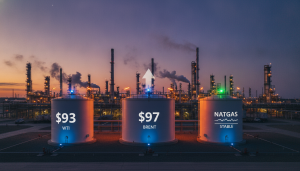
The energy markets continue to grapple with a volatile landscape, where geopolitical tensions frequently overshadow conventional supply-demand fundamentals. As of today, Brent Crude trades at $92.29, down 1.02% for the session, having moved within a day range of $91.39 to $94.21. Similarly, WTI Crude is at $88.60, marking a 1.19% decrease, with its daily range spanning $87.64 to $90.71. This current dip follows a more pronounced retreat from recent highs, with Brent having fallen from $101.16 on April 1st to $94.09 by April 21st, representing a 7% decline over the past two weeks.
The US Dollar continues to exhibit a bullish bias, bolstered by its safe-haven appeal amidst global uncertainties and the reduced expectations for near-term Fed easing. The United States’ position as a net oil exporter further contributes to the dollar’s strength, as sustained energy exports provide a structural tailwind. A stronger dollar typically makes dollar-denominated commodities like crude oil more expensive for international buyers, potentially exerting downward pressure on prices, all else being equal. However, the dominant driver for the dollar and, by extension, energy markets, remains the evolving headlines from the Middle East, ensuring continued volatility and a premium for hedging strategies.
Investor Focus: Navigating Price Direction and Upcoming Data
Investors are intensely focused on predicting the trajectory of crude prices, with a recurring question being, “Is WTI going up or down?” and what the “price of oil per barrel will be by end of 2026.” Our proprietary intent data indicates a clear demand for forward-looking analysis on price direction. The answer, while complex, hinges on a delicate balance of geopolitical stability, global demand resilience, and the responsiveness of supply. The Middle East conflict remains the primary wildcard. Any escalation or resolution could trigger significant price movements, overriding other factors.
Beyond geopolitics, upcoming inventory and supply data will provide crucial insights into the market’s physical balance. Investors should closely monitor the EIA Weekly Petroleum Status Reports scheduled for April 22nd, April 29th, and May 6th. These reports offer a vital snapshot of crude oil, gasoline, and distillate inventories, providing clues about demand strength and potential supply gluts or deficits. Furthermore, the Baker Hughes Rig Count on April 24th and May 1st will indicate North American drilling activity, an important proxy for future supply. The API Weekly Crude Inventory reports on April 28th and May 5th will also offer early indicators ahead of the official EIA data, often setting the tone for the trading week.
Forward Outlook: Economic Indicators and Energy Leakage
Looking ahead, the interplay between central bank policies, economic data, and energy market dynamics will dictate the investment landscape. While the immediate focus is on geopolitical headlines, fundamental economic health remains critical. The US March S&P Global manufacturing and services PMIs, landing on Tuesday, will offer the first comprehensive look at the US economy following the Fed’s meeting and will likely capture the initial ‘indirect effects’ or ‘leakage’ from the Middle East conflict. Investors should pay particular attention to the “prices paid,” employment, and new orders sub-indexes within these reports. Strong prices paid, especially if accompanied by lower employment, could signal that energy input costs are indeed filtering into core inflation, reinforcing the Fed’s cautious stance and potentially strengthening the USD further.
The EIA Short-Term Energy Outlook on May 2nd will also be a key publication, offering updated supply, demand, and price forecasts that will heavily influence market sentiment for the coming months. With central banks effectively on hold, the burden of price discovery falls even more squarely on the interaction of real-time supply shocks and evolving demand destruction. The energy sector remains a high-beta play in this environment, offering both significant upside potential and considerable risk for investors adept at navigating these complex and interconnected market forces.