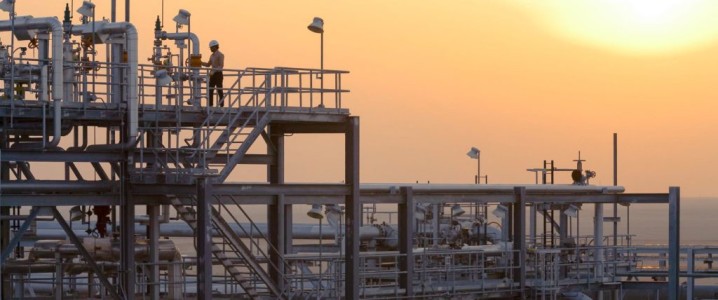
Aramco’s Jafurah Gas Project: A New Era for Saudi Energy Exports and Investor Value
Saudi Aramco’s announcement of initial condensate production from its colossal $100 billion Jafurah unconventional gas project marks a pivotal moment for global energy markets and a significant strategic pivot for the Kingdom. This isn’t just another project; it represents the first export of liquids from what is primarily designed to be a natural gas powerhouse, signaling Saudi Arabia’s intent to diversify its energy export portfolio and optimize its crude oil revenues. As investors navigate an increasingly complex energy landscape, Jafurah’s phased ramp-up and long-term implications demand close scrutiny, offering both new supply dynamics and a clear demonstration of Aramco’s strategic foresight in a decarbonizing world.
Jafurah’s Strategic Significance and Long-Term Value Creation
The Jafurah project is more than just a gas field; it’s a cornerstone of Saudi Arabia’s Vision 2030, aimed at reducing oil dependency and fostering industrial growth. Holding an estimated 229 trillion standard cubic feet (scf) of raw gas and 75 billion standard barrels (STB) of condensate, Jafurah is the Middle East’s largest liquid-rich shale gas play. The initial production of condensate, with 4 to 6 cargoes per month each comprising approximately 500,000 barrels, represents a tangible step towards unlocking this immense resource. These initial cargoes, destined for Asian buyers for delivery in late February or early March 2026, underscore the immediate value derived from the project’s initial phase. For investors, Jafurah presents a long-term, multi-decade asset with substantial upside. The financial structure, highlighted by the August 2025 $11 billion lease-and-lease-back deal with a BlackRock-led consortium for Jafurah Midstream Gas Company (JMGC), illustrates Aramco’s strategic approach to leveraging external capital while retaining majority control (51% in JMGC). This model, alongside Aramco’s objective to boost overall gas production capacity by 60% by 2030, positions Jafurah as a critical driver of sustained value and diversified revenue streams, projecting an annual contribution of $20 billion to the Kingdom’s GDP.
Condensate Supply Enters a Volatile Crude Market
The commencement of condensate exports from Jafurah introduces a new, albeit initially modest, supply stream into a global market that remains highly sensitive to any shifts in inventory and demand. As of today, April 21, 2026, Brent Crude trades at $92.99 per barrel, reflecting a 2.83% increase, with WTI Crude at $89.4, up 2.26%. This daily rebound follows a period of significant volatility; indeed, over the past fortnight, Brent crude experienced a notable $-23.49 decline, falling from $118.35 on March 31, 2026, to $94.86 on April 20, 2026. This stark contrast between recent trends and today’s bounce underscores the immediate challenges and opportunities. Condensate, a high-value light oil, is particularly prized by refiners for its suitability in producing fuels like gasoline. With gasoline prices currently standing at $3.12, up 2.64% today, the market’s demand for light, sweet feedstocks remains robust. While Jafurah’s initial output is small compared to global crude flows, its strategic importance lies in its ability to meet specific refining needs and potentially free up heavier crude grades for export by reducing domestic consumption of crude for power generation. Investors should monitor how this incremental supply of high-quality liquids influences regional refining margins and the broader light crude differential, especially in Asian markets.
Forward Outlook: Gas Ramp-Up and Upcoming Market Catalysts
While condensate production is the immediate headline, Jafurah’s true transformative power lies in its natural gas potential, with Aramco targeting a ramp-up to 2 billion cubic feet per day (Bcf/d) by 2030. This massive gas output will be instrumental in meeting Saudi Arabia’s rapidly growing domestic energy demand and reducing its reliance on burning crude oil for electricity, thereby freeing up more crude for export and supporting the Kingdom’s net-zero 2060 targets. Looking ahead, the coming weeks are packed with events that will shape the global energy narrative, against which Jafurah’s strategic importance will be further defined. The OPEC+ Joint Ministerial Monitoring Committee (JMMC) Meeting on April 21, 2026, could provide insights into future crude production policies, with Saudi Arabia’s ability to free up crude exports through domestic gas substitution potentially influencing its stance. The EIA Weekly Petroleum Status Reports on April 22 and April 29, 2026, will offer crucial snapshots of U.S. inventory levels, impacting short-term price sentiment. Furthermore, the EIA Short-Term Energy Outlook on May 2, 2026, will provide updated forecasts on global supply and demand, offering a macro context for Jafurah’s projected gas ramp-up. These events, combined with the continuous progress at Jafurah, will dictate investment sentiment in the broader energy sector and highlight the long-term value proposition of diversified energy producers.
Addressing Investor Sentiment in a Volatile Market
The prevailing sentiment among many investors, as reflected in frequently asked questions, revolves around the immediate direction of crude prices and the long-term outlook. Questions like “is WTI going up or down?” and “what do you predict the price of oil per barrel will be by end of 2026?” underscore the deep uncertainty and desire for clarity in a volatile market. Jafurah, with its dual focus on high-value condensate and substantial natural gas production, offers a compelling investment thesis that partially de-risks exposure to pure crude price fluctuations. By strategically increasing gas production for domestic consumption, Saudi Arabia aims to optimize its crude export capacity, enhancing its ability to capitalize on global demand for its primary commodity. This diversification strategy, coupled with the long-term, stable cash flow potential from its vast gas reserves and condensate output, provides a degree of insulation against short-term price swings. For investors seeking exposure to a major energy producer with a clear long-term strategy for growth and diversification, Aramco’s Jafurah project represents a calculated move to secure future energy supply, meet environmental targets, and enhance national economic resilience, making it a critical asset to watch in the coming years.


