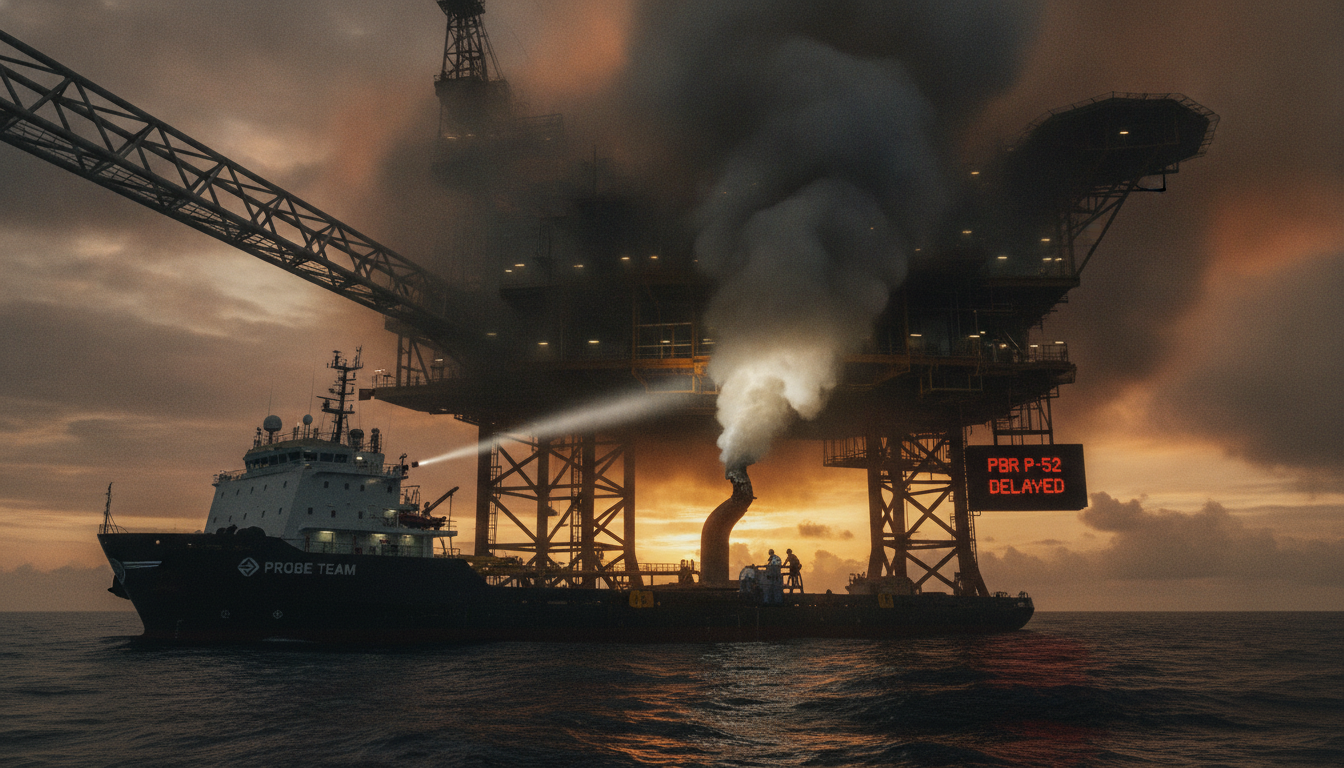
Petrobras’s P-52 Platform Standoff: Nine-Month Production Halt Casts Shadow on Campos Basin Revitalization
Investors closely monitoring Brazil’s state-controlled oil giant, Petroleo Brasileiro SA (Petrobras), are facing significant uncertainty regarding the prolonged shutdown of its P-52 offshore production platform. This critical asset, located in the prolific Roncador field, has remained offline for nine consecutive months following a serious flammable gas leak detected last October, with no clear timeline for its resumption of operations. The extended outage not only impacts immediate production figures but also raises questions about operational integrity and the broader revitalization strategy for the aging Campos Basin.
The P-52, a vital component of Petrobras’s upstream portfolio, was idled after the discovery of a gas leak suspected to originate from a rupture in a gas-lift riser. Subsequent inspections revealed similar degradation in another riser, highlighting a potential systemic issue. This ongoing operational challenge has drawn significant scrutiny from Brazil’s oil regulator, the Agência Nacional do Petróleo, Gás Natural e Biocombustíveis (ANP). The ANP issued a directive in December, explicitly instructing Petrobras to refrain from restarting operations until a comprehensive investigation into the failure is complete, all necessary corrective measures are implemented, and robust evidence demonstrating the elimination of critical operational safety risks is provided.
However, the regulatory body has confirmed that Petrobras has yet to meet these stringent conditions. “Petrobras has yet to provide the ANP with evidence that those conditions have been met,” the agency recently stated, underscoring the impasse. This regulatory hold, coupled with the technical challenges, means P-52’s return to service remains firmly in limbo, with no guarantee of production restarting within the current calendar year.
Operational Delays and Financial Implications for Roncador Field
The P-52 platform is one of four crucial production units operating within the Roncador field, where Petrobras holds a commanding 75% stake. Its partner, Equinor ASA, holds the remaining interest. The Roncador field, situated within the Campos Basin off the northern coast of Rio de Janeiro and extending into southern Espirito Santo, is a cornerstone of Brazil’s offshore production. The P-52, which commenced operations in 2007, was originally designed with an impressive capacity of 180,000 barrels of oil per day (bopd). Yet, prior to its shutdown, it was reportedly producing significantly below this potential, at approximately 35,000 bpd. This discrepancy highlights inherent challenges within the aging infrastructure of the Campos Basin, even before the current incident.
The loss of 35,000 bpd over nine months translates into a substantial volume of foregone production – roughly 9.45 million barrels of oil. For a company like Petrobras, which relies heavily on its production volumes to drive revenue and deliver shareholder value, this represents a tangible financial hit. While 35,000 bpd may not constitute a massive portion of Petrobras’s total output, which often exceeds 2.5 million bpd, the extended nature of the shutdown and the underlying safety concerns could signal broader operational risks impacting investor sentiment. Furthermore, for partner Equinor, this outage means a direct impact on their share of production and associated revenues from Roncador.
Campos Basin Revitalization Under Threat?
The incident on the P-52 platform comes at a particularly sensitive time for Petrobras’s strategic vision for the Campos Basin. This region was instrumental in transforming Petrobras into a major offshore producer in the late 20th century. However, production in the Campos Basin peaked in 2011 and has been on a decline ever since, presenting a significant challenge for the company. To counter this trend, Petrobras has outlined an ambitious $19 billion spending plan within its 2026-30 strategic framework, specifically targeting the revitalization of older fields in the Campos Basin.
The P-52 saga injects a layer of complexity and potential delay into these revitalization efforts. While the 35,000 bpd production from P-52 was already below its design capacity, the extended downtime and the need for significant remediation and regulatory approval could push back timelines for upgrading other assets. Petrobras’s executive director of engineering, technology and innovation, Renata Baruzzi, acknowledged that none of the platforms in the Campos Basin are currently operating at full capacity. This broader underperformance across the basin, now exacerbated by the P-52’s complete shutdown, underscores the formidable task Petrobras faces in restoring the region’s output and realizing its ambitious investment targets.
The Road Ahead: Technical Assessments and Investor Vigilance
A dedicated working group, comprising specialists from Petrobras’s research center, is currently engaged in a comprehensive assessment of options for resuming operations on the P-52. This crucial evaluation is expected to be finalized by October. Investors will be keenly awaiting the outcome of this assessment, as it will likely determine the feasibility and timeline for the platform’s return. The situation demands close attention, not only for the direct impact on production but also as a barometer for Petrobras’s ability to manage aging infrastructure, adhere to stringent safety protocols, and navigate regulatory hurdles.
The prolonged P-52 shutdown serves as a stark reminder of the inherent operational risks in offshore oil and gas production, especially within mature basins. For shareholders, this incident highlights the importance of assessing not just strategic growth plans, but also the execution risks associated with maintaining and upgrading existing assets. The market will be looking for clear communication from Petrobras regarding its corrective actions, regulatory compliance, and a concrete pathway to restoring P-52’s production, which is essential for bolstering confidence in its broader Campos Basin revitalization strategy.