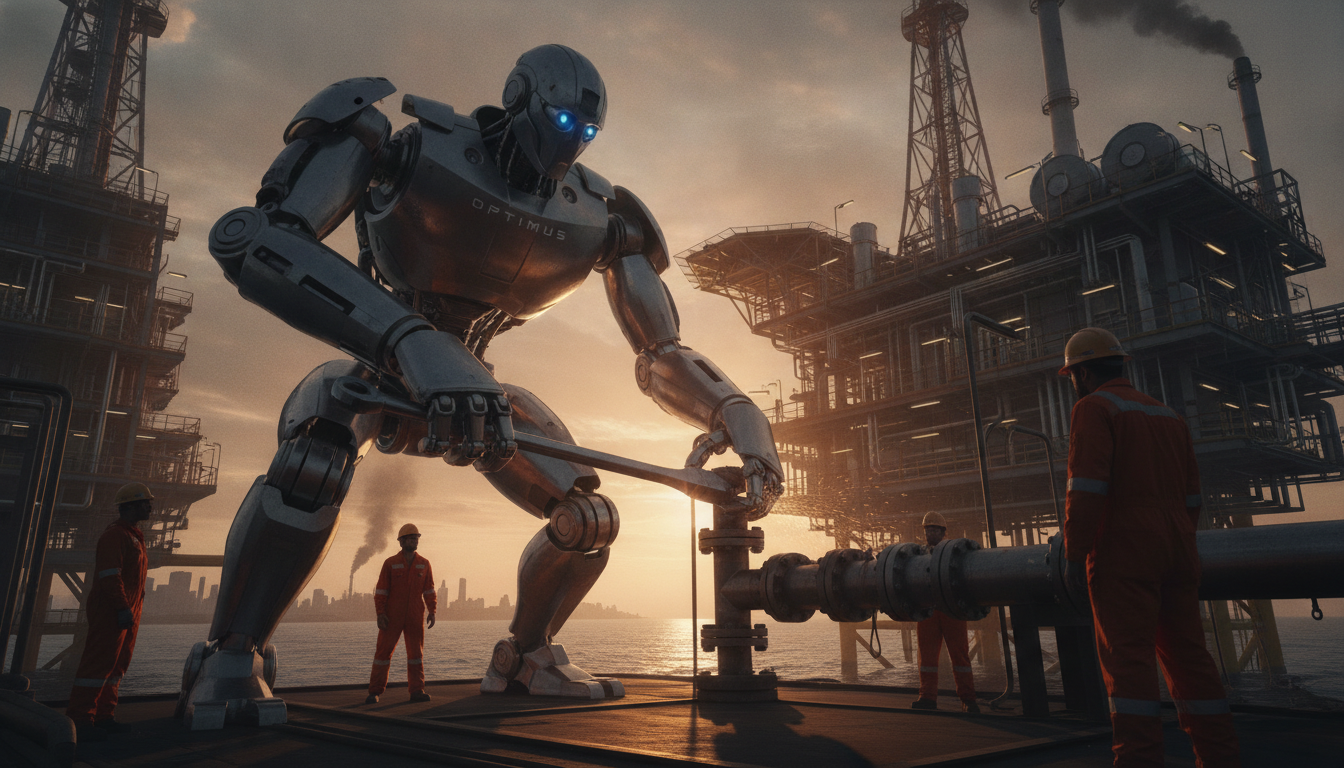
In a world grappling with the intricacies of energy transition and the strategic allocation of global capital, a bold new frontier in technology is demanding significant investor attention: humanoid robotics. Tesla, the electric vehicle titan renowned for its disruptive automotive manufacturing, is now channeling substantial resources into its Optimus robot project, a venture its visionary leader predicts will eclipse even its lucrative car business in scale and impact. This ambitious pivot warrants a closer look, not just for technology enthusiasts, but for energy market participants and financial professionals assessing future industrial demand and capital flow dynamics.
Elon Musk, a figure synonymous with audacious engineering feats, has declared Optimus could become the “most significant product ever developed.” His vision paints a future where countless bipedal robots, or “Optimi” as he calls them, seamlessly integrate into factories, undertake domestic chores, and even autonomously replicate themselves. Such a paradigm shift, if realized, would fundamentally alter labor markets and, crucially for our sector, create entirely new vectors of energy consumption and industrial demand. However, the path to this future remains fraught with immense technical and financial hurdles.
Recent disclosures from Tesla’s earnings call offered scant specific details regarding Optimus’s immediate progress, tempering expectations for a rapid ascent in production volumes. Musk indicated that the third iteration of the robot would commence manufacturing “shortly” at the Fremont facility in the San Francisco Bay Area. For energy investors, understanding the timeline and scale of such production is key, as each robot represents embedded energy in its manufacturing and ongoing operational power draw.
The humanoid robotics landscape is becoming increasingly competitive, a factor that should give investors pause regarding market fragmentation and profitability. Firms like Agility Robotics have already deployed their Digit robots across nine client sites, while Figure AI announced its own implementations in logistical and distribution centers for the current year. Furthermore, Sunday Robotics, 1X, and Weave Robotics are gearing up for residential shipments this autumn. This crowded field suggests a high-stakes race for market dominance, with substantial capital being poured into multiple speculative ventures, potentially diluting returns across the sector.
Academic experts remain deeply skeptical. Guy Hoffman, an associate professor of mechanical and aerospace engineering at Cornell University and director of its human-robot collaboration lab, provocatively labeled humanoids a “fantasy product.” He drew a sobering parallel to autonomous vehicles, which took approximately two decades to commercialize after initial technological demonstrations. Hoffman emphasized that developing fully autonomous bipedal machines presents an even greater challenge, noting that a truly independent, fully functional humanoid has yet to emerge. From a financial perspective, such long development cycles and high technical risk translate into extended capital expenditure periods with uncertain return profiles. “Humanoid robots represent a highly speculative bet,” Hoffman stated, adding, “I foresee no viable near-term future for this product.”
Musk, known for embracing “moonshot” endeavors, has himself conceded that Optimus’s development surpasses the complexity of projects like the Model X, Cybertruck, or establishing gigafactories. If successful, he envisages Optimus paving the way for “sustainable abundance,” a future predicated on artificial intelligence and robotics rendering human labor largely discretionary. This grand vision, while inspiring, implies a complete re-evaluation of economic models and resource utilization, with profound, albeit distant, implications for global energy markets.
From Concept to Prototype: The Journey of Optimus
The Optimus journey began in 2021 with the unveiling of the “Tesla Bot,” initially represented by a human performer in a robotic suit. Fast forward three years, and Tesla’s “We, Robot” event showcased Optimus prototypes engaging in activities like dancing, serving beverages, and conversing with attendees. While the robots demonstrated independent walking, more intricate actions such as pouring drinks and distributing desserts required remote human assistance, underscoring the gap between current capabilities and fully autonomous operation. This early stage requires significant energy investment in prototyping, testing, and computational training before any meaningful scale can be achieved.
The precise appearance of the next-generation Optimus remains undisclosed. Current knowledge indicates a nearly six-foot-tall, human-like form, a design choice Musk defends as essential for performing the full spectrum of human tasks. However, some Silicon Valley investors have dismissed this aesthetic as merely a “parlor trick.” The global market for humanoids currently sees Chinese manufacturers, including Unitree and UBTech, commanding roughly 90% of last year’s shipments, according to Omdia data. Musk asserts that Optimus will possess superior sophistication compared to its Chinese counterparts, yet specific differentiators remain under wraps. “Optimus is engineered for significant intelligence and to exhibit electromechanical dexterity on par with, or even exceeding, human capabilities,” Musk explained on a recent podcast, explicitly contrasting it with the capabilities of rivals like Unitree.
Optimus’s Current Standing and Manufacturing Ambitions
Despite the lack of a public unveiling for the next-generation Optimus, Tesla recently circulated images of its Fremont production line, where manufacturing is slated to commence shortly. Musk has previously stated the company has withheld design details to prevent competitors from reverse-engineering its innovations. This proprietary approach, while strategic, also slows the development of a broader supply chain, a critical consideration for scaling production and ensuring cost-effectiveness, particularly for energy-intensive components.
Tesla has strategically reallocated its manufacturing footprint, discontinuing Model S and Model X production at Fremont earlier this year to accommodate an Optimus line projected to yield one million robots annually. A second, even larger facility is under construction in Austin, with an ambitious target capacity of ten million robots per year. Such prodigious production targets underscore the anticipated surge in electricity demand for manufacturing and operation. This scale of industrial expansion will undoubtedly stress existing grid infrastructure and necessitate substantial investments in new power generation, potentially including natural gas and other baseload sources, to ensure reliability and meet demand spikes.
The initial cohorts of robots will join “Optimus Academy,” an intensive training ground where they will refine tasks and generate critical data to enhance their underlying AI models. Musk estimates that between 10,000 and 30,000 robots will undergo this real-world skill refinement. Tesla’s AI chief, Ashok Elluswamy, suggested that this rigorous training could elevate the robots’ capabilities to a “superhuman level.” From an energy perspective, the computational power required for training these AI models, combined with the operational energy for tens of thousands of robots performing tasks simultaneously, represents a significant, yet often overlooked, component of future industrial energy demand.
Musk has prudently cautioned investors that the initial production ramp-up will be “painfully slow,” primarily due to the absence of established supply chains for many of Optimus’s specialized components. This bottleneck highlights the broader industrial challenges of creating entirely new high-tech manufacturing ecosystems, which can have ripple effects on raw material markets and the energy needed for new material processing.
Three Critical Hurdles for Optimus
Musk identifies three paramount challenges for Optimus’s realization: achieving intelligence, perfecting dexterity, and scaling mass production.
The first hurdle, “intelligence,” demands that the robot learn to comprehend and navigate the physical environment. Tesla believes its extensive work in self-driving technology offers a distinct advantage, allowing Optimus to leverage custom-designed AI chips and algorithms developed for interpreting camera feeds in vehicles. The company has adapted its sophisticated driving simulator – a virtual training ground for self-driving cars – to educate millions of virtual robots. However, simulated environments cannot fully replicate the complexities of the real world, necessitating data collection from physical tasks performed by human employees in factories.
Cornell’s Professor Hoffman remains unconvinced, asserting that humanoid robotics significantly surpasses the difficulty of autonomous driving. “It’s akin to a game of checkers versus engaging in nuclear physics,” he observed. Humanoids must maintain balance on two legs, a complex dynamic feat, and current AI models are far from consistently reliable in unpredictable physical settings. The sheer computational energy required to achieve this level of intelligence across a fleet of robots represents a substantial future load on electricity grids.
The second challenge, dubbed the “hands problem” by Musk, involves replicating the nuanced capabilities of the human hand through advanced motors, sensors, and software. A robot hand must integrate strength, precision, and flexibility within an extremely compact footprint, presenting formidable engineering obstacles. On the recent earnings call, Musk indicated that Optimus is being engineered for “human and then superhuman dexterity,” necessitating the in-house development of highly specialized motors, gears, and sensory systems. The materials and energy intensity of manufacturing these bespoke, high-precision components are considerable.
The final obstacle centers on scaling manufacturing. Musk has warned of an “agonizingly slow” initial production phase. However, once Tesla achieves its goal of producing a million robots annually – a timeline yet to be firmly established – he estimates the production cost for each Optimus unit could fall within the $20,000 to $25,000 range. Achieving this scale and cost efficiency will require not only robust supply chains but also massive, energy-efficient manufacturing facilities, underscoring the future interplay between advanced robotics and industrial energy consumption.
Optimus within Musk’s Expanding AI Ecosystem
Musk increasingly emphasizes a “convergence” across his diverse business portfolio, with artificial intelligence serving as the central unifying force. Prior to and during this week’s earnings call, analysts probed Musk regarding speculative reports of a potential merger between Tesla and SpaceX. While declining to comment on the merger rumors, Musk underscored the significant synergies among his ventures, specifically citing Robotaxi operations and his burgeoning AI businesses, including xAI, acquired in February.
Musk has previously detailed how Optimus could integrate with SpaceX’s technological infrastructure. While each robot would possess sufficient onboard computing power for independent task execution, xAI’s Grok could potentially orchestrate larger groups of Optimi. “Imagine the need to construct a factory,” Musk posited earlier this year. “Grok could organize the Optimus robots, assigning them specific duties to build the factory floor and manufacture your desired product.” This vision of highly coordinated, AI-driven automation points to an exponential increase in data processing and computational demands, directly translating into heightened electricity requirements for data centers and operational facilities, a key area of focus for energy investors tracking future power demand growth. The strategic allocation of capital toward such ambitious, energy-intensive AI projects merits close scrutiny from the oil and gas sector, as these ventures reshape industrial landscapes and global energy consumption patterns for decades to come.


