Distinguishing Oil and Gas: A Critical Imperative for Energy Investors
For investors navigating the complex landscape of global energy, a persistent analytical pitfall involves lumping crude oil and natural gas into a single “energy commodity” basket. This oversight is more perilous now than ever before. These two vital resources, despite their shared hydrocarbon lineage, operate under vastly different market dynamics, respond to pressures in distinct ways, and demand unique investment considerations. Understanding these fundamental divergences is paramount for robust portfolio positioning and effective risk management within the oil and gas sector.
Crude Oil: A Globally Managed Commodity
Crude oil stands as a quintessential global, fungible commodity. Its inherent characteristics facilitate its global trade: seamless movement across international borders, efficient storage capabilities, and deep, highly liquid futures markets. These attributes render crude oil particularly susceptible to geopolitical influence and policy interventions. Governments frequently deploy strategic petroleum reserves, impose stringent sanctions, engage in diplomatic “jawboning” of major producers, and coordinate supply responses to shape market outcomes.
While these policy tools do not eradicate price volatility, they undeniably temper and direct it. Consequently, today’s crude oil prices are not merely unbridled expressions of pure supply-demand equilibrium; they represent a continuous interplay of political and economic policy decisions superimposed onto underlying physical market fundamentals. For investors, this means crude oil markets tend to operate within a definable price corridor, one largely sculpted by political tolerance. Upside potential is often constrained by the threat of strategic releases or public rhetoric, while downside risk receives a floor from producer nations’ supply management strategies and critical fiscal requirements.
Natural Gas: A Market Governed by Physics
In stark contrast, natural gas lacks crude oil’s inherent flexibility. It is intrinsically regional, severely constrained by storage capacity, and profoundly seasonal. The infrastructure required to transport natural gas is substantial and costly, large-scale stockpiling presents significant logistical challenges, and the market proves brutally unforgiving when demand suddenly escalates. While the advent of Liquefied Natural Gas (LNG) has undeniably globalized gas markets, it has not imbued them with elasticity. The complex processes of liquefaction, shipping, and regasification introduce substantial friction, elevate costs, and consume critical time. When a gas shortage emerges, it is typically acute, localized, and immediate – precisely where and when the demand is highest.
This fundamental distinction explains why policy tools that appear effective in crude oil markets routinely fall short or fail entirely when applied to natural gas. Releasing crude from a strategic reserve can influence prices within days; one cannot “release” heating demand during a harsh winter. Redirecting oil flows via sanctions and specialized shipping is feasible; one cannot redirect or negotiate with adverse weather patterns. Politically suppressing oil prices might be achievable for a period, but negotiating with depleted natural gas storage levels is simply impossible when physical delivery is paramount.
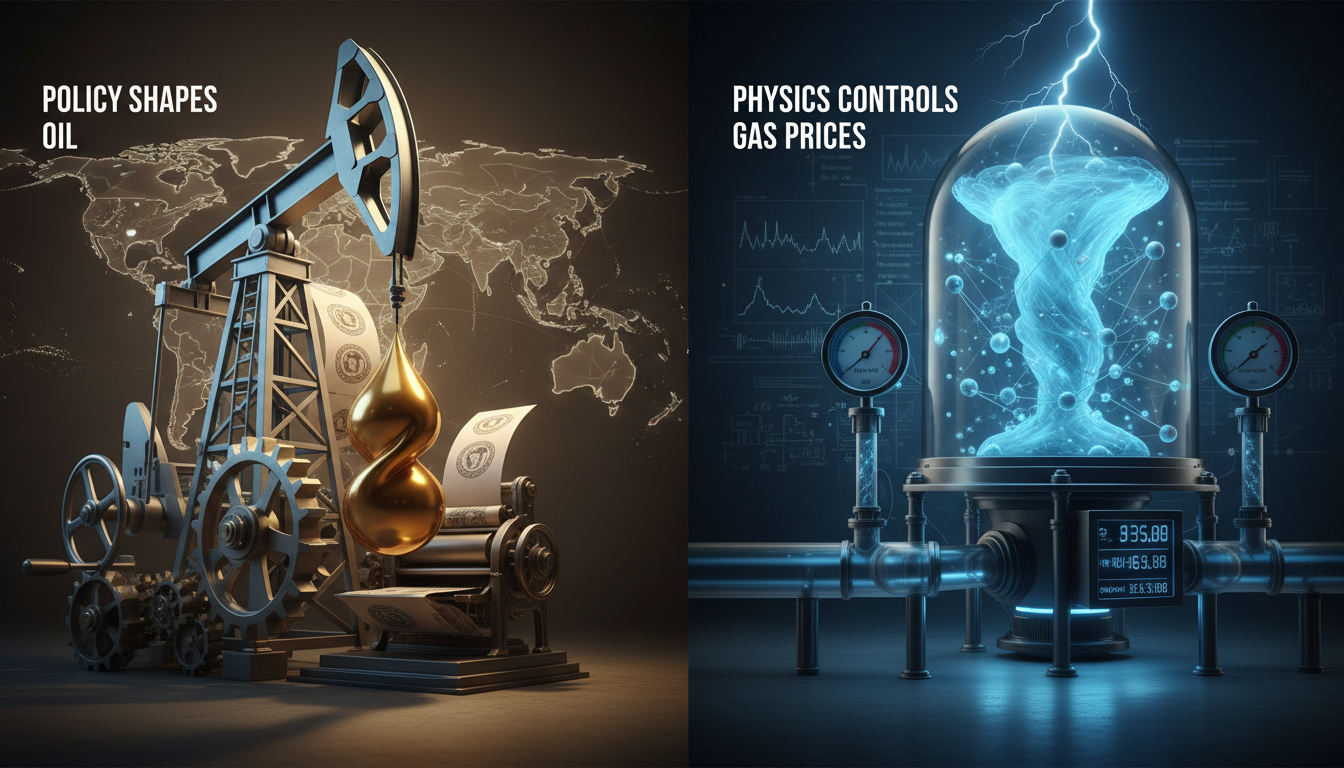
The consequence is clear: natural gas markets ultimately clear through the immutable laws of physics, not through policy preferences or political will.
The Volatility Cycle of Natural Gas
This dynamic often manifests in natural gas pricing that appears deceptively calm, only to erupt violently. Extended periods of oversupply tend to foster market complacency, leading to sustained price depreciation. This, in turn, discourages capital investment in new production, causing storage inventories to fill slowly or remain deficient. The introduction of adverse weather conditions then rapidly exposes these underlying vulnerabilities, making inventory levels critically important. What follows are swift, often dramatic price spikes. These aren’t speculative aberrations but rather mechanical responses to physical constraints and the imperative of delivery.
The current market environment significantly amplifies this pattern. Years of stringent capital discipline within the industry have notably curtailed the development of flexible new natural gas supply, even as global demand has surged, primarily driven by the expansion of LNG export capabilities. Europe’s strategic pivot away from Russian pipeline gas did not diminish overall demand; it merely re-routed it, often to more expensive, LNG-based alternatives. Asia’s relentless economic growth continues to fuel robust demand. Essential uses like power generation, industrial processes, and residential heating remain non-negotiable necessities, locking in demand floors globally.
Under these conditions, any periods of low natural gas prices, such as brief dips to $3 per MMBtu in North America, should be viewed as transient and fragile, rather than indicative of sustained market weakness. The economics of replacement costs, natural production decline rates, and robust export demand will inevitably reassert themselves. The onset of winter, for instance, remains entirely indifferent to prevailing market narratives or political agendas; it simply demands supply.
Strategic Implications for Investment Portfolios
Failing to differentiate between these two distinct market regimes can lead directly to suboptimal investment decisions and flawed portfolio positioning. Investors who erroneously assume natural gas will behave like crude oil will consistently underestimate the potential speed and severity of price repricing when supply-demand balances tighten. Conversely, those who expect crude oil to mirror natural gas’s dynamics might overestimate the probability of sustained, runaway scarcity in the oil market. Each commodity market possesses its own unique vulnerabilities and failure modes that demand tailored analytical approaches.
For discerning portfolio managers, the investment strategy becomes clear. Exposure to crude oil necessitates a deep understanding of policy reaction functions, the optics surrounding inventory levels, and nuanced geopolitical signaling. It’s a market where strategic insight into political decision-making and international relations is key. In contrast, successful navigation of natural gas markets demands a keen focus on precise timing, pronounced seasonality, critical storage levels, and the unpredictable influence of weather patterns. One market is largely negotiated through political and economic levers; the other is ultimately enforced by physical realities.
This crucial distinction also illuminates why many energy transition debates frequently miss the mark regarding natural gas. Substitution narratives, while valid in some contexts, apply unevenly. While power generation facilities might switch between fuels at the margin, widespread fuel switching for heating or industrial processes is simply not feasible at scale without monumental infrastructure overhauls. Industrial demand for gas often remains stubbornly sticky. Furthermore, while LNG links regional systems, it does not eliminate the underlying physical constraints on supply. The net effect is a natural gas market that often remains fundamentally tight, even during periods that superficially appear to be in surplus.
In essence, crude oil prices are shaped by the boundaries of what governments are willing to tolerate and actively manage. Natural gas prices, however, are dictated by the system’s absolute physical capacity to deliver. Conflating these two distinct forces under a singular banner of “energy risk” will inevitably obscure more than it reveals, leading to misguided investment strategies. The market has consistently, and often painfully, reinforced this lesson throughout history, and it will undoubtedly continue to do so.