The historical correlation between significant oil price surges and subsequent economic contractions is a pattern that demands close attention from investors. From the 1973 oil shock preceding a recession to the 2008 commodity supercycle peak coinciding with the Great Recession, energy has consistently acted as a powerful transmission mechanism across the global economy. When crude oil prices escalate aggressively, the impact cascades through transportation, manufacturing, food costs, and ultimately, inflation expectations. Today, with persistent inflationary pressures and geopolitical uncertainties underpinning energy markets, the question isn’t if oil will influence the broader economy, but rather the magnitude of its next move and how investors can position themselves for what appears to be an accelerating supercycle toward a potential 2026 breakout.
Current Market Dynamics: Volatility Amidst Elevated Inflationary Pressures
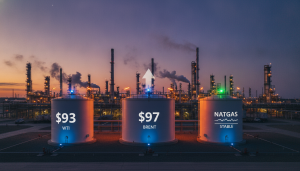
As of today, Brent Crude trades at $91.9 per barrel, reflecting a 1.44% decline within its daily range of $91.39-$94.21. WTI Crude mirrors this sentiment, standing at $88.23, down 1.61% for the day. While these daily dips might suggest a cooling market, it’s crucial to view them within the broader context of recent price action and underlying inflationary forces. Brent, for instance, was trading over $101 just three weeks ago, underscoring the volatility but also the elevated baseline from which prices are operating. Gasoline prices, currently at $3.09, also show a slight daily dip, yet the overall surge in pump prices over recent months has reignited significant inflation fears across major economies. This environment has central banks, particularly the European Central Bank and the Bank of England, signaling more rate hikes, with growing speculation that the Federal Reserve may follow suit. The narrative has abruptly shifted from anticipated rate cuts to a renewed tightening cycle, largely driven by energy-induced inflation. As Bundesbank President Joachim Nagel has underscored, policymakers must act swiftly if energy-driven inflation intensifies, to mitigate the risk of second-round effects where elevated energy costs feed directly into wages and broader pricing behavior, making inflation far more persistent and challenging to control. Institutional models now project that if crude oil remains near current levels for just two more months, U.S. CPI could climb towards 3.3%, reinforcing the ‘higher for longer’ paradigm that has caught many markets off guard.
The Unpriced Breakout: Why $150 Oil is Becoming a Base Case
Despite the recent daily pullbacks, the structural pressures in the global oil market point towards a significant upward trajectory, with some analysts calling for a substantial breakout. The Gold & Silver Club, with its notable 15-year track record in commodity turning points, has set a base-case projection of $150 oil by mid-2026, describing this outlook as “conservative.” This sentiment is echoed across Wall Street, where major institutions are contemplating even higher figures under specific scenarios. Deutsche Bank, for example, warns that a full-scale blockade scenario could propel crude prices toward an unprecedented $200 per barrel. Similarly, JPMorgan estimates that sustained market disruption could push Brent into the $130–$150 range within months. This convergence of projections highlights a growing consensus that current market prices may not fully reflect the true potential for a significant upward move. Factors contributing to this unpriced breakout include persistent geopolitical tensions, underinvestment in new supply over the past decade, and an accelerating global demand recovery that continues to outpace available production capacity. Investors should recognize that while short-term fluctuations are inevitable, the long-term structural tailwinds for higher oil prices appear increasingly robust, setting the stage for a potential multi-year supercycle that could see crude challenging historical highs.
Navigating Volatility: Key Data Points and Upcoming Catalysts
For investors attempting to navigate the volatile energy markets and position for a potential supercycle, understanding the upcoming catalysts and key data releases is paramount. The next two weeks are packed with critical reports that will offer fresh insights into supply-demand balances and production trends. Tomorrow, April 22nd, marks the release of the EIA Weekly Petroleum Status Report, followed by another on April 29th and May 6th. These reports, alongside the API Weekly Crude Inventory updates on April 28th and May 5th, provide crucial data on U.S. crude oil, gasoline, and distillate inventories, which can significantly sway short-term price movements. A sustained draw in inventories, especially during periods of high demand, would underscore tightening market conditions and lend further support to higher prices. Furthermore, the Baker Hughes Rig Count, scheduled for April 24th and May 1st, will offer insights into drilling activity and the future trajectory of oil production. Perhaps one of the most impactful forward-looking reports will be the EIA Short-Term Energy Outlook on May 2nd. This comprehensive outlook will provide revised forecasts for global supply, demand, and prices, acting as a key benchmark for market expectations. Each of these events serves as a potential inflection point, capable of reinforcing the supercycle narrative or introducing new variables that warrant investor attention. Proactive monitoring of these releases is essential for making informed investment decisions in a dynamically evolving energy landscape.
Investor Sentiment and Strategic Positioning for the Long Game
Our proprietary reader intent data reveals a clear focus among investors on the immediate direction of crude prices, with questions like “is WTI going up or down” dominating inquiries. This reflects the prevailing short-term volatility and uncertainty in the market. However, a significant portion of our readership is also looking beyond the immediate horizon, asking “what do you predict the price of oil per barrel will be by end of 2026?” This blend of short-term tactical and long-term strategic thinking underscores the complexity of the current investment environment. For those with a longer-term perspective, the emerging supercycle presents a compelling opportunity. While daily price movements, such as Brent’s current $91.9, might fluctuate, the underlying structural shifts, inflationary pressures, and expert projections pointing towards $150 oil by 2026 suggest a powerful tailwind for the energy sector. Investors should consider strategic positioning in resilient exploration and production companies, integrated oil majors, or energy-focused ETFs. Even specific inquiries, such as those regarding the performance of companies like Repsol by April 2026, highlight the need for granular analysis within the sector. The key is to look beyond daily noise and focus on the fundamental drivers that are likely to shape crude oil prices over the next several years. The consistent historical link between elevated energy prices and broader economic shifts, combined with expert forecasts, indicates that the energy sector is poised for a breakout that investors cannot afford to ignore.