The Current Market Picture: A Resilient Floor Amidst Volatility
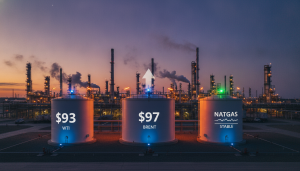
Despite a backdrop of persistent macroeconomic uncertainties and shifting geopolitical tides, crude oil prices continue to exhibit a remarkable resilience, seemingly defying the gravitational pull of bearish sentiment. As of today, Brent crude trades at $92.92 per barrel, reflecting a modest daily dip of 0.34%, with WTI crude following closely at $89.33, down 0.38%. This marginal softness comes after a more significant downward correction over the past two weeks, where Brent shed approximately 7% from its April 1st high of $101.16 to $94.09 by April 21st. However, the current consolidation around the low-$90s for Brent and high-$80s for WTI suggests that the market may be establishing a new, robust floor, resisting further substantial declines. This stabilization is a key indicator for investors seeking clarity on the commodity’s immediate trajectory. Downstream, gasoline prices are reflecting similar dynamics, currently sitting at $3.11, a slight decrease of 0.64% today, indicating a broad market adjustment without a complete collapse in demand expectations.
Decoding Investor Sentiment: Where Are Prices Headed?
Our proprietary reader intent data reveals a prevalent question among investors this week: “Is WTI going up or down?” This immediate concern about directional movement underscores the market’s current uncertainty. While short-term fluctuations are always present, the underlying sentiment points to a cautious optimism, or at least a belief in price stability at elevated levels. Many investors are also looking further ahead, with a keen interest in the “price of oil per barrel by end of 2026.” This forward-looking perspective suggests that market participants are evaluating not just immediate catalysts but also longer-term supply-demand balances and geopolitical risks. For companies like Repsol, or indeed any exploration and production (E&P) firm, the ability of crude prices to maintain this resilient floor is crucial for profitability and investment decisions, impacting their ability to deliver strong earnings through the remainder of April and beyond. The consistent pricing above $90 for Brent, even with daily volatility, offers a more favorable operating environment than many might have anticipated a few months ago, underpinning confidence in the sector’s financial health.
Navigating the Next Fortnight: Key Data Points on the Horizon
The coming weeks are packed with crucial data releases that could inject significant volatility or confirm the market’s current trajectory. Investors are advised to closely monitor these events for actionable insights. Tomorrow, April 22nd, the EIA Weekly Petroleum Status Report will provide vital statistics on crude oil inventories, refinery utilization, and demand indicators – a potential catalyst for price movement. Following this, the Baker Hughes Rig Count on April 24th will offer a glimpse into North American drilling activity, influencing future supply expectations. As we move into the next week, the API Weekly Crude Inventory report on April 28th will serve as an early indicator ahead of the EIA’s subsequent release on April 29th. Perhaps most impactful for the longer-term outlook will be the EIA Short-Term Energy Outlook on May 2nd, which provides comprehensive forecasts for supply, demand, and prices across various energy commodities. These regularly scheduled updates, especially the EIA reports, are critical for understanding the fundamental shifts in the global oil market and will directly influence investor positioning and price discovery for Brent and WTI.
Beyond the Headlines: Structural Support for Crude Prices
The “defying gravity” narrative for crude prices isn’t merely a fleeting market anomaly; it reflects several underlying structural supports that continue to underpin the commodity. Geopolitical tensions, particularly in key oil-producing regions, persist as a significant risk premium embedded in current prices, limiting downside potential even in the face of demand concerns. Furthermore, disciplined capital expenditure by major oil producers in recent years has constrained new supply growth, creating a tighter market balance than historical norms. OPEC+ production policies also play a pivotal role, with the cartel demonstrating a willingness to manage supply to support prices. While global economic growth projections are varied, a resilient, albeit uneven, recovery in major economies could continue to fuel oil demand, particularly in sectors like aviation and transportation. This combination of supply-side discipline, ongoing geopolitical risks, and steady demand, even if not robust, creates a fundamental floor for crude prices that makes significant and sustained declines less likely, reinforcing the perception that current valuations are holding firm against prevailing bearish winds.