Energy Prices Retreat From Session Peaks: An Investor’s Guide to Navigating the Volatility
The global energy market has seen a distinct shift in recent sentiment, with crude benchmarks pulling back from their prior highs. While today’s trading shows a modest rebound from session lows, the broader trend over the past fortnight indicates a strategic retreat, prompting investors to reassess their positions and outlooks. This recent price action underscores the dynamic interplay of supply expectations, demand signals, and geopolitical undercurrents that continuously shape the investment landscape in oil and gas. For discerning investors, understanding these movements requires a deep dive into current data, upcoming catalysts, and the underlying questions driving market participants.
Current Market Dynamics and the Recent Pullback
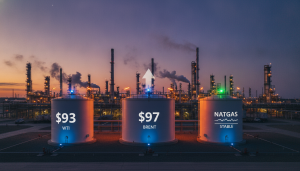
As of today, Brent crude trades at $93.57, showing a modest daily gain of 0.35%, with its session range oscillating between $93.49 and $94.21. Similarly, WTI crude is priced at $90.12, up 0.5% for the day, having traded between $89.71 and $90.71. While these minor upward adjustments suggest some resilience, they occur within a broader context of significant correction. Our proprietary data reveals that Brent crude has shed a notable $7.07, or approximately 7%, over the last 14 days, falling from $101.16 on April 1st to $94.09 by April 21st. This sharp decline from previous peaks signals profit-taking and a re-evaluation of bullish drivers that had previously propelled prices higher. Gasoline, often a bellwether for consumer demand and refining margins, also shows a slight retreat, currently trading at $3.12, down 0.32% for the day. This collective softening across the energy complex indicates a market grappling with robust supply prospects against potentially tempered demand growth, a critical juncture for those allocating capital in the sector.
Upcoming Catalysts: Navigating the Next Fortnight
The coming weeks are packed with crucial data releases that could either stabilize the market or intensify the current price retreat. Investors should pay close attention to several key events. The **EIA Weekly Petroleum Status Report**, scheduled for April 22nd and again on April 29th, will provide fresh insights into U.S. crude oil and product inventories, refining activity, and demand indicators. Unexpected builds in crude stocks could exert further downward pressure, while significant draws might signal a tightening market. Following this, the **Baker Hughes Rig Count** on April 24th and May 1st offers a pulse check on North American drilling activity, an important proxy for future production trends. An increase in active rigs could suggest rising supply capacity, impacting long-term price expectations. Furthermore, the **API Weekly Crude Inventory** reports on April 28th and May 5th will serve as early indicators ahead of the official EIA figures, often moving prices in anticipation. Perhaps one of the most significant forward-looking events will be the **EIA Short-Term Energy Outlook (STEO)** on May 2nd. This comprehensive report will update supply and demand forecasts, providing a critical benchmark for 2026 oil price predictions and shaping investor sentiment for the months ahead. These scheduled events are not merely data points; they are potential inflection points for energy prices, demanding keen analysis from investors.
Addressing Investor Focus: WTI, Long-Term Outlook, and Equities
Our proprietary reader intent data reveals a clear focus among investors on directional calls and future price trajectories. A frequently asked question this week is, “Is WTI going up or down?” This immediate concern highlights the prevailing uncertainty. While WTI has seen a modest uptick today, the broader 14-day trend for Brent suggests underlying bearish sentiment. The direction of WTI in the near term will heavily depend on the inventory data from the upcoming EIA and API reports, as well as the Baker Hughes Rig Count’s implications for U.S. crude production. Any signs of persistent oversupply or weakening demand, particularly from key Asian economies, could push WTI lower, while geopolitical flare-ups or stronger-than-expected economic data could provide support.
Beyond the immediate, investors are also keenly interested in the longer-term, asking, “What do you predict the price of oil per barrel will be by the end of 2026?” Forecasting oil prices 8 months out is complex, but several factors will be paramount. Global economic growth, particularly in China and India, will dictate demand. On the supply side, OPEC+ production policy and the stability of non-OPEC output, especially from the U.S. shale patch, will be critical. Any escalation in geopolitical tensions, particularly in the Middle East or Eastern Europe, always carries the potential for significant price spikes. Investors should anticipate a range-bound environment, perhaps with Brent averaging in the high $80s to low $90s, but with considerable volatility driven by these macro and geopolitical variables.
Finally, questions regarding specific equities, such as “How well do you think Repsol will end in April 2026?”, underscore the direct linkage between commodity prices and company performance. For integrated players like Repsol, crude price movements directly impact upstream profitability, while refining margins are influenced by product prices like gasoline. The current retreat in crude prices, combined with the slight dip in gasoline, could pressure refining margins if crude costs don’t fall sufficiently or if product demand weakens. Investors in such companies must monitor not only crude benchmarks but also regional product crack spreads and the company’s specific project pipeline and cost efficiencies to gauge performance effectively in this volatile environment.
Navigating Volatility: Strategic Considerations for Oil & Gas Investors
The recent retreat in energy prices, while concerning for some, presents a nuanced landscape for strategic investors. The decline from session peaks, particularly the 7% drop in Brent over the past two weeks, could be interpreted as a healthy correction after a period of strong gains, potentially creating more attractive entry points for long-term positions. However, the absence of a clear, definitive catalyst for this pullback necessitates caution. Investors should carefully scrutinize upcoming inventory reports for signs of structural shifts in supply/demand balances rather than just short-term noise. Furthermore, the EIA’s Short-Term Energy Outlook will offer a crucial macro perspective, shaping expectations for the remainder of the year and into 2027. Diversification within the energy sector, balancing exposure to exploration and production (E&P) with midstream and downstream assets, can help mitigate risks associated with direct commodity price fluctuations. In this environment of heightened uncertainty and evolving fundamentals, staying abreast of real-time market data and forward-looking analysis remains paramount for successful capital deployment in oil and gas.