Close Menu
  • Home
  • Market News
    • Crude Oil Prices
    • Brent vs WTI
    • Futures & Trading
    • OPEC Announcements
  • Company & Corporate
    • Mergers & Acquisitions
    • Earnings Reports
    • Executive Moves
    • ESG & Sustainability
  • Geopolitical & Global
    • Middle East
    • North America
    • Europe & Russia
    • Asia & China
    • Latin America
  • Supply & Disruption
    • Pipeline Disruptions
    • Refinery Outages
    • Weather Events (hurricanes, floods)
    • Labor Strikes & Protest Movements
  • Policy & Regulation
    • U.S. Energy Policy
    • EU Carbon Targets
    • Emissions Regulations
    • International Trade & Sanctions
  • Tech
    • Energy Transition
    • Hydrogen & LNG
    • Carbon Capture
    • Battery / Storage Tech
  • ESG
    • Climate Commitments
    • Greenwashing News
    • Net-Zero Tracking
    • Institutional Divestments
  • Financial
    • Interest Rates Impact on Oil
    • Inflation + Demand
    • Oil & Stock Correlation
    • Investor Sentiment

Subscribe to Updates

Subscribe to our newsletter and never miss our latest news

Subscribe my Newsletter for New Posts & tips Let's stay updated!

What's Hot

DNV awards ModuSpec technology qualification for BOP real-time monitoring platform

January 15, 2026

Verizon to Give $20 Credit for 9-Hour Outage. Here’s How to Claim It.

January 15, 2026

bp flags up to $5 billion in energy transition writedowns in Q4 update – Oil & Gas 360

January 15, 2026
Facebook X (Twitter) Instagram Threads
Oil Market Cap – Global Oil & Energy News, Data & Analysis
  • Home
  • Market News
    • Crude Oil Prices
    • Brent vs WTI
    • Futures & Trading
    • OPEC Announcements
  • Company & Corporate
    • Mergers & Acquisitions
    • Earnings Reports
    • Executive Moves
    • ESG & Sustainability
  • Geopolitical & Global
    • Middle East
    • North America
    • Europe & Russia
    • Asia & China
    • Latin America
  • Supply & Disruption
    • Pipeline Disruptions
    • Refinery Outages
    • Weather Events (hurricanes, floods)
    • Labor Strikes & Protest Movements
  • Policy & Regulation
    • U.S. Energy Policy
    • EU Carbon Targets
    • Emissions Regulations
    • International Trade & Sanctions
  • Tech
    • Energy Transition
    • Hydrogen & LNG
    • Carbon Capture
    • Battery / Storage Tech
  • ESG
    • Climate Commitments
    • Greenwashing News
    • Net-Zero Tracking
    • Institutional Divestments
  • Financial
    • Interest Rates Impact on Oil
    • Inflation + Demand
    • Oil & Stock Correlation
    • Investor Sentiment
Oil Market Cap – Global Oil & Energy News, Data & Analysis
Home » Cop30: calls for new urgency to talks as studies show global warming may reach 2.5C – latest updates | Climate crisis
Climate Commitments

Cop30: calls for new urgency to talks as studies show global warming may reach 2.5C – latest updates | Climate crisis

omc_adminBy omc_adminNovember 17, 2025No Comments11 Mins Read
Share
Facebook Twitter Pinterest Threads Bluesky Copy Link


Key events

Show key events only

Please turn on JavaScript to use this feature

Adam Morton

Adam Morton

There was a brief flurry of noise in the “where on Earth will Cop31 be held” guessing game on the weekend.

For those who have not been paying attention: Australia and Turkey have rival bids to host next year’s Cop. They have for years. Australia’s bid is to co-host a “Pacific Cop” with Pacific island nations.

Under UN rules, the decision must be resolved by consensus. Australia has had the overwhelming support of the countries in the Western Europe and Others Group, from which next year’s host must be selected – but both countries remain in the race.

If the stand-off isn’t resolved, hosting responsibilities fall by default to Germany, which is home to the UN climate headquarters in Bonn. But Germany doesn’t want to host Cop31.

The leaders of the two countries, Anthony Albanese and Recep Tayyip Erdoğan, have recently exchanged correspondence over a potential deal to sort it out, without success.

Reuters reported on Sunday that Turkey had proposed on the sidelines of the UN general assembly in September that the two countries jointly lead the conference. Australia also made proposals, including that Turkey could host other events linked to Cop31. The Guardian reported on these negotiations at the time and since.

The latest news story prompted a journalist to ask Albanese about it at a media conference in Melbourne on Monday. He flatly dismissed the idea of a jointly-led Cop, saying:

“No, we won’t be co-hosting, because co-hosting isn’t provided for under the rules of the UNFCCC [the United Nations Framework Convention on Climate Change].

So, that’s not an option, and people are aware that that’s not an option, which is why it’s been ruled out.”

So the wait continues.

You can read a more on the deadlock in this piece from Friday.

Share

Brazil environment minister: ‘It is good that we have a map. But the map does not force us to travel’

Fiona Harvey

Fiona Harvey

President Lula da Silva of Brazil has called Cop30 the “Cop of truth”. For negotiators, it may become known as the Cop of roadmaps.

Many countries are hoping to begin the process here of a roadmap to “transition away from fossil fuels”, the key promise made at Cop28 in 2023 but not followed up since then. Marina Silva, Brazil’s environment minister, in an interview with the Guardian, urged all countries to have the courage to address the issue, saying: “The map is an answer to our scientific knowledge [of the climate crisis]. It is an ethical answer.”

The Baku to Belem roadmap on the $1.3 trillion was published in Belem during the leaders’ summit that preceded the formal opening of Cop30, to much approval from governments. It delivered a menu of options, such as levies on frequent flyers and on fossil fuels, or new taxes on financial transactions, that would raise the $1.3 trillion promised to poor countries each year by 2035.

Now it looks like there could be more roadmaps to come. On Sunday night, Cop president Andre Correa do Lago published his promised “note” on the progress of the presidency consultations which have been taking place since last Monday.

The presidency consultations were a neat way of avoiding a damaging and delaying fight over what should be on the Cop agenda. While the less contentious items proposed for the Cop agenda were allowed to proceed – and many have already been resolved or are approaching resolution – the four trickiest issues were set aside to be dealt with separately.

The four issues are: trade; transparency; finance; and addressing the shortfall between the emissions-cutting pledges countries have made, and the cuts needed to limit global heating to 1.5C. (The transition away from fossil fuels, though probably the most controversial issue at this Cop, was not on the list because it is so explosive it can only be dealt with away from the formal agenda.)

In his note, do Lago sets out the possibility of a new roadmap, this time on the 1.5C issue. Ahead of Cop, countries were supposed to submit new national climate plans, called “nationally determined contributions” (NDCs) under the Paris agreement. These set out targets on future emissions, and measures to achieve them. Nearly 120 NDCs have so far been filed, but some key countries are still missing – India, for instance – and the current submissions would result in temperature rises of about 2.5C, way above the 1.5C target.

Technically, under the Paris agreement, countries need not assess and respond to the NDCs for another three years, until the next “global stocktake”– a periodic assessment of progress towards the goal of limiting temperature rises to 1.5C. China and some of its allies want to stick to the letter of the Paris agreement and refuse to discuss the NDCs in Belem.

But many other countries, and most campaigners, believe that – with temperatures already at 1.5C above pre-industrial levels, and rising – would be grossly inadequate. If Cop30 does not set out some credible response to the shortfall, and a pathway to achieving the 1.5C target, it will be counted a failure by many.

One potential compromise listed by do Lago is for a “roadmap”. If this were adopted, it would mean, according to his note: “[Cop30] invites COP Presidencies to develop the XXXX Roadmap to identify opportunities to accelerate the implementation of, and international cooperation and investment in NDCs, to close the gaps; convene a Coalition of Climate Ministers to inform the Roadmap to be published before COP31 and present findings at the annual high-level roundtable on pre-2030 ambition at COP31”.

This compromise will be regarded by some as kicking the can down the road, to Cop31 – and no one currently even knows where Cop31 will be held, as Australia and Turkey are still battling it out for the honour.

Where does a roadmap lead? Possibly to an action plan. The rest of do Lago’s note sets out some of the potential solutions to the other tricky issues, including an “action plan” on climate finance that would follow the Baku to Belem roadmap, or a “work programme” on similar issues, or in the case of trade, possibly round tables “on the nexus between trade and climate change, in 2026 and 2027”.

Roadmaps are an attractive instrument, for negotiations that appear stuck. But setting out a map is one thing. Persuading people to follow it is quite another. As Marina Silva told us: “When we have a terrain or environment that is quite grim, it is good that we have a map. But the map does not force us to travel, or to climb.”

Share

Updated at 07.35 EST

Jonathan Watts

Jonathan Watts

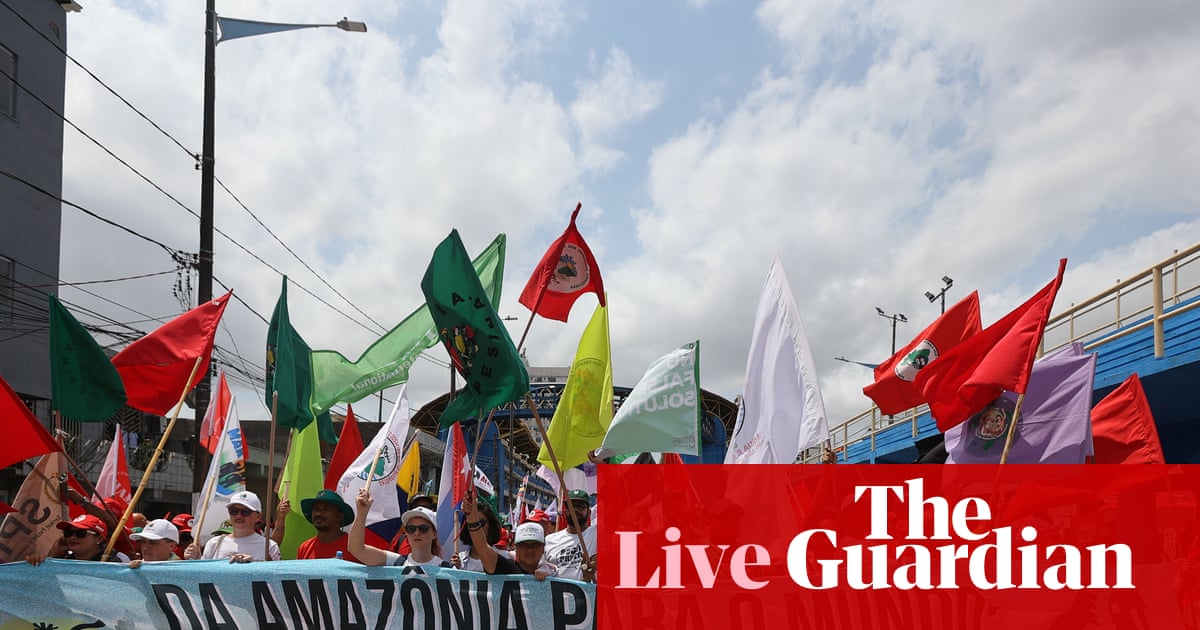
A spectacular demonstration by tens of thousands of climate, nature and land activists in Belém this weekend has set the stage for the second week of COP30 negotiations, when organisers hope the energy from the streets can be channeled into the conference halls.

Monday and Tuesday mark the transition to the political phase of the negotiations, when ministers fly in to grapple with the issues that were too thorny for their bureaucrats to handle.

Climate protestors in Belem on Saturday. Photograph: André Penner/AP

The climate conference got off to a flying start last week with a rapid agreement on the agenda, but then quickly became snarled up in dispute over four subjects: trade, transparency, finance, and how to address the shortfall between the emissions cuts planned by countries and those required to limit global heating to the 1.5C target of the Paris agreement.

Developing countries insist on much higher levels of climate finance from wealthy industrialised countries to assist with the energy transition and compensate for the loss and damage that is already being suffered as a result of global heating.

There have been more fruitful talks on a just transition for those affected by the move to a low-carbon economy, with a big push from the G77 group of countries, China and labour unions to adopt a Belém Action Mechanism on this topic.

For the first time, one draft mentions the “critical minerals” that will be needed for the energy transition. Other strong areas of debate were on adaptation and the need to address climate disinformation, which is recognised as a growing threat.

A fossil fuel phase out is not part of the official Cop30 agenda, but this fundamental issue has been bubbling away throughout the past week, and at a volume that has rarely been heard before. The Brazilian presidency is seeking a space within the process for talks on a roadmap “to accelerate the transition” with strong support from many global south nations and island states that are worst affected by the climate crisis. In an exclusive interview with The Guardian, Brazil’s environment minister Marina Silva said countries should have the “courage” to address the phase-out of fossil fuels, calling the drawing up of a roadmap for it an “ethical” response.

The need for urgency has never been more apparent. Numerous studies, unveiled in Belém, have shown the world has already failed to limit global heating to the Paris Agreement target of 1.5C, continues to put record amounts of warming gases such as methane and carbon dioxide into the atmosphere, and has started to pass dangerous tipping points in the Earth System. Over the past year, previous progress has been put into reverse, largely as a result of US president Donald Trump’s backtracking and trade tariffs that slow the spread of clean technologies. if “stated policies” are implemented as planned, the International Energy Agency revealed last week that it expects global warming to reach 2.5C by the end of this century, a tenth of a degree higher than last year’s forecast.

Brazil has yet to conclusively confirm or deny hopes that it will seek a concluding “cover text” to codify any progress achieved at this conference. If parties remain too far apart for that, the host may look for other ways to maintain momentum until next year’s Cop. Where that will take place is on the long list of unresolved issues. Australia and Turkey have been vying for hosting rights since 2022. If they fail to reach an agreement Cop31 could default to Bonn. Wherever it ends up, the host will be working against the clock to get ready with less than a year to go.

Belém faced similar doubts this time last year, but despite sky high accommodation costs and last-minute construction work, it has won many visitors over during the past week. The expected traffic chaos has not materialised. And many participants have expressed delight that indigenous groups and other elements of civil society have been given more space to participate and protest than the past three climate summits in authoritarian nations.

Cop30 President Andre Correa do Lago receiving documents from Indigenous leaders from the Tapajos region. Photograph: Mauro Pimentel/AFP/Getty Images

The “People’s Summit”, a series of civil society discussions that has been running in parallel to Cop30, wrapped up on Sunday with a declaration that capitalism was the root cause of the climate and nature crisis. Its demands, including an end to carbon credits and other market-based solutions, were presented to Brazilian environment minister Marina Silva and Cop30 president André Corrêa do Lago, who promised the statement would be noted in the proceedings of the conference.

Nothing remotely as radical is likely to be approved inside the official blue zone of the conference centre this week. But Monday will see several announcements and events related to forests and nature, including a new commitment to support land tenure for indigenous peoples and other traditional communities.

This is a significant step forward, particularly given this is the first summit of its type in the Amazon rainforest. But much more will be needed if forests and other natural biomes are to play a central role in restoring climate stability and planetary abundance.

While much of the attention this week will be on whether Cop30 can initiate the drawing of a roadmap away from the fossil fuel era, the Amazon ought to be as good a place as any to start thinking beyond wind farms and solar panels to where humanity might go next.

Share

Updated at 07.21 EST

Hello, Ajit Niranjan here from Berlin – I’ll be hosting the liveblog this morning and my colleague Nina Lakhani will take over this afternoon.

We’re joined by a team of expert reporters on the ground, who’ll be bringing you the latest as the second week of the 30th UN climate summit kicks off.

Share


Source link

Share. Facebook Twitter Pinterest Bluesky Threads Tumblr Telegram Email
omc_admin
  • Website

Related Posts

Spain’s climate scientists subjected to ‘alarming’ rise in hate speech, minister warns | Spain

January 15, 2026

EPA to stop calculating money and lives saved by curbs on air pollution | Trump administration

January 14, 2026

‘It has destroyed years of work’: Cornish beauty spot loses 80% of its trees to Storm Goretti | Cornwall

January 14, 2026
Add A Comment
Leave A Reply Cancel Reply

Top Posts

Citigroup must face $1 billion lawsuit claiming it aided Mexican oil company fraud

July 1, 20077 Views

LPG sales grow 5.1% in FY25, 43.6 lakh new customers enrolled, ET EnergyWorld

May 16, 20255 Views

Trump’s 100 days, AI bubble, volatility: Market Takeaways

December 16, 20075 Views
Don't Miss

DNV awards ModuSpec technology qualification for BOP real-time monitoring platform

By omc_adminJanuary 15, 2026

ModuSpec has received DNV Technology Qualification (TQ) for blowout preventer (BOP) real-time monitoring capabilities within…

TotalEnergies partners with BluEnergies on deepwater prospect offshore Liberia

January 15, 2026

TotalEnergies partners with BluEnergies on deepwater prospect offshore Liberia

January 15, 2026

Canopy Launches $2 Billion Platform to Scale Circular Textiles as Wood Supply Risks Rise

January 15, 2026
Top Trending

Rolls-Royce Appoints Former bp CSO Ivanka Mamic as New Chief Sustainability Officer

By omc_adminJanuary 15, 2026

Canaccord Acquires Energy Transition-Focused Investment Bank CRC-IB

By omc_adminJanuary 15, 2026

Microsoft Kicks Off 2026 With Flurry of Large-Scale Carbon Removal Purchase Deals

By omc_adminJanuary 15, 2026
Most Popular

The 5 Best 65-Inch TVs of 2025

July 3, 202510 Views

The Layoffs List of 2025: Meta, Microsoft, Block, and More

May 9, 202510 Views

‘Looksmaxxing’ on ChatGPT Rated Me a ‘Mid-Tier Becky.’ Be Careful.

June 3, 20257 Views
Our Picks

Chapo Sees Total LNG Project Restart Within Weeks

January 15, 2026

Chapo Sees Total LNG Project Restart Within Weeks

January 15, 2026

Analyst Explains Why Feb NatGas Contract Collapsed Wednesday

January 15, 2026

Subscribe to Updates

Subscribe to our newsletter and never miss our latest news

Subscribe my Newsletter for New Posts & tips Let's stay updated!

Facebook X (Twitter) Instagram Pinterest
  • Home
  • About Us
  • Advertise With Us
  • Contact Us
  • DMCA
  • Privacy Policy
  • Terms & Conditions
© 2026 oilmarketcap. Designed by oilmarketcap.

Type above and press Enter to search. Press Esc to cancel.


