Close Menu
  • Home
  • Market News
    • Crude Oil Prices
    • Brent vs WTI
    • Futures & Trading
    • OPEC Announcements
  • Company & Corporate
    • Mergers & Acquisitions
    • Earnings Reports
    • Executive Moves
    • ESG & Sustainability
  • Geopolitical & Global
    • Middle East
    • North America
    • Europe & Russia
    • Asia & China
    • Latin America
  • Supply & Disruption
    • Pipeline Disruptions
    • Refinery Outages
    • Weather Events (hurricanes, floods)
    • Labor Strikes & Protest Movements
  • Policy & Regulation
    • U.S. Energy Policy
    • EU Carbon Targets
    • Emissions Regulations
    • International Trade & Sanctions
  • Tech
    • Energy Transition
    • Hydrogen & LNG
    • Carbon Capture
    • Battery / Storage Tech
  • ESG
    • Climate Commitments
    • Greenwashing News
    • Net-Zero Tracking
    • Institutional Divestments
  • Financial
    • Interest Rates Impact on Oil
    • Inflation + Demand
    • Oil & Stock Correlation
    • Investor Sentiment

Subscribe to Updates

Subscribe to our newsletter and never miss our latest news

Subscribe my Newsletter for New Posts & tips Let's stay updated!

What's Hot

What China is thinking about U.S. strikes against Iran

March 2, 2026

Oil surges as Strait of Hormuz traffic nearly halts amid Middle East war

March 2, 2026

JPMorgan: Oil Prices Could Hit $120 Per Barrel

March 2, 2026
Facebook X (Twitter) Instagram Threads
Oil Market Cap – Global Oil & Energy News, Data & Analysis
  • Home
  • Market News
    • Crude Oil Prices
    • Brent vs WTI
    • Futures & Trading
    • OPEC Announcements
  • Company & Corporate
    • Mergers & Acquisitions
    • Earnings Reports
    • Executive Moves
    • ESG & Sustainability
  • Geopolitical & Global
    • Middle East
    • North America
    • Europe & Russia
    • Asia & China
    • Latin America
  • Supply & Disruption
    • Pipeline Disruptions
    • Refinery Outages
    • Weather Events (hurricanes, floods)
    • Labor Strikes & Protest Movements
  • Policy & Regulation
    • U.S. Energy Policy
    • EU Carbon Targets
    • Emissions Regulations
    • International Trade & Sanctions
  • Tech
    • Energy Transition
    • Hydrogen & LNG
    • Carbon Capture
    • Battery / Storage Tech
  • ESG
    • Climate Commitments
    • Greenwashing News
    • Net-Zero Tracking
    • Institutional Divestments
  • Financial
    • Interest Rates Impact on Oil
    • Inflation + Demand
    • Oil & Stock Correlation
    • Investor Sentiment
Oil Market Cap – Global Oil & Energy News, Data & Analysis
Home » Climate disasters in first half of 2025 costliest ever on record, research shows | Climate crisis
Climate Commitments

Climate disasters in first half of 2025 costliest ever on record, research shows | Climate crisis

omc_adminBy omc_adminOctober 22, 2025No Comments5 Mins Read
Share
Facebook Twitter Pinterest Threads Bluesky Copy Link


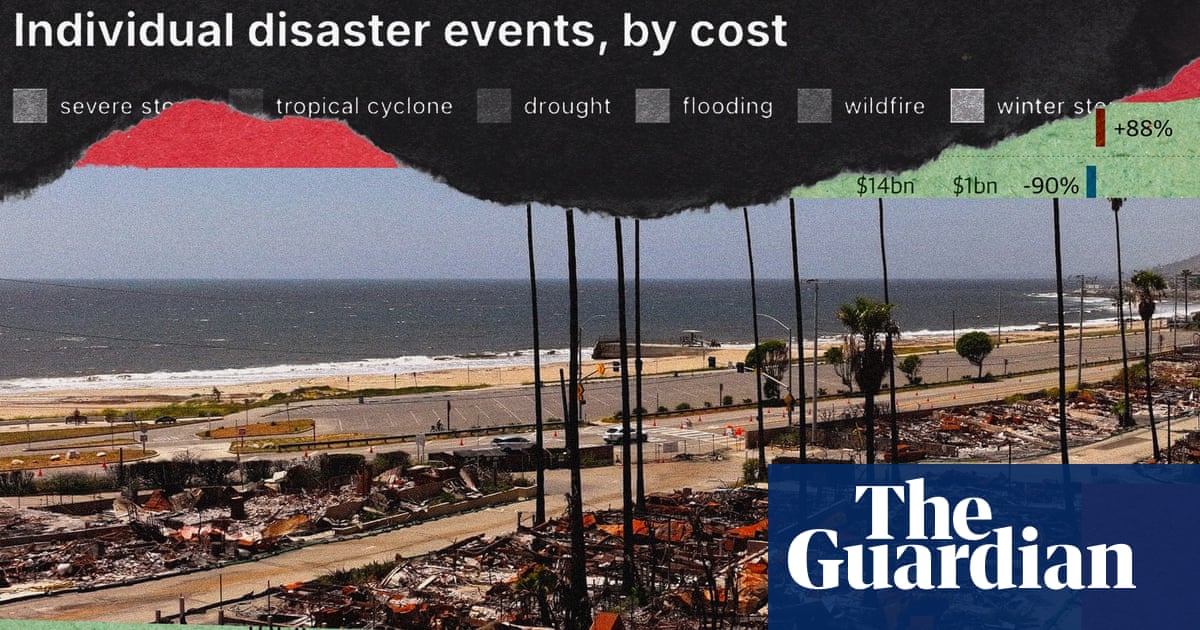
The first half of 2025 was the costliest on record for major disasters in the US, driven by huge wildfires in Los Angeles and storms that battered much of the rest of the country, according to a climate non-profit that has resurrected work axed by Donald Trump’s administration that tracked the biggest disasters.

In the first six months of this year, 14 separate weather-related disasters that each caused at least $1bn in damage hit the US, the Climate Central group has calculated. In total, these events cost $101bn in damages – lost homes, businesses, highways and other infrastructure – a toll higher than any other first half of a year since records on this began in 1980.

The bulk of this toll was caused by the ferocious wildfires that razed parts of Los Angeles in January, a disaster that destroyed about 16,000 buildings and resulted in the indirect deaths of around 400 people. At $61bn in damages, the LA fires are one of the most expensive climate-related disasters on record in the US, and the only top 10 event that is not a hurricane.

Two charts. Top bar chart shows how 13 severe storms and the Los Angeles fire drove 2025 to be the most expensive half year for billion-dollar climate disasters. Bottom bar chart places the fires as the most expensive event aside from hurricanes.

The mounting cost of fires, storms, hurricanes, drought and floods – all worsened by the human-caused climate crisis – was charted over the previous 45 years by the National Oceanic and Atmospheric Administration (Noaa), until the Trump administration “retired” the dataset in May, citing “evolving priorities, statutory mandates and staffing changes”.

Information on billion-dollar disasters until the end of 2024 is still available, frozen, on Noaa’s website, but Climate Central has sought to extend this work, citing its importance as a barometer of the climate crisis as well as a planning resource for cities and states facing increasing dangers from extreme weather impacts.

Over the past four decades, such disasters have become far more savage. The cost of all disasters between 1985 and 1995 was $299bn, a figure dwarfed by the damages of the past decade – with $1.4tn in losses between 2014 and last year.

“This dataset is simply too important to not be updated, we were getting requests from the private sector, local communities and academia for this information,” said Adam Smith, who headed the billion-dollar disaster project at Noaa, before ending his 20-year spell at the agency in May amid a purge of the federal workforce by Trump.

Smith, who has now revived this work at Climate Central, said the latest dataset was compiled using the same methodology as Noaa. “We are certainly seeing more of these big, costly events, since 2017 it’s been on an entirely different level,” he said. “Climate change is supercharging the intensity and frequency of these extremes.

“Climate Central is trying to step into the void of information to recover some of the lost expertise and tools that society needs access to. We are in a sort of triage situation where we are trying to save and continue as much as we can. We are doing the best we can to do this.”

Bar chart shows the increase in costs of billion-dollar climate disasters from 1985-1995 to 2014-2024. Severe storms, tropical cyclones and wildfires have increased the most.

The initial Climate Central update ends in June, meaning it doesn’t capture July’s deadly floods in Texas, which killed more than 130 people, including young girls camping beside a river that burst its banks.

Also, so far this year the US has not been hit by a major, destructive hurricane, meaning that 2025 is currently not on track to be among the most costly on record by year’s end. The lack of hurricanes making landfall is fortunate, experts have said, particularly as the Trump administration has sought to dismantle the disaster response that Americans have come to take for granted.

The Federal Emergency Management Agency (Fema) has slashed staff numbers, with Trump demanding states, rather than the federal government, shoulder the fallout from major disasters.

The agency has faced criticism over its leadership, its sluggish response times to disasters and for the politically motivated withholding of its funds – last week, a federal judge ruled that Fema could not halt grants to Democratic-run states due to differences over immigration policies.

This is a “tremendous concern” given the growing threat from disasters that are being worsened by the climate crisis, as well as population shifts to risky areas such as Florida and the failure to update infrastructure to cope with a warming world, according to Samantha Montano, an expert in emergency management at the Massachusetts Maritime Academy.

“No part of the country is being left unscathed, but unfortunately Fema has backslid to becoming a dysfunctional and ineffectual agency,” Montano said. Improvements made to Fema since Hurricane Katrina in 2005 have been wiped out under Trump, Montano added, leaving local and state agencies unsure of how to cope when disasters strike.

“Fema has fired people who have unique expertise who can’t just be hired back at five hours’ notice, so even if the administration wanted to respond effectively to a disaster I’m not sure it’s possible for them to do so,” she said.

“We’ve got extremely lucky we’ve not had any bigger disasters than we’ve already had this year. We are basically sitting ducks for when the next major disaster hits.”



Source link

Share. Facebook Twitter Pinterest Bluesky Threads Tumblr Telegram Email
omc_admin
  • Website

Related Posts

Winter getting shorter in 80% of major US cities, new data shows | US weather

February 27, 2026

Trump officials move to kill system that protects US from chemical disasters | US Environmental Protection Agency

February 27, 2026

US ‘bullying’ could scupper carbon levy on shipping, warn experts | Shipping emissions

February 26, 2026
Add A Comment
Leave A Reply Cancel Reply

Top Posts

Federal Reserve cuts key rate for first time this year

September 17, 202513 Views

Inflation or jobs: Federal Reserve officials are divided over competing concerns

August 14, 20259 Views

Oil tanker rates to stay strong into 2026 as sanctions remove ships for hire – Oil & Gas 360

December 16, 20258 Views
Don't Miss

Oil surges as Strait of Hormuz traffic nearly halts amid Middle East war

By omc_adminMarch 2, 2026

(Bloomberg) – Oil prices posted their largest single-day gain in four years as conflict in…

Oil Could Pass $100 as Strait of Hormuz Traffic Halts

March 2, 2026

Global oil prices may spike in next few days but calm down in longer term

March 2, 2026

Global oil prices may spike in next few days but calm down in longer term

March 2, 2026
Top Trending

Datamaran Launches New ESG Regulation Monitoring Solution

By omc_adminMarch 2, 2026

California Sets August 2026 Deadline for First Corporate Climate Reports

By omc_adminMarch 2, 2026

Standard Chartered Earns Over $1 Billion in Sustainable Finance Income

By omc_adminMarch 2, 2026
Most Popular

The 5 Best 65-Inch TVs of 2025

July 3, 202515 Views

AI’s Next Bottleneck Isn’t Just Chips — It’s the Power Grid: Goldman

November 14, 202514 Views

The Layoffs List of 2025: Meta, Microsoft, Block, and More

May 9, 202510 Views
Our Picks

Equinor Discovers More Oil around Snorre offshore Norway

March 2, 2026

Hopes for Suez Canal Revival Dashed

March 2, 2026

Petronas Posts Lower Annual Profit

March 2, 2026

Subscribe to Updates

Subscribe to our newsletter and never miss our latest news

Subscribe my Newsletter for New Posts & tips Let's stay updated!

Facebook X (Twitter) Instagram Pinterest
  • Home
  • About Us
  • Advertise With Us
  • Contact Us
  • DMCA
  • Privacy Policy
  • Terms & Conditions
© 2026 oilmarketcap. Designed by oilmarketcap.

Type above and press Enter to search. Press Esc to cancel.