The global crude oil market finds itself at a critical juncture, exhibiting a fascinating dichotomy: a prevailing bearish sentiment driven by macroeconomic anxieties, yet simultaneous technical signals suggesting that prices may be poised for a significant rebound. After a period of aggressive sell-offs, investor focus is now firmly fixed on understanding whether the current downturn represents a temporary correction in an otherwise tight market, or if deeper structural issues are at play. Our proprietary market data and reader intent signals indicate a palpable tension, with investors seeking clarity on price floors, future catalysts, and the long-term outlook amidst this volatility. This analysis will delve into the current market dynamics, highlight crucial upcoming events, and address key investor concerns to provide a comprehensive outlook for crude oil in the immediate future.
The Current Market Landscape: Decoding Recent Price Action
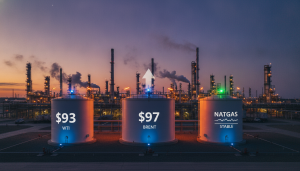
The recent performance of crude oil benchmarks paints a stark picture of market unease. As of today, Brent Crude trades at $90.38, marking a significant 9.07% decline within the day, with its price oscillating between a daily low of $86.08 and a high of $98.97. Similarly, WTI Crude stands at $82.59, down 9.41% for the session, having traded within a range of $78.97 to $90.34. This aggressive daily markdown follows a pronounced trend: our 14-day Brent trend data reveals a substantial drop of $22.4, or nearly 20%, from $112.78 on March 30th to today’s $90.38. Such a rapid depreciation over a short period strongly suggests that the market has entered an oversold condition, a technical state often preceding a price correction or “relief rally.” While the overall market sentiment remains negative, these sharp declines have triggered technical indicators, such as consecutive ‘hammer’ formations on daily charts, which are traditionally interpreted as signs of potential buying interest emerging at lower price points and hinting at a possible reversal. For investors, monitoring the intraday lows of $86.08 for Brent and $78.97 for WTI will be crucial, as these levels could act as immediate psychological floors, testing the market’s conviction.
Catalysts on the Horizon: Key Events Shaping the Next Fortnight
The coming days are packed with critical energy events that hold the power to significantly alter crude oil’s trajectory. Investors should closely monitor the OPEC+ JMMC Meeting scheduled for Sunday, April 19th, immediately followed by the full OPEC+ Ministerial Meeting on Monday, April 20th. These gatherings are paramount, especially in the wake of recent price declines. The market will be scrutinizing any statements regarding current production quotas, compliance levels, or potential adjustments to output policy. A hawkish stance from OPEC+, particularly if they signal a commitment to maintaining market stability or even hint at production cuts to counteract perceived oversupply, could provide a strong bullish catalyst. Conversely, any indication of internal discord or a failure to address market concerns could exacerbate bearish pressure.
Beyond OPEC+, weekly inventory data will offer vital insights into the immediate supply-demand balance. The API Weekly Crude Inventory report on Tuesday, April 21st, and the EIA Weekly Petroleum Status Report on Wednesday, April 22nd, will provide a snapshot of U.S. crude stockpiles, refinery utilization, and product demand. Significant builds in crude inventories could reinforce oversupply fears, while unexpected drawdowns might signal strengthening demand. These reports will be repeated the following week, on April 28th and April 29th, respectively, offering a consistent pulse on the U.S. market. Furthermore, the Baker Hughes Rig Count, released on April 24th and May 1st, will give investors a read on drilling activity and future production trends in North America, adding another layer to the supply outlook.
Addressing Investor Concerns: Supply, Demand, and the 2026 Outlook
Our proprietary reader intent data reveals a clear focus among investors on the long-term outlook and the underlying fundamentals. A prominent question this week is, “What do you predict the price of oil per barrel will be by end of 2026?” This reflects deep-seated anxiety about future market stability and a desire to understand the interplay of supply dynamics, global economic health, and geopolitical factors. The current market narrative is heavily influenced by concerns about potential global economic slowdown, which directly impacts demand forecasts. Simultaneously, investor questions about “OPEC+ current production quotas” underscore the apprehension around persistent overproduction from key players, including Russia, OPEC members, and the United States. This perceived supply glut, combined with demand uncertainty, creates a potent cocktail for volatility.
For the end of 2026, the trajectory will largely hinge on how these two opposing forces resolve. If global economic growth stabilizes or accelerates, particularly in Asia, and OPEC+ demonstrates disciplined production management, prices could find a firmer floor and trend upwards. However, should the global economy falter significantly, or if major producers continue to prioritize market share over price stability, even the most robust technical indicators for a short-term rebound might be overwhelmed by fundamental weakness. The upcoming OPEC+ meetings are thus not just about immediate market reaction, but about setting the tone for how these producers intend to manage supply against a backdrop of evolving global demand for the remainder of the year and into 2026.
Investment Outlook: Positioning for the Rebound
Given the confluence of an oversold market, compelling technical reversal signals, and a packed calendar of high-impact events, crude oil appears poised for a rebound, at least in the near term. The dramatic price adjustments seen over the past two weeks suggest that much of the bearish sentiment related to immediate macro concerns has already been priced in. While the risk of a global economic slowdown remains a valid long-term concern, the short-term market dynamics indicate that the selling pressure may have overextended itself.
Investors should prepare for increased volatility surrounding the OPEC+ meetings, as any decisive action or lack thereof will send clear signals. A concerted effort by OPEC+ to stabilize prices could ignite a strong relief rally, potentially targeting the upper bounds of recent trading ranges, or even higher, as short positions are unwound. Conversely, a failure to act could see prices test deeper support levels. However, the sheer magnitude of the recent decline, coupled with the technical indications of oversold conditions, makes a bounce highly probable. Prudent investors will be closely monitoring not only the headlines from the upcoming events but also the daily trading ranges, looking for confirmation of renewed buying strength to capitalize on the potential upside in an energy market showing signs of a turnaround.