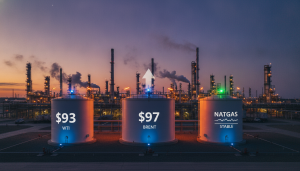
The global oil market presents a fascinating dichotomy for investors today: while macroeconomic indicators suggest robust demand drivers, crude prices are experiencing a sharp pullback. Reports of de-escalating US-China trade tensions and strong export performance from China traditionally serve as powerful tailwinds for energy demand. However, the current price action reveals a deeper, more complex narrative, challenging investors to look beyond headline optimism and assess the multifaceted forces shaping the commodity landscape. Our proprietary data pipelines offer a real-time pulse on market sentiment and impending catalysts, providing critical context for navigating this volatile environment.
Trade Optimism Collides with Current Price Reality
Initial sentiment in the market was undeniably buoyed by signs of progress in US-China trade relations, particularly ahead of the anticipated APEC Summit where a significant trade deal was hoped for. This optimism, coupled with China’s impressive economic data, suggested a strengthening demand outlook for global commodities. Specifically, China’s exports surged 8.3% year-on-year in September, a substantial acceleration from the 4.4% rise in August. Concurrently, imports also saw a robust increase of 7.4%, up sharply from 1.3% in August, signaling robust domestic demand for raw materials and energy inputs.
Yet, this positive macroeconomic backdrop is not translating into immediate upside for crude prices. As of today, Brent Crude trades at $90.38, marking a significant decline of 9.07% within the day, with a range between $86.08 and $98.97. WTI Crude reflects a similar bearish trend, currently priced at $82.59, down 9.41% and trading within a daily range of $78.97-$90.34. This sharp daily drop extends a more concerning trend for Brent, which has fallen from $112.78 on March 30th to its current level of $90.38 by April 17th, representing a substantial 19.9% depreciation in just over two weeks. This stark divergence suggests that while trade hopes and strong Chinese data provide a foundational demand argument, other powerful bearish forces are currently dominating market sentiment, prompting a reassessment of short-term crude trajectories.
China’s Enduring Demand Engine: A Long-Term Anchor
Despite the immediate market volatility, China’s economic performance remains a critical pillar for global oil demand. The substantial rebound in September exports and imports underscores the resilience and scale of the Chinese economy. An 8.3% year-on-year surge in exports indicates robust global appetite for Chinese manufactured goods, which in turn fuels industrial activity and energy consumption within China. Even more directly relevant for oil demand is the 7.4% surge in imports, reflecting strong domestic consumption and industrial feedstock requirements. These figures reinforce China’s role as the world’s largest crude oil importer and a primary driver of demand growth.
For investors considering the long-term price of oil, a healthy and growing Chinese economy is non-negotiable. Our reader intent data shows a consistent investor focus on the “price of oil per barrel by end of 2026,” a forecast heavily influenced by sustained demand from key economies like China. While trade tensions can create short-term disruption, a resolution or de-escalation typically unleashes pent-up demand. The current data suggests that the underlying economic engine in China remains strong, providing a crucial demand floor that could eventually help stabilize and potentially re-ignite crude prices once other headwinds dissipate. The question for investors is the timing and magnitude of this recovery.
OPEC+ at a Critical Juncture: Upcoming Decisions Will Shape Volatility
The recent significant depreciation in crude prices places unprecedented scrutiny on the upcoming OPEC+ meetings. With Brent crude shedding nearly 20% in the last fortnight, the market is bracing for potential policy responses from the world’s leading oil producers. Our event calendar highlights the OPEC+ Joint Ministerial Monitoring Committee (JMMC) Meeting scheduled for April 19th, followed immediately by the full OPEC+ Ministerial Meeting on April 20th. These gatherings are now more critical than ever.
Investors are keenly focused on “OPEC+ current production quotas” and how these might evolve. The substantial price drop could compel the alliance to consider maintaining or even deepening current production cuts to stabilize the market. Conversely, if OPEC+ perceives the decline as transient or driven by speculative trading rather than fundamental demand erosion, they might adhere to existing plans. Any decision to increase supply or signal a lack of resolve in defending price levels could exacerbate the current bearish trend. Beyond OPEC+, we will also be closely monitoring the API Weekly Crude Inventory reports on April 21st and 28th, along with the EIA Weekly Petroleum Status Reports on April 22nd and 29th. These real-time snapshots of US supply-demand dynamics will provide further clues for OPEC+ decision-makers and investors alike, alongside the Baker Hughes Rig Count reports on April 24th and May 1st, which offer insight into future supply capacity from North America.
Navigating Macro Headwinds and Investor Positioning
Beyond the direct supply-demand dynamics of crude, broader macroeconomic factors continue to exert significant influence on oil prices and investor confidence. While US stock futures saw rallies in earlier trading sessions, indicating a potential ‘risk-on’ sentiment, the sharp decline in crude suggests that the energy sector is grappling with its own unique set of challenges. Concerns surrounding Federal Reserve monetary policy, specifically the potential for a less dovish rate path due to sticky inflation, could weigh on risk assets broadly. Higher borrowing costs disproportionately impact capital-intensive industries, including oil and gas exploration and production (E&P) companies.
This dynamic directly resonates with investor inquiries, such as “How well do you think Repsol will end in April 2026?” The performance of integrated energy majors and E&P firms is intrinsically linked to crude prices and the cost of capital. A sustained period of lower oil prices, coupled with tighter monetary policy, could pressure earnings and investment decisions across the sector. Investors must meticulously evaluate balance sheets, hedging strategies, and operational efficiencies of individual companies. While trade hopes offer a glimmer of long-term demand stability, the immediate environment demands vigilance against a complex interplay of supply concerns, monetary policy uncertainties, and broader economic sentiment that continue to dictate market direction.