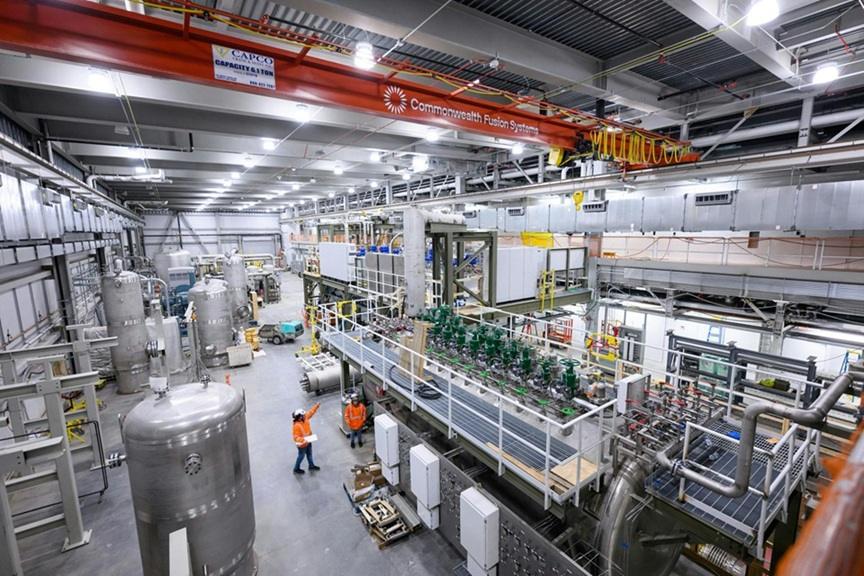
The energy investment landscape is perpetually evolving, marked by both the immediate volatility of commodity markets and the profound, long-term shifts driven by technological innovation. A recent announcement from Commonwealth Fusion Systems (CFS) underscores this duality, revealing an impressive $863 million secured in a Series B2 fundraising round. This substantial capital injection is earmarked to accelerate the company’s ambitious journey towards commercializing fusion energy, a prospect long considered the “Holy Grail” of clean power. For astute oil and gas investors, this development, while seemingly distant from immediate crude price fluctuations, represents a critical signal of where significant capital is flowing and where future energy competition may emerge.
The “Holy Grail” Emerges: Unpacking Fusion’s Commercial Path
Fusion energy, the process mirroring the sun’s power generation by combining light atoms to release immense energy, stands as a beacon for a future free from carbon emissions and radioactive waste. Its promise of abundant, clean power derived from hydrogen, the universe’s most common element, has captivated scientists and investors for decades. CFS, an MIT spin-out established in 2018, is at the forefront of this pursuit. The company is actively constructing SPARC, a demonstration machine in Massachusetts designed to achieve net-energy positive fusion – producing more energy than it consumes. This device utilizes a “tokamak” design, employing high-temperature superconductor magnets to confine and control plasma, creating the precise conditions for fusion. The $863 million funding will be instrumental in completing SPARC and advancing the development of ARC, CFS’s first grid-scale fusion power plant slated for Chesterfield, Virginia. The ambitious target is to connect ARC to the grid in the early 2030s, a timeline supported by strategic partnerships with industry giants like Dominion Energy and Google, the latter having committed to purchasing half of the plant’s future output. This significant progress, backed by substantial capital and strategic alliances, positions CFS as a formidable contender in the long-term energy transition narrative.
Navigating Today’s Volatile Energy Markets Amidst Long-Term Shifts
While the long-term promise of fusion energy captures headlines, oil and gas investors must contend with the immediate realities of global commodity markets. As of today, Brent crude trades at $98.3, reflecting a 1.1% decline on the day, with its intra-day range settling between $98.11 and $98.3. Similarly, WTI crude has seen a downturn, sitting at $89.84, marking a 1.46% drop, fluctuating between $89.72 and $90.08. This daily volatility is a stark reminder of the immediate pressures facing traditional energy investments. Looking at the broader trend, Brent crude has experienced a significant correction over the past two weeks, dropping from $108.01 on March 26th to $94.58 on April 15th, representing a sharp 12.4% decline. This sustained downward pressure underscores the complex interplay of geopolitical factors, supply-demand dynamics, and macroeconomic indicators that define the oil market. For investors accustomed to these fluctuations, the multi-decade horizon of fusion energy presents a dramatically different risk-reward profile, yet one that demands attention as a potential disruptor to the very foundations of global energy supply.
Strategic Alliances and the Road Ahead: Fusion’s Long-Term Calendar
The energy investment calendar for oil and gas is typically dominated by near-term events that directly impact supply, demand, and pricing. Investors keenly await the Baker Hughes Rig Count every Friday, anticipate the OPEC+ Joint Ministerial Monitoring Committee (JMMC) meeting on April 18th, and the Full Ministerial Meeting on April 20th, all of which can trigger significant market movements. Furthermore, the weekly API and EIA crude inventory reports provide critical insights into current supply-demand balances. In stark contrast to this rapid-fire event cycle, the fusion energy sector operates on a fundamentally different timeline, a long-term roadmap defined by scientific breakthroughs, engineering milestones, and massive capital deployment. The $863 million Series B2 funding for CFS is a testament to this extended horizon. It will finance the completion of the SPARC demonstration machine and advance the ARC plant, targeting grid connection in the early 2030s. The backing of a consortium of 12 Japanese companies, led by Mitsui, Mitsubishi, and the Development Bank of Japan, alongside new investors like Brevan Howard Macro Venture Fund, Morgan Stanley’s Counterpoint Global, and NVIDIA’s venture capital arm NVentures, signifies serious institutional confidence in CFS’s long-term vision. These strategic alliances and the sheer scale of investment illustrate a commitment to a future energy paradigm that, while not immediately impacting next week’s rig count, will fundamentally reshape the global energy matrix over the coming decades.
Addressing Investor Questions: Fusion in the O&G Portfolio
Our proprietary reader intent data reveals a consistent focus among OilMarketCap users on immediate, actionable insights within the traditional energy sector. Investors frequently inquire about specifics such as, “What are OPEC+ current production quotas?” or “What is the current Brent crude price and what model powers this response?” and delve into the precise data sources and APIs that fuel our market intelligence platforms. This strong emphasis on real-time price discovery, supply-demand fundamentals, and the operational mechanics of current energy markets underscores the immediate concerns driving oil and gas investment decisions. However, the substantial funding round for CFS compels a broader, more strategic perspective. While fusion energy may not influence today’s production quotas or next week’s inventory reports, the infusion of $863 million, backed by prominent investors like Bill Gates-backed Breakthrough Energy Ventures, Google, and Eni, signals a profound, albeit distant, shift in the global energy landscape. For oil and gas investors, this isn’t about abandoning existing portfolios overnight, but rather recognizing the emerging long-term risks and opportunities. Fusion energy, once commercialized, promises unparalleled energy independence and security, potentially expanding energy access globally. This development should prompt a re-evaluation of long-term portfolio diversification strategies, considering how a future abundant in clean, limitless power could reshape the value proposition of traditional fossil fuel assets, offering a compelling, albeit patient, investment horizon for those willing to look beyond immediate market fluctuations.


