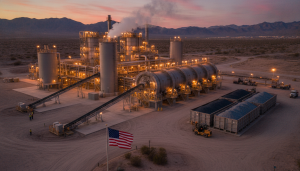
Georgia Power’s recent tender for 500 megawatts (MW) of energy storage capacity, slated for operation before 2032, signals more than just a localized utility expansion; it underscores a profound shift in the broader energy investment landscape. This significant move, open to standalone or renewable-integrated projects, represents a tangible commitment to grid modernization and reliability in one of the fastest-growing regions of the U.S. For oil and gas investors, this development is not an isolated event but a critical data point within a rapidly evolving market, demanding a nuanced understanding of diversification, long-term energy transition plays, and the enduring volatility in traditional fossil fuel markets.
The Accelerating Pace of Energy Transition in Utility Planning
Georgia Power, serving approximately 2.8 million customers across nearly all of Georgia’s 159 counties, is demonstrating an aggressive pivot towards advanced energy solutions. This 500 MW tender builds upon an existing commitment to add over 1.5 gigawatts (GW) of battery energy storage systems (BESS) in the coming years. The utility’s 2022 Integrated Resource Plan (IRP), approved by the Georgia Public Service Commission (PSC), laid the groundwork for this expansion, indicating a strategic, regulated push towards greater grid flexibility. Notably, in July, Georgia Power sought PSC certification for 9.9 GW of new generation resources, with 3 GW specifically allocated to energy storage.
The scale of this shift is further highlighted by projected load growth. Over the next five to six years, the utility anticipates an 8.2 GW increase in electrical load, a substantial 2.2 GW upward revision from its 2023 IRP update. To meet this demand, Georgia Power is not just focusing on short-duration storage. Their IRP details plans for 3 GW per year of four-hour storage commencing in 2028, followed by an ambitious 3 GW per year of 12-hour duration storage starting in 2033. This emphasis on longer-duration solutions suggests a fundamental re-evaluation of grid stability, moving beyond peak shaving to more comprehensive energy resilience. While renewables constituted only 8% of Georgia Power’s energy mix in 2024, compared to over 50% from gas and oil (40%) plus coal (16%), the trajectory is clear: storage is becoming an indispensable component of future energy infrastructure, creating substantial opportunities for investors in battery technology, project development, and grid services.
Market Volatility Underscores Diversification Imperatives
The backdrop to these long-term energy transition strategies is a perpetually dynamic and often volatile commodity market. As of today, Brent Crude is trading at $90.38, reflecting a sharp decline of 9.07% within the day’s range of $86.08 to $98.97. Similarly, WTI Crude stands at $82.59, down 9.41% from its open, oscillating between $78.97 and $90.34. Gasoline prices have also followed suit, currently at $2.93, a 5.18% drop for the day. This immediate market snapshot is not an anomaly; the 14-day trend for Brent crude reveals an even more dramatic shift, plummeting from $112.78 on March 30th to $91.87 just yesterday, a staggering 18.5% erosion in value. Such rapid and significant price movements in traditional oil and gas markets emphasize the critical need for diversified investment portfolios.
For investors heavily exposed to hydrocarbon exploration and production, these periods of intense volatility highlight the strategic value of assets that offer more predictable revenue streams and align with evolving energy policies. The utility-scale battery storage market, underpinned by long-term power purchase agreements and regulated returns, presents a compelling counter-cyclical opportunity. While Georgia Power’s current energy mix still heavily relies on natural gas (40%), the aggressive integration of storage capacity is designed to optimize the efficiency and reliability of all generation sources, including gas, demonstrating that the energy transition is often an evolution of existing assets rather than outright displacement in the near term. This confluence of factors demands investors to consider how the stability offered by regulated infrastructure projects can balance the inherent risks of commodity price swings.
Navigating Future Oil Price Dynamics and Investor Concerns
The persistent volatility in crude markets naturally leads to investor questions, a trend reflected in our proprietary reader intent data. Common inquiries this week include “what do you predict the price of oil per barrel will be by end of 2026?” and “What are OPEC+ current production quotas?”. These questions underscore a pervasive uncertainty regarding supply-demand fundamentals and geopolitical influences. The upcoming calendar provides critical events that will shape these dynamics: the OPEC+ Joint Ministerial Monitoring Committee (JMMC) meeting today, April 18th, followed by the Full Ministerial Meeting tomorrow, April 19th. These gatherings are pivotal, as any adjustments to current production quotas will directly impact global supply and, consequently, crude prices for the remainder of 2026 and beyond.
Our analysis suggests that while the current price downturn is significant, OPEC+’s response, combined with inventory data from API and EIA weekly reports (due April 21st and 22nd, respectively), will largely dictate short-to-medium term sentiment. Should OPEC+ maintain or further reduce quotas, it could provide a floor for prices, potentially mitigating further declines. Conversely, inaction or an unexpected increase in supply could exacerbate the downward pressure. For investors tracking integrated energy majors like Repsol, whose performance is intrinsically linked to these global price movements, understanding these forthcoming decisions is paramount. The blend of sustained demand from emerging economies, geopolitical tensions, and the pace of the energy transition will continue to create a complex pricing environment, demanding constant vigilance and a strategic approach to capital allocation.
Investment Implications: Spotting Opportunities in the Transition
Georgia Power’s robust investment plans, including its $59.3 billion total gross investment in facilities as of the end of 2024, signal a vast and growing market for energy infrastructure. The current 500 MW tender, alongside the broader 3 GW of planned storage capacity within its 9.9 GW generation request, represents a significant opportunity for developers, technology providers, and financiers in the battery energy storage sector. The shift towards longer-duration storage, with 4-hour systems from 2028 and 12-hour systems from 2033, points to an escalating demand for innovative solutions beyond conventional lithium-ion, potentially opening doors for flow batteries, compressed air, or other emerging technologies.
While the utility’s energy mix still leans heavily on natural gas, the consistent integration of storage capacity means that natural gas assets will increasingly operate in conjunction with, rather than independently of, renewable sources and batteries. This implies a future where gas plants provide firming capacity, optimized by storage, rather than base load. Investors should therefore assess their oil and gas holdings not just on traditional metrics but also on their adaptability to a hybrid energy landscape. Companies with capabilities in gas turbine flexibility, hydrogen blending, or carbon capture technologies could find new relevance within this evolving framework. The strategic deployment of capital into areas that bridge the gap between conventional energy and the grid of the future will be key to unlocking sustainable returns in this dynamic environment.