As we navigate a complex global economic landscape, discerning where truly asymmetric opportunities lie for investors in the coming years is paramount. While much capital has gravitated towards the allure of technology and high-growth equities, a compelling case is quietly building for a decisive rotation back into foundational commodities. Specifically, crude oil and natural gas are exhibiting a unique confluence of structural undersupply, escalating geopolitical risks, and understated market valuations that positions them for potentially robust returns by 2026. Savvy investors are increasingly looking beyond short-term volatility to the fundamental drivers that could propel these essential resources into the spotlight, making them central tenets of a diversified portfolio.
The Deep-Seated Imbalance: Underinvestment Meets Geopolitics
The energy sector has long grappled with a significant structural imbalance: chronic underinvestment in new supply capacity. This trend, exacerbated by shifting capital allocation preferences and environmental pressures, has created a scenario where global energy supply struggles to keep pace with even modest demand growth. This fundamental reality provides a robust floor for prices, cushioning downside risk, while simultaneously setting the stage for explosive upside potential should geopolitical tensions persist or escalate. We’ve seen this dynamic play out repeatedly, and its long-term implications are profound.
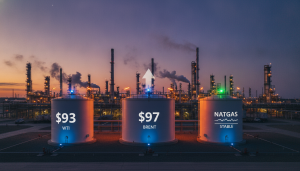
Consider the recent trajectory of crude oil. As of today, Brent Crude trades at $93.93, reflecting a modest daily gain of 0.74%, with WTI Crude mirroring this stability at $90.35. However, this current snapshot belies the significant volatility of the past weeks. Our proprietary data shows Brent crude experienced a notable retreat, falling from $118.35 on March 31st to $94.86 just yesterday, representing a nearly 20% decline in under three weeks. This sharp correction underscores the market’s sensitivity to headlines and perceived demand shifts, yet the underlying structural issues remain.
This recent price “containment” is precisely what makes the current moment so intriguing. The market is absorbing various shocks, but the core issue of insufficient upstream capital expenditure persists. This scenario directly addresses a key question many of our readers are asking: “is WTI going up or down?” While short-term fluctuations are inevitable, the long-term outlook for crude, particularly towards the end of 2026, appears increasingly bullish due to these supply constraints. The asymmetry here is compelling: limited downside due to structural undersupply, but potentially massive upside if demand holds and geopolitical risks manifest into tangible supply disruptions.
Natural Gas: The Unsung Hero of Inflationary Pressures
If crude oil provides the foundational energy spark, natural gas often acts as the accelerant, particularly in the current global energy paradigm. The natural gas market, especially in Europe, is remarkably tighter than many observers realize. European benchmark gas prices have recently exhibited significant volatility, with sharp single-session leaps underscoring the market’s fragility. A substantial portion – around 15% – of global Liquefied Natural Gas (LNG) flows, much of it originating from Qatar, transits critical chokepoints in the Gulf. With Europe having largely replaced Russian pipeline gas with seaborne LNG, any sustained interference with these crucial shipping routes could have dramatic consequences.
Analysts are increasingly warning that such disruptions could propel European gas prices towards €80–100 per MWh, effectively doubling current levels. This would not merely impact energy bills; it would act as a powerful inflation multiplier across the continent, affecting industrial production, consumer prices, and broader economic stability. Our proprietary insights confirm that global storage levels for natural gas are lower year-on-year, and elevated speculative short positions create ripe conditions for a significant short-covering rally should any supply shock materialize. This fundamental tightness, coupled with geopolitical vulnerabilities, positions natural gas as a commodity with explosive potential, often overlooked by capital flowing into other sectors.
Upcoming Catalysts: Events Shaping the 2026 Outlook
For investors focused on the next 12-24 months, monitoring key calendar events is crucial, as these can serve as significant catalysts for price discovery and market sentiment. The immediate horizon offers several such opportunities that could influence the trajectory of both oil and natural gas, impacting their 2026 performance.
On April 21st, the OPEC+ JMMC Meeting is scheduled. This gathering of the Joint Ministerial Monitoring Committee will offer critical insights into the alliance’s production policy, particularly against the backdrop of recent price volatility and global demand concerns. Any signals regarding supply adjustments could significantly sway crude markets. Following closely, investors will be keenly watching the EIA Weekly Petroleum Status Reports on April 22nd and April 29th, alongside the API Weekly Crude Inventory reports on April 28th and May 5th. These regular data releases provide indispensable snapshots of U.S. crude oil, gasoline, and distillate inventories, offering real-time indicators of demand and supply balances that can trigger immediate price reactions.
Further shaping the supply side, the Baker Hughes Rig Count on April 24th and May 1st will indicate drilling activity levels, providing a forward-looking signal for future production capacity. However, perhaps the most significant forward-looking event in the near term is the EIA Short-Term Energy Outlook (STEO) due on May 2nd. This comprehensive report from the U.S. Energy Information Administration will provide updated forecasts for supply, demand, and prices across various energy commodities, extending well into 2026. The STEO is a bellwether publication that can solidify or challenge prevailing market narratives, directly influencing investor confidence and positioning for the longer term. These upcoming events, when viewed through the lens of structural underinvestment, represent potential flashpoints for price acceleration.
Shifting Tides: Investor Sentiment and the Rotation into Hard Assets
Our first-party intent data reveals a consistent theme among OilMarketCap readers: a deep curiosity about future price direction, particularly “what do you predict the price of oil per barrel will be by end of 2026?” This question underscores a broader market sentiment where energy, despite its fundamental importance, has been largely ‘underowned’ and ‘underestimated’ compared to the high-flying valuations seen in artificial intelligence and mega-cap technology stocks over the past year. This capital misallocation has left energy futures positioning reflecting a degree of complacency, even as the underlying supply-demand dynamics tighten.
This current environment bears striking resemblance to historical moments before major commodity bull cycles. Much like gold quietly building pressure beneath the surface eighteen months before its historic breakout, oil and natural gas today are exhibiting similar characteristics: dismissed by mainstream capital, yet fundamentally robust. The decisive variable for the broader macro economy, and consequently for hard asset performance, hinges on whether crude oil prices remain contained. If energy prices break out decisively, inflation is likely to resurge, triggering a significant and potentially rapid capital rotation into hard assets. This rotation would not only benefit the commodities themselves but also the upstream energy companies, addressing questions like “How well do you think Repsol will end in April 2026” by providing a tailwind for their valuations as their underlying assets appreciate.
The opportunity for strong returns in 2026 is not hidden in complex financial instruments or esoteric strategies. It is visible in the fundamental realities of global tanker routes, LNG terminal utilization, and the stark numbers reflecting barrels of oil and cubic meters of gas. The volatility in energy markets is already on the rise; the crucial question for investors is whether they are positioned to benefit before this inevitable repricing accelerates and consensus finally catches up. The message is becoming clearer: momentum is building, capital is poised for rotation, and 2026 may indeed prove to be the year energy commodities outperform other major asset classes.