Market Plunge Signals Deepening Bearish Sentiment
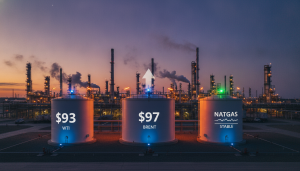
The global crude market is grappling with a confluence of bearish drivers, leading to significant price erosion and amplifying the risk of WTI falling below the $50 per barrel mark. As of today, Brent Crude trades at $90.38, registering a sharp 9.07% decline within the day, with its range spanning $86.08 to $98.97. Similarly, WTI Crude has plunged to $82.59, down a substantial 9.41% from its open, trading within a day range of $78.97 to $90.34. This dramatic single-day sell-off extends a clear downtrend observed over the past two weeks, where Brent alone has shed nearly 20%, plummeting from $112.78 on March 30th to its current $90.38. This sustained pressure reflects a fundamental shift in market psychology, driven by receding geopolitical risk premiums and an increasingly skeptical view on global demand resilience.
A significant factor in the contracting risk premium has been the de-escalation of key geopolitical flashpoints. Reports of a ceasefire agreement in Gaza and the confirmed upcoming summit between U.S. President Trump and Russian President Putin have largely removed a substantial amount of perceived supply risk from the market. While geopolitical events can rapidly shift, the current environment has allowed traders to shed some of the premium previously baked into crude prices, further contributing to the rapid descent we’ve witnessed.
Structural Oversupply and Softening Demand Weigh Heavily
Beyond the geopolitical landscape, the core supply-demand fundamentals paint an increasingly bleak picture for oil prices. The International Energy Agency (IEA) has reiterated its forecast for a substantial global oil surplus, potentially reaching 4 million barrels per day by 2026. While the agency acknowledged a 1.47 million bpd discrepancy in its August data, leading to some skepticism regarding precise balances, the overarching sentiment remains bearish due to persistent oversupply concerns. This structural surplus is exacerbated by growing reliance on “shadow fleet” crude from sanctioned producers, which continues to find its way into the market, adding to global inventories and undermining efforts by compliant producers to manage supply.
Compounding the issue are clear signs of weakening demand from major economies. Renewed trade tensions between the U.S. and China, coupled with new port tariffs, are injecting fresh uncertainty into global trade flows. Sluggish industrial data from key manufacturing hubs worldwide further reinforces fears of a significant slowdown in global consumption. China’s crude imports, a critical barometer for global demand, have shown only modest growth, and broader economic indicators suggest that expectations for a robust demand rebound are now largely muted. Even gasoline prices are reflecting this broader weakness, with our proprietary data showing a 5.18% drop today to $2.93, indicating softening demand at the consumer level.
Upcoming Events: OPEC+ Decisions and Inventory Data in Focus
Investors are keenly focused on upcoming calendar events that could either stabilize or further destabilize the market. Our proprietary reader intent data reveals a keen interest in OPEC+’s next moves, with many asking specifically about “OPEC+ current production quotas.” This question is highly relevant as the Joint Ministerial Monitoring Committee (JMMC) is scheduled to meet on April 19th, followed by the full OPEC+ Ministerial Meeting on April 20th. These meetings will be critical in determining whether the alliance maintains current production levels, deepens cuts, or signals any shift in strategy in response to the recent price declines and persistent surplus forecasts. Any indication of inaction or further increases could send prices spiraling further.
Beyond OPEC+, market participants will closely scrutinize weekly inventory data for immediate supply-demand signals. The API Weekly Crude Inventory reports on April 21st and 28th, followed by the official EIA Weekly Petroleum Status Reports on April 22nd and 29th, will provide crucial insights into U.S. crude stockpiles and refining activity. Furthermore, the Baker Hughes Rig Count on April 24th and May 1st will offer a glimpse into future production trends. These regular data releases are essential for investors seeking to gauge the short-term market balance and will be key determinants of immediate price direction. Investors are also looking to the long-term, with many querying “what do you predict the price of oil per barrel will be by end of 2026?” – a question directly impacted by the IEA’s surplus projections and OPEC+’s evolving strategy.
Navigating the Technical Landscape: Downside Risks Intensify
The technical picture for WTI is increasingly challenging, with the current sharp decline pushing the benchmark toward critical support levels. While WTI currently trades at $82.59, significantly above previously observed resistance zones, the sheer velocity of today’s nearly 9.5% drop signals extreme bearish momentum. This rapid descent means that previously considered distant support levels are now coming into sharper focus. The market had recently tested support near $56.15 and attempted a minor reversal, but these efforts have been quickly overshadowed by the renewed selling pressure. The 52-week moving average, a key indicator, has been a robust resistance point, and the market is now unwinding from higher levels.
Analysts are now shifting their attention to new downside targets if the current selling pressure persists. While WTI is far from the $50 mark today, the fundamental headwinds of record output, swelling inventories, and fading geopolitical risk premiums, combined with the current market plunge, create a tangible pathway for further declines. A sustained break below immediate support could accelerate downside momentum, exposing major psychological and technical targets. The risk of WTI revisiting the $50-$55 range, and potentially even breaking below $50 to targets like $47.51, is rapidly increasing, making it imperative for investors to monitor these levels closely.