


Thomas Alva Edison, 1905. Private Collection. Creator: Dochy, Henri (1851-1915). (Photo by Fine Art Images/Heritage Images via Getty Images)
Getty Images
Rising electricity demand from AI data centers and electric vehicles threatens the resiliency of an already strained power grid. But supplying the added demand with the existing grid, an architecture first designed to power lightbulbs, is like eating soup with a fork — you can do it, but there’s a better way.
Ironically, the better way is arguably how Thomas Edison designed the first U.S. commercial power plant back in 1882, which was with direct current electricity that flows in one direction like water through a hose.
AI data centers require massive, concentrated power. What’s at stake is whether the grid can economically support this next era of electrification. Data center server racks run on direct current, even though the utility grid delivers alternating current. That mismatch introduces repeated power conversions, adding cost, complexity and energy loss at a time when utilities and operators are under pressure to deliver more capacity, faster.
The Current Wars
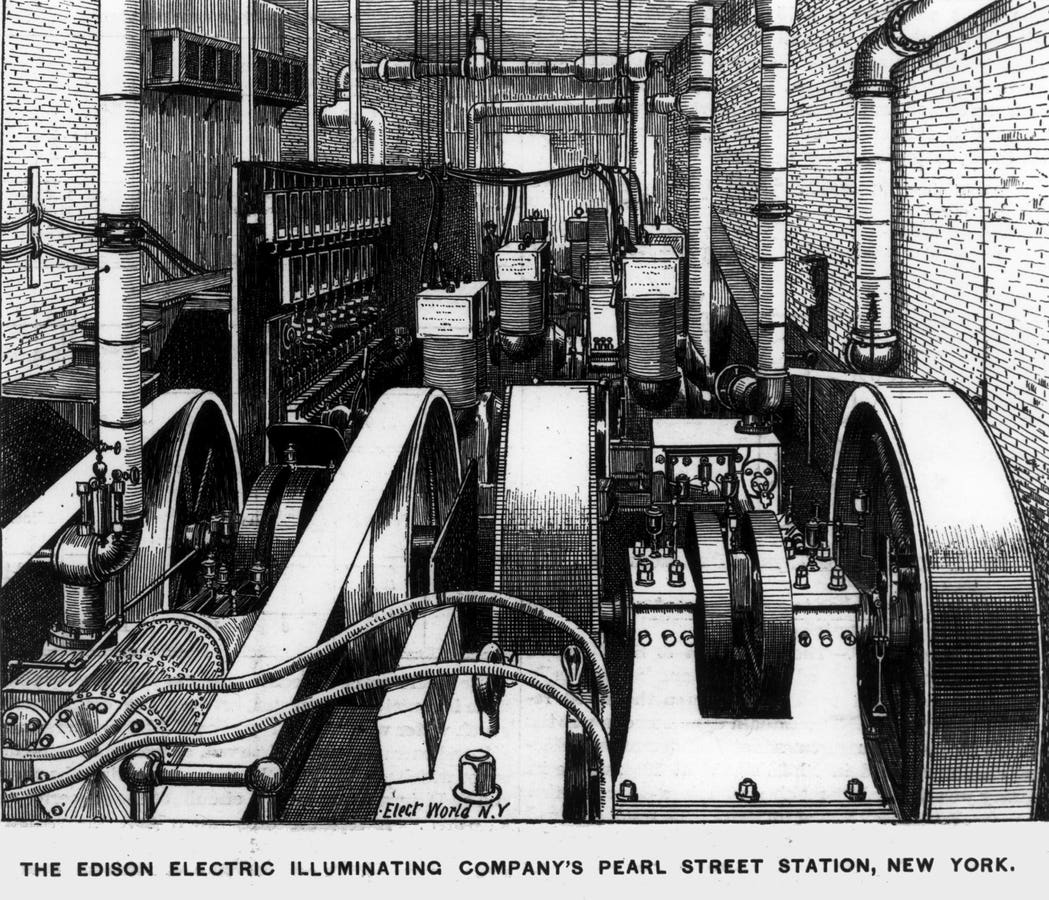
Edison’s Pearl Street Station initially served just two customers, J.P. Morgan and The New York Times, supplying them with the kind of power that data center servers (computers) and electric vehicles need to run today.
Edison’s rival, George Westinghouse, championed alternating current electricity, which rapidly reverses direction back and forth like the ocean tide. That trait let Westinghouse leverage equipment called transformers that allows AC electricity to travel over long distances, setting the stage for a centralized grid.
What followed became known as the Current Wars, a bitter public feud between Edison the inventor and Westinghouse the businessman. Edison even staged the electrocution of Topsy the elephant in 1903 to prove AC’s danger. Westinghouse won the war, and the grid has been running on AC ever since.
The Infrastructure That Never Left
In the decades after the Current Wars, DC faded into the background but never fully disappeared. It quietly persisted in corners of the energy world where DC was simpler, more efficient or both. It was the preferred current for railways, telegraphs and early telephone systems. In the 1970s, low-voltage DC found new life among off-grid enthusiasts, known as back-to-the-earthers, who wired cabins with 12-volt lighting and car batteries long before cleantech microgrids were in fashion. RVs, sailboats and remote outposts ran happily on low-voltage DC.
The straightforwardness of the technology has made it accessible for those without access or simply escaping the utility grid’s reach.
Power adapters or ‘wall warts’ needed to convert utility AC power supply to digital DC power demand
VCG via Getty Images
The Digital Age
Then came the digital age and, without fanfare, DC quietly staged a comeback. Modern electronics are inherently DC based, meaning the alternating current delivered by the grid must always be converted before it can power our digital devices. Every laptop, cell phone, TV and LED bulb converts AC from the wall into DC through tiny bricks and adapters, known as wall warts, scattered under desks and behind couches. Multiply that by billions of devices, and you get an invisible thrum of energy conversions happening all around us, every second of every day.
The rise of solar and batteries over the past two decades made DC’s case even stronger. Solar panels generate DC. Batteries store it. Yet the grid still insists on turning that clean current into AC in order to move it a few feet, only to convert it back again to DC to run our devices. Each step adds inefficiency and cost, a relic of the grid’s 19th century design choices.
Rows of servers fill Data Hall B at the Facebook’s Fort Worth Data Center in Texas. (Paul Moseley/Fort Worth Star-Telegram/Tribune News Service via Getty Images)
TNS
AI Changes The Equation
Now we have reached a turning point, one that could finally rewrite the ending of the Current Wars. For the first time in decades, electricity demand is soaring, driven by AI data centers that run on direct current: Every server training and delivering AI and every battery storage system backing up those servers speak the same electrical language that Edison once championed.
Inside data centers, the mismatch becomes a costly problem. Power from the grid gets converted multiple times between alternating and direct current until it arrives as direct current to the servers that actually use it. Each of these conversions wastes energy, generates heat and eats up valuable computer server rack space.
Speed To Power
Hyperscalers, like Google and Microsoft, which are obsessed with “speed to power” and frustrated by sluggish utilities, are turning to solar and battery storage to provide or augment power. Given that these DC sources power DC loads directly, converting through AC in the middle begins to look absurd.
AI companies like Nvidia are not accepting the status quo but rather actively steering the power industry toward a new paradigm of high-voltage DC. Legacy suppliers as well as a new wave of startups are racing to design the infrastructure for this DC-native world.
The Next Chapter
After more than a century, direct current is no longer a quirky relic. It is becoming the natural current of the AI age. When Edison lit up lower Manhattan, he might never have imagined his current powering fleets of autonomous vehicles or feeding AI clusters the size of city blocks. Yet the technology he championed turns out to be exactly what the digital age demands.
The grid won’t abandon AC, but the frontier of electrification may once again belong to DC. After 140 years, the Current Wars are being fought anew, and this time, Edison just might win.
