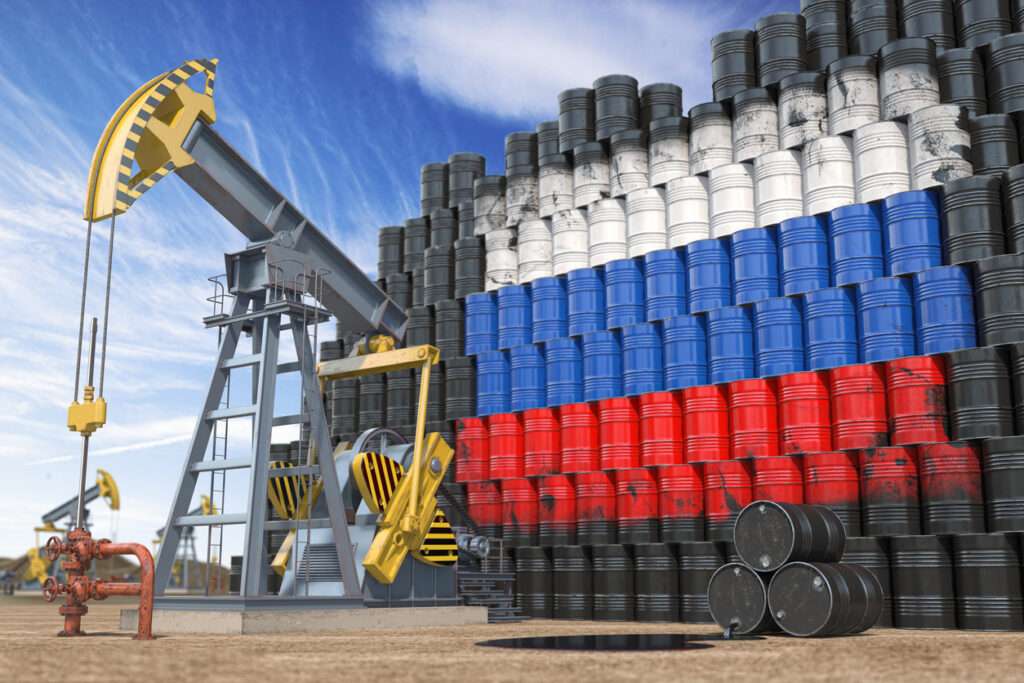
The global oil market is grappling with a significant upheaval as recent U.S. sanctions against Russia’s key energy producers, Rosneft and Lukoil, are creating an unprecedented bottleneck in crude oil exports. This isn’t merely a blip on the radar; it represents a fundamental shift in supply dynamics, with implications reverberating from the Baltic Sea to the bustling refineries of Asia. For investors, understanding the immediate fallout and the long-term strategic adjustments required is paramount, as nearly a third of Russia’s seaborne crude potential now finds itself stranded, prompting a re-evaluation of global energy security and pricing benchmarks.
The Immediate Impact: Stranded Barrels and Widening Discounts
The sanctions have swiftly translated into tangible disruption, with an estimated 1.4 million barrels per day (bpd) of Russian crude oil currently idling on tankers. This substantial volume, representing nearly one-third of Russia’s total exporting capacity, is a direct consequence of buyer hesitation and logistical complexities following the U.S. measures. The ripple effect is clearly visible in the pricing of Russia’s flagship Urals crude. The discount of Urals to Brent has recently widened to an alarming $20 per barrel, marking the highest such spread observed this year. This steep discount reflects the increasing difficulty Russia faces in placing its crude, even among traditionally friendly buyers. As of today, Brent Crude trades at $90.38, marking a significant decline of 9.07% over the last 24 hours. This recent price action, down nearly 20% from its $112.78 peak just weeks ago, underscores a complex market environment where geopolitical supply disruptions are intersecting with broader macroeconomic anxieties, creating volatile trading conditions with Brent experiencing a daily range from $86.08 to $98.97.
Asia’s Dilemma: Navigating Sanctions and Supply Chains
The immediate challenge for Russia’s crude exports is the cautious stance adopted by its largest customers: India and China. These nations have become crucial lifelines for Russian oil since the onset of broader sanctions, but the latest U.S. measures directly targeting entities like Rosneft and Lukoil have introduced a new layer of risk. In India, a significant development sees all but two refiners opting out of placing orders for Russian crude for December deliveries. This widespread avoidance highlights the severe perceived risk of engaging with sanctioned entities, even for nations traditionally eager for discounted oil. Similarly, in China, major state-owned refiners have reportedly suspended their Russian crude purchases. While the independent refiners in Shandong province, often referred to as “teapots,” are less likely to cease imports of the attractively priced crude, the withdrawal of state-backed entities signals a substantial shift in the market for Russian barrels. This hesitation from key buyers forces Russian oil to embark on more circuitous and costly routes, potentially leading to further delays and increased shipping costs, ultimately impacting the global supply chain stability that investors rely on.
Market Volatility and Forward-Looking Indicators
The ongoing disruption to Russian crude flows introduces another layer of uncertainty into an already dynamic global oil market. Investors are keenly watching upcoming events for clearer signals on how this will impact the delicate balance of supply and demand. The OPEC+ Joint Ministerial Monitoring Committee (JMMC) meeting on April 19th, followed by the full OPEC+ Ministerial Meeting on April 20th, will be crucial. With nearly a third of Russia’s seaborne exports under duress, the cartel’s stance on production quotas could shift dramatically. Any indication of adjusted output, whether an increase to compensate for Russian shortfalls or a cut to stabilize prices amidst broader demand concerns, will heavily influence market direction. Additionally, weekly data from the API on April 21st and the EIA Weekly Petroleum Status Report on April 22nd will offer vital insights into U.S. inventory levels and demand trends, providing a critical counterpoint to the Russian supply issues. Further out, the Baker Hughes Rig Count on April 24th and May 1st will indicate future supply potential from North America, a key factor in assessing global production capacity. These forthcoming data points and meetings are critical for investors to gauge the true extent of market rebalancing in the wake of Russian export challenges.
Investor Sentiment and Strategic Positioning Amidst Uncertainty
The current market environment, characterized by geopolitical shocks and significant price movements, naturally sparks fundamental questions among investors. Many are grappling with the core inquiry: ‘Is WTI going up or down?’ and seeking predictions for ‘the price of oil per barrel by the end of 2026?’ The turbulence surrounding Russian crude flows adds significant complexity to these forecasts. While the immediate effect of sanctions is a reduction in available supply, the significant decline in Brent crude prices over the past two weeks suggests that broader market concerns, possibly related to global economic growth or demand outlook, are also exerting strong downward pressure. WTI Crude, currently at $82.59, down 9.41% today, reflects similar investor anxiety, trading in a wide daily range of $78.97 to $90.34. For investors, this moment calls for strategic positioning and heightened vigilance. Monitoring geopolitical developments, anticipating OPEC+ decisions, and meticulously analyzing inventory and production data will be critical. The long-term implications of these sanctions could fundamentally redraw global energy trade routes, redefine pricing benchmarks, and shift the balance of power in the international oil market, making informed, data-driven decisions more important than ever for navigating the path ahead.