The United Kingdom is on a collision course with a significant energy security challenge in the 2030s, particularly concerning natural gas supply. A recent assessment by the National Energy System Operator (NESO) highlights an emerging risk of gas shortages, driven by a dramatic decline in domestic production and an increasing reliance on imports. This isn’t merely a geological inevitability; industry bodies point to government policy as a primary accelerant of this trend. For investors, this situation presents a complex interplay of long-term structural risks, immediate market volatility, and the strategic implications of energy policy on capital allocation in the North Sea and beyond.
The Looming Gas Supply Deficit
NESO’s inaugural Gas Security of Supply Assessment, covering the winters from 2030 to 2036, paints a concerning picture for Great Britain’s energy future. While normal weather conditions are unlikely to trigger immediate shortages, the report identifies a clear and emerging risk under “1-in-20-year peak demand scenarios.” This vulnerability is especially pronounced where decarbonization efforts lag, keeping gas demand high. More critically, the assessment warns that in the “unlikely event of the loss of the single largest piece of gas infrastructure,” supply would fall short of demand expectations across all pathways as early as 2030/31, even if all other infrastructure remains operational. This underscores a significant structural fragility in the UK’s energy system, a stark contrast to the historical role of the UK Continental Shelf (UKCS) as a robust domestic supplier. The long-term natural decline of UKCS production, a trend evident since the early 2000s, is accelerating, making the UK increasingly dependent on pipeline imports from Norway and Europe, as well as LNG cargoes.
Policy-Driven Production Plunge and Market Realities
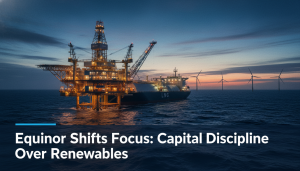
The decline in UK oil and gas production is not a gradual, unavoidable fade but rather an accelerated fall, heavily influenced by government policy. Offshore Energies UK (OEUK) notes that domestic oil and gas production has plummeted by 40% in the last five years and is projected to halve again by 2030. OEUK attributes this sharp downturn to policies such as the ban on new exploration projects and the punitive Energy Profits Levy (EPL), often termed a windfall tax, which has not seen reforms despite industry calls. This challenging fiscal and regulatory environment directly impacts investment decisions. While the broader global energy market remains dynamic, the specific conditions in the UK make it a less attractive prospect for new capital. As of today, Brent Crude trades at $95.49, holding steady with a marginal 0.01% gain, while WTI Crude is at $87.29, down slightly by 0.15%. This current stability, however, follows a significant downturn, with Brent having dropped by nearly 20% from $118.35 just two weeks ago to $94.86 yesterday. Such volatility, coupled with a punitive tax regime, severely diminishes the appetite for the long-term, high-capital commitments required for North Sea exploration and development, effectively pushing investment away from the UK and further exacerbating the domestic supply shortfall.
Investor Sentiment, Global Dynamics, and Upcoming Events
Our proprietary reader intent data reveals a keen investor focus on price trajectory and company performance. Questions like “is WTI going up or down?” and “what do you predict the price of oil per barrel will be by end of 2026?” dominate current inquiries, indicating a strong emphasis on immediate and medium-term market movements. This short-term price obsession often overshadows the longer-term structural issues like the UK’s emerging gas shortage. However, these broader market dynamics are inextricably linked. The upcoming OPEC+ JMMC Meeting on April 21st, followed by regular EIA Weekly Petroleum Status Reports and Baker Hughes Rig Counts, will be critical in shaping global supply expectations and, consequently, crude prices. A decision by OPEC+ to maintain or deepen supply cuts could push prices higher, potentially providing a marginal incentive for investment in higher-cost basins. Conversely, an easing of cuts could depress prices, making the already challenging economics of UK North Sea projects even less viable. For investors assessing European energy companies or those with exposure to the UK, understanding how these global forces intersect with the distinct policy headwinds in Britain is paramount. The long-term outlook for gas prices and supply security in the UK will directly impact the profitability and strategic positioning of entities operating within or supplying to the region.
Strategic Imperatives and Investment Pathways
NESO’s report outlines a combination of measures necessary to mitigate the emerging security of supply risks. These include reducing peak day gas demand through accelerated decarbonization, maximizing peak day supply from existing infrastructure, and crucially, developing new gas supply infrastructure. Each of these pathways presents distinct investment opportunities and challenges. Decarbonization initiatives, such as electrification of heating and industrial processes, will drive demand for renewable energy projects, smart grid technologies, and energy efficiency solutions. Maximizing output from existing gas infrastructure, while a short-term fix, might involve investments in maintenance and optimization to extend field life. However, the most direct solution to the impending shortfall – developing new gas supply infrastructure – faces significant hurdles due to the current policy landscape. Investors looking for long-term returns in the UK energy sector must navigate this complex environment, weighing the government’s decarbonization ambitions against the immediate imperative of energy security. Without a clear and consistent policy framework that encourages investment in both traditional and transitional energy infrastructure, the UK risks not only a future gas shortage but also missing out on the capital required to secure its energy future.