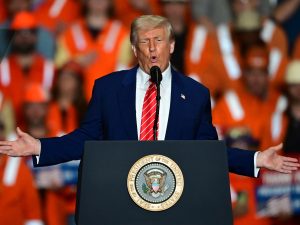
The specter of a significant trade conflict looms large as former U.S. President Donald Trump has signaled his intent to impose a sweeping 50 percent tariff on all European Union goods. This aggressive stance, announced via his social media platform, threatens to ignite a substantial economic skirmish, effective June 1, citing stalled negotiations with the 27-member bloc. For investors navigating the volatile landscape of oil and gas markets, this development introduces a new layer of macroeconomic uncertainty that demands close attention.
Trump’s Tariff Ultimatum: A Disruption to Global Trade
The proposed 50 percent import duty represents a dramatic escalation from previous trade rhetoric and actions. Trump explicitly stated his belief that talks with the EU were “going nowhere,” leading him to recommend this substantial levy. This move follows a period earlier in April where a 20 percent tariff on most EU goods was initially floated, subsequently reduced to 10 percent with an expiration date of July 8, ostensibly to allow for further dialogue. However, the latest pronouncement suggests a hardening of positions.
In a subsequent address from the Oval Office, the Republican leader underscored his uncompromising stance, declaring, “I’m not looking for a deal. We’ve set the deal. It’s at 50 percent.” He further hinted that any delay in implementing these tariffs would hinge on European companies committing to significant new investments within the United States. This aggressive posture indicates a transactional approach to international trade relations, where economic leverage is paramount.
The rationale behind Trump’s renewed push for tariffs centers on what he perceives as “unfair” existing trade frameworks. He has consistently voiced complaints that the European bloc benefits disproportionately, selling more goods to the U.S. than it imports. Should the 50 percent tariff come to fruition, it would place European exports at a significant disadvantage, imposing higher import taxes on hundreds of billions of dollars worth of goods compared to China, whose tariffs were recently reduced to facilitate ongoing negotiations between Washington and Beijing.
EU Vows Defense Amidst Mounting Pressure
In response to Trump’s threat, European Union officials have swiftly affirmed their commitment to defending the bloc’s interests. Maros Sefcovic, the EU’s top trade representative, conveyed through social media that he engaged in discussions with U.S. Trade Representative Jamieson Greer and Commerce Secretary Howard Lutnick on the matter. Sefcovic emphasized the EU’s full engagement and dedication to securing a mutually beneficial agreement, asserting that transatlantic trade, unparalleled in its scope, “must be guided by mutual respect, not threats.” He concluded with a resolute declaration: “We stand ready to defend our interests.”
European leaders have echoed this sentiment, cautioning that such tariffs would inflict damage on both sides of the Atlantic. German economy minister Katherina Reiche underscored the imperative of achieving a negotiated settlement with the United States. French foreign minister Laurent Saint-Martin, while expressing a preference for de-escalation, made it clear that the bloc is “ready to respond” should the tariffs be enacted. This collective stance signals the EU’s readiness to engage in counter-measures, potentially leading to a tit-for-tat trade war that could have far-reaching global economic consequences.
Implications for Oil and Gas Investors
For investors focused on the oil and gas sector, the prospect of a major U.S.-EU trade war introduces several critical considerations. Global trade tensions inherently dampen economic growth projections. Reduced trade volumes, disrupted supply chains, and increased costs for businesses on both continents typically translate into slower industrial activity and diminished consumer spending. This deceleration in economic momentum directly impacts global energy demand, potentially putting downward pressure on crude oil and natural gas prices.
Specifically, the manufacturing sectors in both the EU and the U.S. are significant consumers of industrial fuels and natural gas. Tariffs that elevate production costs or reduce market access could lead to factory slowdowns or relocations, thereby decreasing demand for these energy commodities. Furthermore, a contraction in international trade would inevitably reduce shipping activity, impacting demand for bunker fuels and diesel, which are vital components of global logistics. Energy companies with extensive transatlantic operations or supply chains could face direct cost increases and logistical headaches, affecting their profitability and operational efficiency.
Beyond direct demand impacts, increased geopolitical friction and economic uncertainty can trigger broader market volatility. While a direct supply shock to oil markets is not the immediate concern, the overall sentiment among investors can shift dramatically. A flight from risk assets, including energy equities, is a common reaction to such instability. Currency fluctuations, often exacerbated by trade disputes, can also influence dollar-denominated commodity prices like crude oil, adding another layer of complexity for portfolio managers.
Market Reaction and the Path Forward
The immediate reaction to Trump’s tariff threats was palpable across global financial markets. U.S. equities saw a decline, with the S&P 500 index falling approximately 0.8 percent. European markets experienced an even sharper downturn, as the pan-European STOXX 600 index registered a drop of about 1.2 percent. These movements underscore investor apprehension regarding the potential economic fallout from a full-blown trade conflict, highlighting concerns about corporate earnings, consumer confidence, and overall economic stability.
Adding to the pressure, Trump also issued a separate warning regarding U.S. tech giant Apple, suggesting a potential 25 percent import tax on all iPhones sold in the U.S. but not manufactured domestically. This move signals a broader protectionist agenda that extends beyond traditional goods to encompass global technology supply chains, further unsettling market participants.
As the June 1 deadline approaches, oil and gas investors must closely monitor diplomatic efforts between the U.S. and EU, as well as any indications of retaliatory measures from Europe. The ultimate implementation of these tariffs, or any negotiated resolution, will significantly shape the global economic outlook and, consequently, the trajectory of energy demand and commodity prices. The unfolding trade drama represents a critical geopolitical risk factor that demands vigilant analysis in the current investment climate.