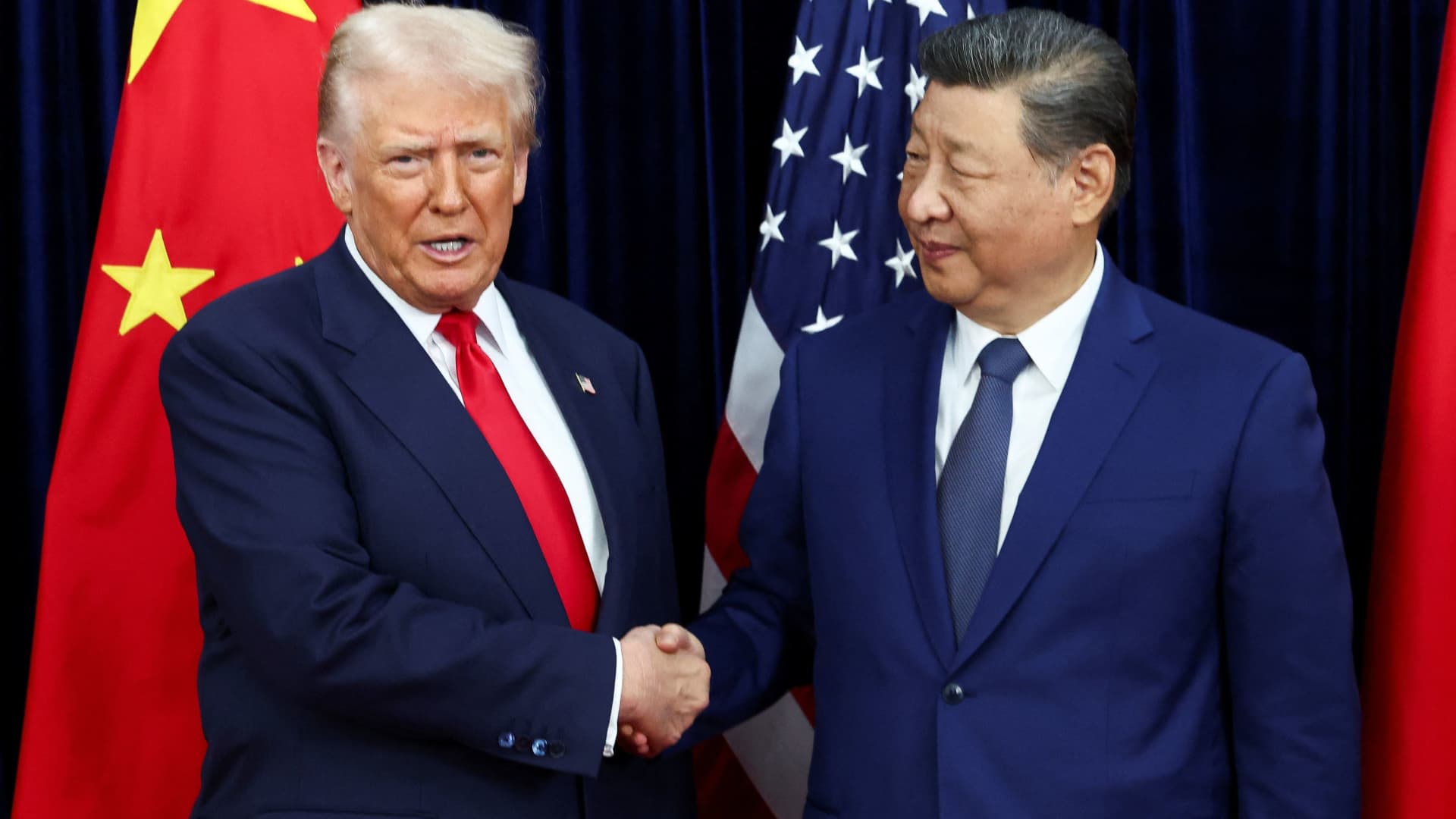
The global oil and gas market often dances to the tune of geopolitical rhythms, and the recent trade truce between President Donald Trump and President Xi Jinping in South Korea has certainly struck a complex chord. While the immediate market reaction presents a nuanced picture, this de-escalation of tensions over critical rare earth elements and broader trade disputes fundamentally reshapes the demand outlook for crude, providing a crucial, albeit fragile, pillar of support for energy investors. This analysis dives into the implications of this ‘uneasy truce’ for crude prices, upcoming market events, and the long-term investment horizon, leveraging OilMarketCap’s proprietary data to offer unique insights.
Immediate Market Reaction and Underlying Dynamics
The agreement between the U.S. and China has temporarily defused a potentially catastrophic trade war, particularly concerning China’s sweeping export controls on rare earths. Key components of this truce include a one-year pause on these export controls, a reduction in U.S. tariffs on Chinese fentanyl from 20% to 10%, the postponement of a U.S. rule blacklisting Chinese subsidiaries, and China’s commitment to purchase significant agricultural products, specifically 25 million metric tons of soybeans annually for three years. Additionally, both nations agreed to suspend fees on ships docking in each other’s ports for one year. This broad-based de-escalation, while not a comprehensive resolution, removes a significant layer of uncertainty that had clouded global economic growth projections.
Despite the ostensibly positive news of eased trade tensions, the immediate market reaction for crude has been bearish. As of today, Brent Crude trades at $90.38, reflecting a substantial 9.07% decline within the day, with its range fluctuating between $86.08 and $98.97. Similarly, WTI Crude stands at $82.59, marking a 9.41% drop, having traded between $78.97 and $90.34. Gasoline prices have also followed suit, falling to $2.93, down 5.18%. This current volatility, however, must be viewed in context. Our proprietary 14-day Brent trend data indicates a significant downturn from $112.78 on March 30 to today’s $90.38, representing a $-22.4 or -19.9% correction. This suggests that broader macroeconomic concerns, potential oversupply narratives, or perhaps profit-taking after recent highs are currently dominating market sentiment. The trade truce, therefore, acts less as an immediate catalyst for price appreciation and more as a critical mitigating factor, preventing an even steeper decline by removing a major demand-side downside risk and offering a more stable fundamental outlook moving forward.
Navigating Future Volatility: Upcoming Events and Strategic Implications
Looking ahead, the trade truce provides a more stable backdrop for several critical energy market events on our calendar. Investors should closely monitor the upcoming OPEC+ Joint Ministerial Monitoring Committee (JMMC) Meeting on April 19, followed by the full OPEC+ Ministerial Meeting on April 20. A more predictable global demand environment, bolstered by the U.S.-China detente, could influence OPEC+’s decisions regarding production quotas. While the recent price declines might typically prompt calls for deeper cuts, the removal of a major geopolitical risk could lend OPEC+ members more confidence in the long-term demand trajectory, potentially reducing the urgency for drastic supply adjustments. Any signals from these meetings will be paramount for short-to-medium term price direction.
Further insights into market balance will come from the API Weekly Crude Inventory reports on April 21 and 28, and the EIA Weekly Petroleum Status Reports on April 22 and 29. A stabilized trade relationship between the world’s two largest economies should, over time, translate into stronger industrial activity and transportation demand, which will be reflected in inventory draws. The Baker Hughes Rig Count, scheduled for April 24 and May 1, will also offer a pulse on U.S. production response. If the truce holds and economic activity improves, we could see a more robust recovery in drilling activity, although current lower prices might temper immediate enthusiasm. Investors should also note the planned visits of President Trump to China in April and President Xi to the U.S. later. These high-level engagements will be crucial in determining whether this truce evolves into a more comprehensive deal or remains an uneasy ceasefire, with direct implications for long-term demand stability.
Investor Sentiment and the Long-Term Oil Price Trajectory
Our first-party intent data from OilMarketCap readers reveals a strong appetite for forward-looking analysis, with a recurring question being, “what do you predict the price of oil per barrel will be by end of 2026?” This long-term perspective is precisely where the Trump-Xi truce offers its most significant value. While the immediate market is reacting to various factors, a stable U.S.-China relationship is foundational for global economic growth and, consequently, for sustained oil demand. The rare earths agreement and tariff reductions, even if temporary, inject a much-needed dose of certainty into the global supply chain and manufacturing outlook, providing a potential floor for longer-term price predictions by mitigating the risk of demand destruction from an escalating trade war.
Another prevalent query among our readers concerns “OPEC+ current production quotas.” The stability offered by the truce gives OPEC+ more reliable data points when assessing the global supply-demand balance. With reduced geopolitical noise from the U.S.-China front, the cartel can focus more acutely on fundamental market signals, potentially leading to more adaptive and effective quota adjustments. For investors holding positions in integrated energy companies like those inquired about (e.g., Repsol), a more predictable global trade environment is broadly positive. Such companies benefit from stable demand for both crude and refined products. The current dip in gasoline prices, while significant today, could be viewed as a temporary adjustment, with the underlying demand story improving as trade tensions ease. While the truce is not a panacea, it significantly reduces a major source of systemic risk, allowing investors to shift focus from geopolitical anxiety to core supply-demand fundamentals and the adaptive strategies of key producers.


