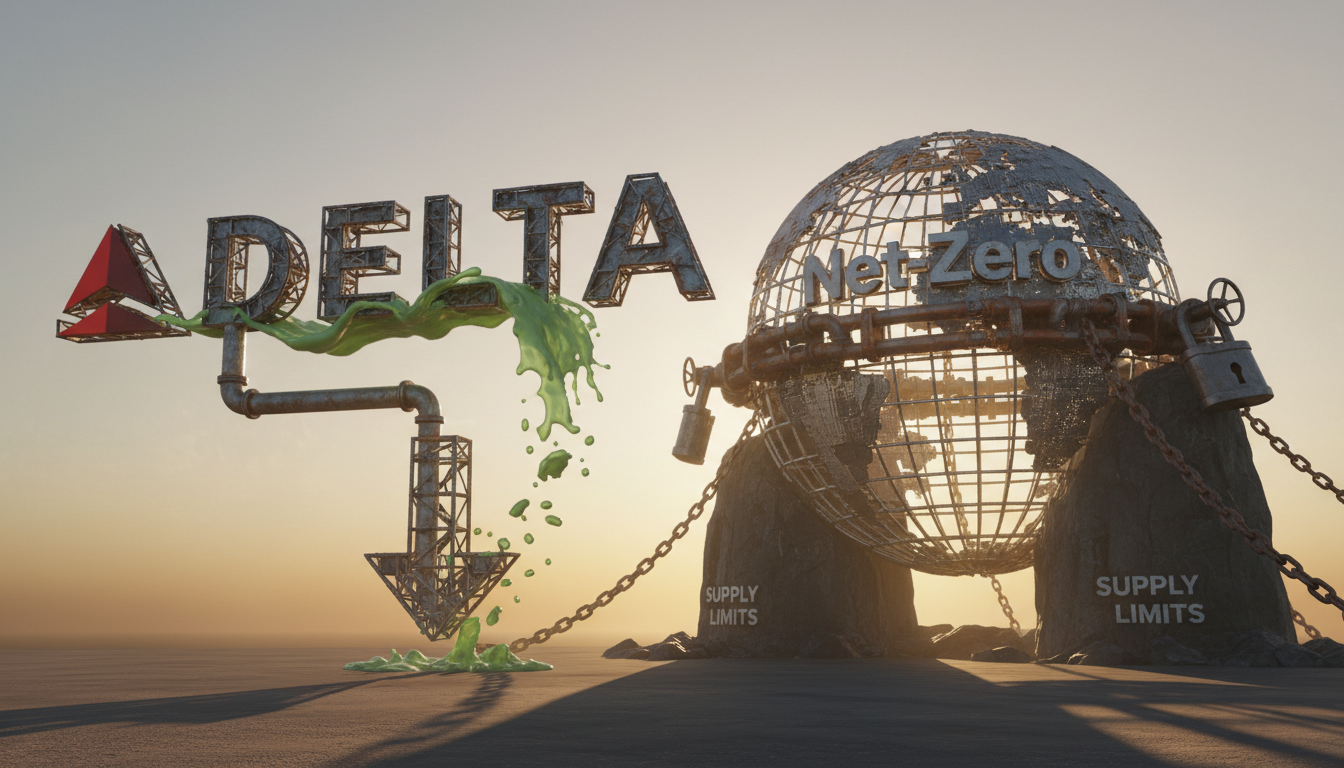
A recent recalibration of climate commitments by a major U.S. airline sends a strong signal across the energy transition landscape, particularly for the oil and gas sector. Delta Air Lines has quietly adjusted two pivotal environmental objectives, casting a new light on the challenges and realities of decarbonizing hard-to-abate industries like aviation. Investors and industry observers are closely examining these shifts, which impact everything from future jet fuel demand to the viability of sustainable aviation fuel (SAF) production at scale.
The airline revised its ambitious target to procure 10% of its jet fuel from SAF by 2030, effectively removing this specific benchmark. Simultaneously, its long-term aspiration for net-zero emissions by 2050 has been reclassified from a firm goal to an “aspiration.” These changes, subtly updated on Delta’s corporate sustainability disclosures, carry substantial implications for capital allocation, energy policy, and the trajectory of aviation’s environmental commitments.
The Stark Economics of Sustainable Aviation Fuel
Sustainable aviation fuel has long been heralded as the most direct route for airlines to significantly reduce their carbon footprint. Derived from diverse feedstocks such as used cooking oil, agricultural waste, or even municipal solid waste, SAF promises substantial lifecycle greenhouse gas reductions compared to traditional kerosene-based jet fuel. However, the commercial rollout of SAF continues to face formidable economic and logistical hurdles.
The primary barrier remains cost. Current market prices for SAF range dramatically, typically between two and five times higher than conventional jet fuel. This significant premium presents an immense challenge for airlines operating in a highly competitive, margin-sensitive industry. For oil and gas investors, this disparity highlights a fundamental market inefficiency where environmental benefits are not yet adequately priced into the commodity. The production capacity for SAF also lags considerably behind the ambitious targets set by the aviation industry, creating a supply-side bottleneck that further exacerbates cost pressures and limits widespread adoption.
A spokesperson for the airline acknowledged the central role SAF plays in their long-term decarbonization strategy but underscored that the slow pace of its commercial development poses a genuine threat to the broader industry’s climate objectives. This tension between environmental ambition and economic reality is increasingly evident in corporate disclosures, prompting a re-evaluation of expected timelines for the energy transition within aviation.
Industry-Wide Pressures Mount on Decarbonization Pathways
Delta’s strategic adjustments are not isolated. The global aviation sector, which contributes approximately 2% to 3% of worldwide emissions, has been under intense scrutiny to align with international climate frameworks while safeguarding profitability and operational efficiency. In 2021, member airlines of the International Air Transport Association (IATA) collectively committed to achieving net-zero emissions by 2050. This ambitious pathway heavily relies on a massive scale-up of SAF production, alongside the introduction of more fuel-efficient aircraft and advanced propulsion technologies.
However, the execution of these plans has proven more challenging than initially projected. Willie Walsh, IATA’s Director General, explicitly warned earlier this year about market distortions stemming from shortages of new, more efficient aircraft and the constrained availability of alternative fuels. This environment allows suppliers to capitalize on limited capacity, forcing airlines to contend with escalating costs and delayed access to the critical tools required for their decarbonization strategies. The resulting chasm between aspirational targets and tangible operational progress is becoming increasingly apparent across the industry.
ESG Governance and Disclosure: Investor Scrutiny Intensifies
For investors focused on Environmental, Social, and Governance (ESG) criteria, Delta’s revised commitments raise pertinent questions about target-setting rigor and disclosure integrity. Reclassifying a net-zero target from a defined “goal” to an “aspiration” fundamentally alters the accountability framework, reducing the measurable benchmarks and interim milestones against which progress can be assessed. Similarly, removing a specific SAF adoption target eliminates a key operational metric vital for tracking real-world decarbonization efforts.
These adjustments will likely influence how rating agencies, lenders, and participants in sustainability-linked financing structures evaluate aviation sector risk. This development also reflects a broader trend observed across various industries: companies are recalibrating their climate commitments in response to persistent supply chain disruptions, inflationary cost pressures, and an evolving regulatory and policy landscape. For the oil and gas sector, this signals a potential for prolonged demand for conventional fuels in aviation, alongside the need for clearer policy signals to de-risk investment in alternative fuels.
What Energy Executives and Capital Allocators Should Monitor
For C-suite executives within the oil and gas industry and for sophisticated capital allocators, the message is unequivocal: execution risk associated with climate strategies is increasing, particularly in sectors heavily reliant on nascent technologies and underdeveloped supply chains. Three critical dynamics will define the next phase of this transition:
- Policy Intervention: Governments worldwide will likely need to implement more aggressive policy mechanisms to bridge the substantial cost gap for SAF. This could include mandatory blending quotas, direct subsidies, or advanced tax incentives designed to accelerate production and adoption. Such interventions represent both potential market opportunities and regulatory risks for energy companies.
- Capital Deployment: Substantial, sustained investment into SAF production facilities, innovative feedstock development, and expanded refining capacity will be absolutely essential to achieve economies of scale. The oil and gas sector, with its extensive refining infrastructure and capital allocation capabilities, stands at a critical juncture to either lead or adapt to these investment flows. Co-processing SAF feedstocks in existing refineries or building dedicated greenfield facilities present significant opportunities.
- Transparency and Credibility: Companies that successfully navigate this complex environment will be those that transparently communicate constraints, responsibly adjust their targets when necessary, and align their public disclosures with operational realities. This builds trust with investors and minimizes accusations of greenwashing, especially as the energy transition faces increasing scrutiny.
A Sector at a Crucial Inflection Point for Energy Transition
Delta’s decision underscores a pivotal moment for aviation’s ambitious decarbonization agenda and its implications for the broader energy market. While the collective ambition for a sustainable future remains strong across the industry, the practical timelines are being rigorously tested by challenging economic fundamentals and the slow development of critical infrastructure. For oil and gas companies, this implies that conventional jet fuel will likely remain a dominant energy source for aviation for longer than some projections initially suggested, presenting continued revenue streams but also intensifying pressure to innovate within the sustainability domain.
As supply chain bottlenecks persist and the costs of next-generation fuels remain elevated, the path to net-zero aviation will likely prove more incremental, more capital intensive, and less linear than many stakeholders initially envisioned. For global ESG investors and energy market participants alike, this recalibration serves as a powerful reminder that transition pathways are shaped not only by corporate intent and environmental aspirations but also, fundamentally, by industrial capacity, market dynamics, and the massive scale of capital required to transform a global energy system.


