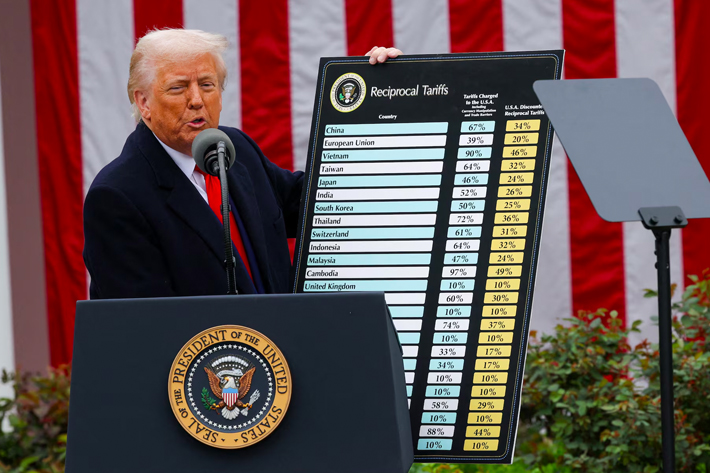
The global energy market is once again confronting a significant wave of policy uncertainty as the White House prepares to petition the Supreme Court this week. The aim is to validate President Donald Trump’s use of ’emergency’ tariffs, a move that comes on the heels of a Federal Appeals Court ruling that deemed their imposition illegal. This legal battle over presidential authority on trade policy casts a long shadow over an already complex geopolitical landscape, forcing oil and gas investors to recalibrate their risk assessments and demand outlooks. The stakes are high, not just for international trade relations, but for the fundamental drivers of energy consumption and pricing in the coming months.
Tariff Tensions and Current Market Volatility
The recent ruling by a federal appeals court, which found Trump’s declaration of a national emergency to justify tariffs under the International Emergency Economic Powers Act (IEEPA) unlawful by a 7-4 vote, has injected considerable legal ambiguity into global trade. This decision challenges the extent of presidential power to impose duties without specific Congressional approval, specifically stating that the 1977 IEEPA statute does not grant unlimited authority for tariffs. This uncertainty directly translates into market jitters, influencing everything from manufacturing output to shipping costs, and inevitably, the global demand for crude oil.
As of today, Brent Crude trades at $90.38, marking a significant 9.07% decline within the day, having fluctuated wildly between $86.08 and $98.97. Similarly, WTI Crude stands at $82.59, down 9.41% for the day, traversing a range of $78.97 to $90.34. This pronounced intraday volatility, coupled with a broader trend seeing Brent drop from $112.78 on March 30 to $91.87 just yesterday, underscores investor unease. While multiple factors contribute to these price swings, the specter of renewed trade disputes and unpredictable policy shifts undoubtedly amplifies market sensitivity. Gasoline prices too reflect this tension, currently at $2.93, a 5.18% drop today within a range of $2.82-$3.1. Investors are keenly watching how this legal drama unfolds, recognizing its potential to either stabilize or further disrupt global economic growth, and by extension, energy demand.
Judicial Crossroads: Implications for Global Trade and Energy
The Supreme Court appeal represents a critical juncture for U.S. trade policy and, consequently, for global energy markets. The administration, with top officials like Treasury Secretary Scott Bessent expressing confidence, expects the conservative-majority court to uphold the use of IEEPA for tariffs. Legal and trade experts acknowledge the court’s 6-3 Republican-appointed majority might slightly improve the odds for the administration to maintain its “reciprocal” and fentanyl-related duties. However, previous legal losses suggest the argument for broad, unwritten regulatory authority under IEEPA faces tough scrutiny. The administration seeks an expedited ruling, with President Trump warning of “devastation” if the duties are struck down, emphasizing the urgency of the matter. The tariffs are set to remain in place at least until October 14, providing a window for the government to file its appeal.
For investors, the outcome will dictate the predictability of international trade. A ruling in favor of the administration could signal an era of heightened trade friction, potentially disrupting supply chains and dampening global economic growth, thus suppressing long-term oil demand. Conversely, a ruling against the tariffs could bring greater certainty to trade relations, potentially bolstering economic activity and providing a clearer demand outlook. The energy sector, heavily reliant on stable global trade for both upstream and downstream activities, will be among the most impacted by the clarity, or lack thereof, emerging from this judicial review.
Navigating Upcoming Catalysts Amidst Policy Uncertainty
The ongoing legal battle over tariffs compounds an already complex calendar of market-moving events for the energy sector. Investors are not only grappling with the judicial outcome but also with critical fundamental data releases and strategic decisions from major producers. This weekend features crucial OPEC+ Meetings, with the Joint Ministerial Monitoring Committee (JMMC) convening today, April 18, followed by the Full Ministerial meeting tomorrow, April 19. Any decisions on production quotas made by this influential group will be weighed against the backdrop of potential trade wars and their impact on global demand projections. Our proprietary data indicates a high level of investor interest in “OPEC+ current production quotas,” reflecting the market’s need for supply-side clarity.
Beyond OPEC+, the coming weeks are packed with key data points that will further inform market direction. The API Weekly Crude Inventory reports are due on April 21 and April 28, followed by the EIA Weekly Petroleum Status Reports on April 22 and April 29. These inventory figures will be crucial barometers of demand, especially as the market tries to discern the real-world impact of trade policy uncertainty. Furthermore, the Baker Hughes Rig Count, scheduled for April 24 and May 1, will offer insights into upstream activity and future supply trends, which could be influenced by investor confidence in a stable global economic environment. The interplay between these fundamental catalysts and the looming Supreme Court decision creates a dynamic and challenging environment for forecasting, demanding heightened vigilance from all participants.
Investor Sentiment and Strategic Outlook
Our proprietary reader intent data reveals a clear desire among investors for forward-looking clarity, with questions ranging from specific company performance like “How well do you think Repsol will end in April 2026” to broader market outlooks such as “what do you predict the price of oil per barrel will be by end of 2026?” This underscores the significant role that macro-level policy, like trade tariffs, plays in influencing investor confidence and strategic planning. The outcome of the Supreme Court’s review of these tariffs will be a pivotal factor in shaping the global economic growth narrative for the remainder of 2026 and beyond, directly impacting demand forecasts for crude oil and refined products.
For oil and gas investors, the current environment demands a nuanced approach. The potential for prolonged trade uncertainty necessitates stress-testing portfolios against various scenarios, including disruptions to supply chains and shifts in global demand patterns. Companies with diversified operations and robust balance sheets may be better positioned to weather potential volatility. Monitoring the Supreme Court’s expedited ruling, along with the upcoming OPEC+ decisions and weekly inventory data, will be essential for making informed investment decisions. The interplay of legal precedent, geopolitical strategy, and fundamental market drivers will continue to define the investment landscape, rewarding those who can skillfully navigate the fog of policy uncertainty.