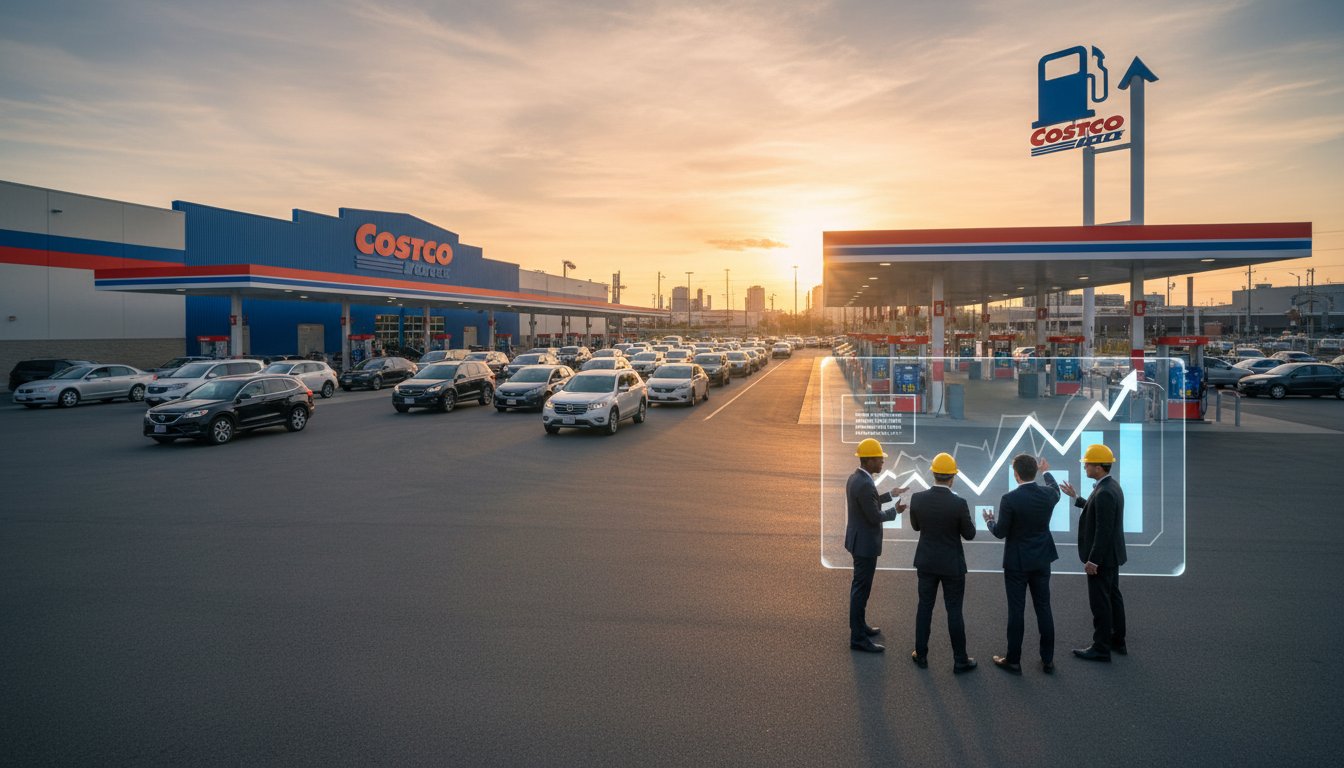
Costco, the retail giant known for its membership-based warehouse model, is embarking on a significant strategic shift within its highly profitable ancillary fuel business. Traditionally, discounted gasoline at Costco locations has served as a powerful magnet, drawing members onto warehouse premises and reinforcing loyalty. Now, the company is piloting standalone, members-only fuel stations, signaling a potential evolution of its footprint in the energy retail sector. This move warrants close attention from oil and gas investors, as it represents a calculated effort to reaccelerate membership growth—a high-margin, predictable revenue stream—by offering an even more convenient and visible demonstration of value, independent of the main warehouse shopping experience. For investors evaluating the broader energy landscape and consumer spending trends, understanding Costco’s play could offer unique insights into resilient business models.
The Strategic Imperative: Fueling Membership Growth
Costco’s foray into standalone fuel stations is a direct response to the need for sustained membership growth, a critical metric for the company’s valuation. While its existing fuel operations are already substantial—comprising roughly 10% of net sales in 2025, with approximately 750 stations selling over 8 billion gallons annually—the new standalone model aims to remove friction for members whose primary need might be fuel. Raymond James analyst Bobby Griffin highlights that Costco’s pumps are typically 20 to 30 cents per gallon cheaper than competitors, a compelling incentive that becomes even more potent during periods of elevated energy prices. This significant price advantage, as noted by commentators like Jim Cramer, could serve as a fresh entry point into the Costco ecosystem, attracting new members who might not otherwise visit a full warehouse. By separating the fuel transaction from the general shopping trip, Costco aims to enhance convenience and amplify its value proposition, potentially unlocking a new segment of membership acquisition.
Market Dynamics and Fuel Retail Profitability
The timing of Costco’s expanded fuel strategy unfolds against a dynamic global energy market. As of today, Brent crude trades at $92.95, reflecting a modest intraday decline of 0.31%, within a daily range of $91.39 to $94.21. WTI crude stands at $89.14, down 0.59%, with its day range between $87.64 and $90.71. For consumers, the national average for regular unleaded gasoline, according to our real-time data, is $3.11 per gallon, showing a slight dip of 0.32% today. While these figures represent a softening from the 14-day Brent trend, which saw prices as high as $101.16 on April 1st before declining by $7.07 to $94.09 by April 21st, they still indicate a market where fuel costs are a significant consumer concern. This sustained pricing environment, particularly against a backdrop where geopolitical tensions have historically propelled prices to multi-year highs, reinforces the attractiveness of Costco’s discount fuel model. The ability to consistently offer fuel at a substantial discount provides a tangible benefit to members, strengthening their loyalty and making the membership fee an even clearer value proposition, thereby bolstering Costco’s financial resilience against broader energy market volatility.
Project Pipeline and Forward-Looking Growth Trajectory
Costco’s new standalone fuel station strategy is currently manifesting in two key pilot projects. The first, a significant 17,000-square-foot facility featuring 40 pumps and multiple underground fuel tanks, is nearing completion in Mission Viejo, California, with a grand opening slated for late June. This site is designed exclusively for fuel sales, without an accompanying warehouse. A second standalone station is under construction in Honolulu, Hawaii, with completion anticipated in 2027. These projects represent crucial test cases for Costco, allowing the company to evaluate the operational efficiencies and membership growth impact of a fuel-only model. For investors, monitoring the performance of these sites will be key to understanding the potential for broader rollout. Looking ahead, the general trajectory of crude oil prices will influence the perceived value and profitability of these operations. Investors will be closely watching upcoming market indicators such as the EIA Weekly Petroleum Status Reports on April 29th and May 6th, and the Baker Hughes Rig Count on May 1st. These reports will offer critical insights into supply and demand dynamics, which in turn affect wholesale gasoline prices and Costco’s ability to maintain its competitive pricing advantage, directly impacting the success and expansion potential of its standalone fuel initiative. Furthermore, the EIA Short-Term Energy Outlook on May 2nd will provide a macro forecast that could shape long-term investment decisions in energy retail.
Investor Sentiment and the Value Proposition
Our proprietary reader intent data highlights a persistent investor focus on the direction of crude oil prices, with common queries including “is WTI going up or down” and “what do you predict the price of oil per barrel will be by end of 2026?” These questions underscore the inherent volatility and speculative nature of the broader energy commodity markets. It is precisely within this environment of price uncertainty that Costco’s fuel strategy presents a compelling case for investors. By offering a predictable, significant discount on a high-demand commodity, Costco effectively hedges its members against some of this volatility, strengthening its core value proposition. This, in turn, underpins the stability and growth potential of its membership revenue, which is less susceptible to the immediate swings of crude futures. While direct exposure to oil price movements can be a high-risk, high-reward play, Costco’s approach leverages these dynamics to fortify a reliable, recurring revenue stream. The ability to attract and retain members through tangible savings at the pump, especially in an era of elevated and fluctuating energy costs, positions Costco’s fuel retail expansion as a shrewd, defensive investment strategy that capitalizes on a fundamental consumer need while bolstering its robust subscription model.