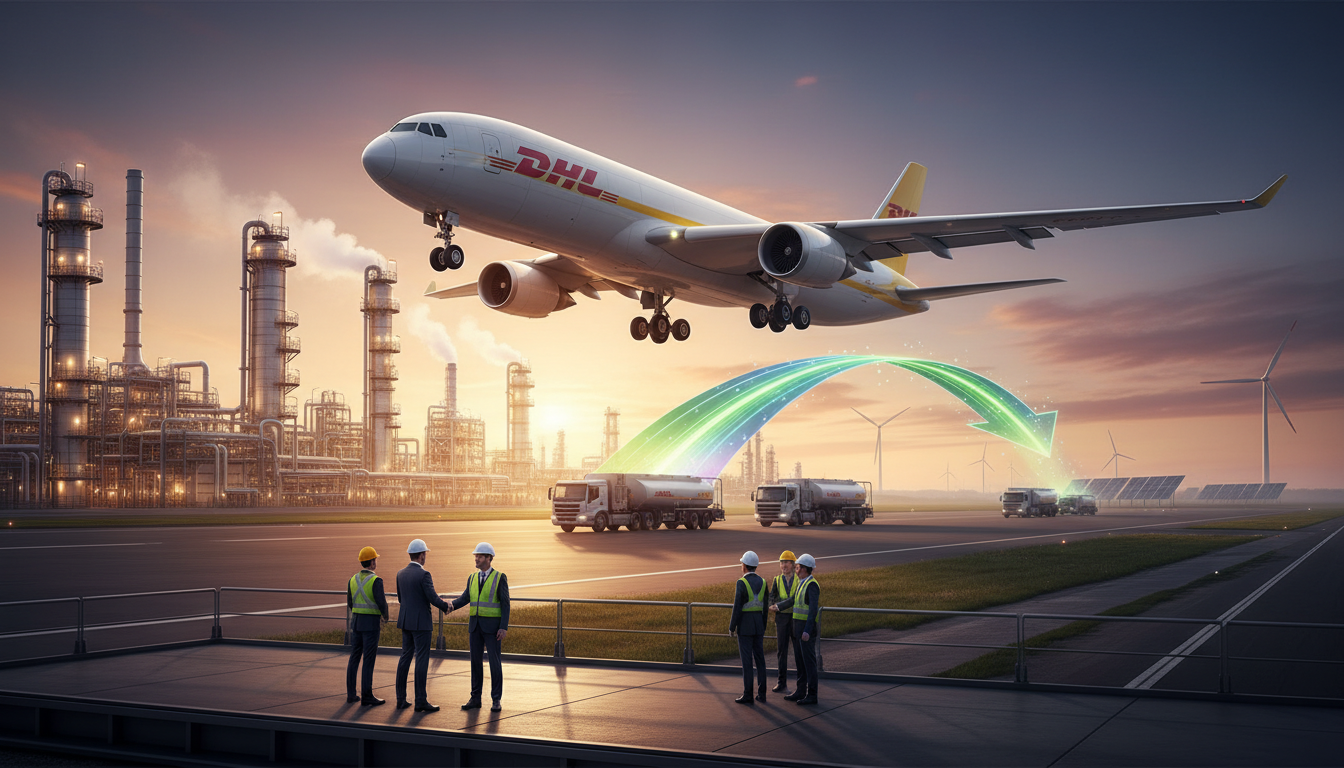
Aviation Giants Ink Landmark SAF Deal, Fueling Investor Interest in Sustainable Energy Transition
A significant five-year pact between logistics powerhouse DHL Express and IAG Cargo, the dedicated freight division of International Airlines Group, signals a pivotal moment for the sustainable aviation fuel (SAF) market. This extensive agreement aims to dramatically escalate the adoption of SAF, fundamentally altering the lifecycle emissions profile of global air freight operations and drawing considerable attention from investors monitoring the energy transition.
Under the terms of this renewed and expanded collaboration, DHL Express stands to realize substantial Scope 3 emissions reductions, directly attributable to the annual uplift of approximately 40 million liters of neat SAF. When combined with a critical 2025 renewal, this strategic alliance will facilitate the deployment of an impressive 240 million liters of SAF at London Heathrow Airport alone. Financial analysts and environmental strategists alike estimate this commitment will slash lifecycle greenhouse gas emissions from DHL Express cargo transported on British Airways flights by an estimated 640,000 tons of CO2 equivalent, underscoring the tangible impact of such large-scale decarbonization efforts on the bottom line and corporate responsibility metrics.
This wide-ranging agreement is designed to encompass nearly all fuel requirements associated with the transportation of DHL Express cargo across IAG Cargo’s extensive global network. Such comprehensive coverage highlights the deep integration and commitment from both parties to embed sustainability into core operational processes. Furthermore, the companies have established an additional framework agreement, which possesses the potential to elevate total lifecycle emissions reductions to beyond one million tons. This demonstrates a forward-thinking, cross-divisional strategy by DHL to secure diversified and reliable access to sustainable fuels, positioning the company as a leader in environmentally responsible logistics and offering a compelling case for ESG-focused investors.
For DHL, scaling the deployment of sustainable aviation fuels is not merely a public relations exercise; it forms an integral pillar of its ambitious Sustainability Roadmap, initially unveiled in 2021. This roadmap outlines a series of aggressive decarbonization and environmental commitments, including more stringent climate targets and, notably, the direct linkage of executive compensation to achieving these crucial ESG goals. This alignment of financial incentives with sustainability targets provides a strong signal to the market regarding the company’s dedication. DHL has publicly declared its aim to achieve at least a 30% SAF blending target across its entire air transport fleet by the year 2030, a goal that necessitates substantial investments and strategic partnerships like the one with IAG Cargo.
The sustainable aviation fuel central to this collaboration is derived from renewable feedstocks such as used cooking oil and various forms of food waste. This second-generation SAF boasts an impressive environmental performance, achieving approximately 80% lower lifecycle emissions when compared to conventional jet fuel derived from fossil sources. The fuel’s integrity and environmental credentials are independently verified and certified by the International Sustainability & Carbon Certification (ISCC) body, providing transparency and assurance for stakeholders and investors scrutinizing the efficacy of green investments. The commitment to such high-quality, certified SAF reinforces the credibility of these companies’ decarbonization claims.
Travis Cobb, Executive Vice President Global Network Operations & Aviation at DHL Express, emphasized the collaborative spirit driving this initiative. “This agreement clearly illustrates what can be achieved when two major SAF consumers in the industry converge their efforts,” Cobb stated. “It significantly enhances our capacity to curtail lifecycle greenhouse gas emissions on a critical trade route and serves as a powerful testament to how cross-sector partnerships can deliver concrete and measurable emissions reductions.” His remarks underscore the strategic importance of inter-industry cooperation in overcoming the challenges associated with scaling nascent green technologies.
IAG, the overarching parent company of leading airlines including Aer Lingus, British Airways, Iberia, Vueling, and LEVEL, has also established aggressive sustainability benchmarks. The group aims for a 10% SAF usage rate by 2030 and has committed to achieving net-zero emissions across its operations by 2050. These targets position IAG as a proactive participant in the aviation sector’s energy transition. By the close of 2023, IAG had already secured over $1 billion in SAF investment agreements, a clear indicator of its financial commitment to this nascent but critical market. Impressively, the company has already secured one-third of the SAF volumes required to meet its ambitious 2030 target, demonstrating foresight and effective supply chain management that should reassure investors.
Camilo Garcia Cervera, Chief Sales and Marketing Officer at IAG Cargo, highlighted the enduring nature of their commercial relationship. “DHL and IAG Cargo share a longstanding partnership, and it is truly encouraging to witness our collaboration deepen as we collectively strive to provide more sustainable air freight solutions, all while ensuring the seamless flow of global trade,” Cervera commented. He further stressed the critical role of such alliances in accelerating the adoption curve for sustainable aviation fuel. “Partnerships of this magnitude will be absolutely essential to effectively scale the utilization of sustainable aviation fuel across the industry,” he concluded, reinforcing the message that collective action is paramount for driving meaningful change in the global energy landscape.
For oil and gas investors, this landmark agreement serves as a potent indicator of the growing demand for renewable liquid fuels and the accelerating shift away from traditional jet kerosene. While the volumes of SAF still represent a fraction of global aviation fuel consumption, the financial commitments from major players like DHL and IAG signal a robust market trajectory. This trend creates significant investment opportunities in SAF production technologies, feedstock development, and specialized logistics, while also posing long-term strategic challenges for companies solely reliant on conventional petroleum products. The active pursuit of these partnerships underscores a fundamental transformation in how the aviation sector intends to power its future, making SAF a key area for astute investors monitoring the energy transition.


