The global oil market finds itself at a critical juncture, grappling with a volatile interplay of geopolitical tensions, shifting supply dynamics, and an underlying bullish sentiment that is now being rigorously tested. While the early part of the year saw prices trending upwards, driven by supply concerns and robust demand forecasts, recent weeks have introduced significant headwinds. Investors are navigating a complex landscape where the potential for a sustained bullish reversal is continually challenged by escalating sanctions and the inherent risks to global supply chains. Understanding these forces is paramount for anyone invested in the energy sector.
Recent Price Correction Amidst Enduring Geopolitical Risk
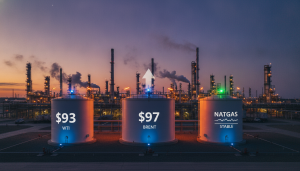
The optimism that propelled crude prices higher earlier in the year has given way to a notable pullback, illustrating the market’s inherent sensitivity to both perceived risk and profit-taking. As of today, Brent Crude is trading at $90.38, marking a significant daily decline of 9.07%, having traversed a wide range between $86.08 and $98.97. Similarly, WTI Crude stands at $82.59, down 9.41% for the day, with its range spanning $78.97 to $90.34. This sharp correction follows a broader trend; Brent has shed nearly 20% from its March 30th peak of $112.78, settling at $90.38 on April 17th. This substantial retreat prompts a re-evaluation of the market’s trajectory. While some might interpret this as a cooling of the earlier bullish fervor, it’s crucial to consider the context. The daily trading ranges suggest extreme volatility, indicating strong battles between buyers and sellers reacting to fast-evolving information. Despite the recent dips, the underlying geopolitical risks that have kept a floor under prices have not dissipated. Instead, the market appears to be recalibrating the immediate impact of these risks against broader economic signals, leading to heightened intraday swings and a more cautious outlook in the short term.
Navigating Key Catalysts: OPEC+ and Inventory Data
The coming weeks are packed with crucial events that will undoubtedly shape the near-term trajectory of oil prices, demanding close attention from investors. Foremost among these are the upcoming OPEC+ meetings. The Joint Ministerial Monitoring Committee (JMMC) is scheduled for April 19th, followed by the full OPEC+ Ministerial Meeting on April 20th. These gatherings are pivotal, as participants will deliberate on current market conditions and potentially adjust production quotas. Investors are keenly asking about “OPEC+ current production quotas” and whether the alliance will maintain its disciplined approach or consider output adjustments in response to the recent price declines or evolving demand outlooks. Any deviation from their current strategy, whether an unexpected cut to bolster prices or an increase to stabilize markets, could trigger significant price movements. Beyond OPEC+, weekly inventory reports from the API (April 21st, April 28th) and the EIA (April 22nd, April 29th) will offer critical insights into the real-time supply-demand balance in the United States, a key consumption hub. High draws from inventories typically signal robust demand or constrained supply, while builds could indicate the opposite. Furthermore, the Baker Hughes Rig Count, due on April 24th and May 1st, will provide an early indicator of future North American production trends, reflecting producers’ confidence and investment appetite. These scheduled events represent immediate catalysts that could either reinforce or challenge the current market sentiment, requiring investors to stay agile.
Investor Focus: Long-Term Outlook and Sector Performance
Our proprietary data indicates that investors are deeply engaged in deciphering the long-term outlook for crude, with questions like “what do you predict the price of oil per barrel will be by end of 2026?” dominating discussions. While providing a definitive price prediction is fraught with variables, analyzing the forces that will shape it offers invaluable insight. The ongoing geopolitical backdrop, particularly the expansion of sanctions and persistent supply risks, suggests that a significant risk premium will likely remain embedded in oil prices throughout the year. However, global economic growth trajectories, central bank policies, and the pace of energy transition efforts will also play critical roles. A sustained global economic recovery would bolster demand, while a significant slowdown could temper it, irrespective of supply constraints. Investors are also closely monitoring the performance of integrated energy majors, as evidenced by interest in specific company performance such as “How well do you think Repsol will end in April 2026.” The ability of these companies to navigate volatile commodity prices, manage operational costs, and strategically invest in both traditional and renewable energy projects will dictate their profitability and shareholder returns. Their resilience in the face of market swings and their strategic responses to a changing energy landscape will be key determinants of their success.
The Sanctions-Supply Nexus: A Persistent Market Undercurrent
The article title aptly highlights “Sanctions & Supply Risk Test Oil’s Bullish Reversal,” and indeed, this nexus remains a dominant theme for the oil market. Geopolitical events, from regional conflicts to new sanctions imposed on key oil-producing nations, continue to introduce profound uncertainty into global supply. These actions, whether directly targeting oil exports or impacting related financial transactions and shipping, can effectively remove barrels from the market or make their delivery significantly more complex and costly. This creates a persistent “risk premium” in crude prices, meaning prices are higher than they might otherwise be due to the perceived threat of supply disruption, even if actual disruptions are not always immediate or fully realized. The market is constantly weighing the potential for escalation against the resilience of the global supply network to reroute flows or find alternative sources. This dynamic ensures that even during periods of price correction, the floor for crude prices remains relatively high compared to historical norms. For investors, understanding the nuances of these geopolitical developments and their potential to tighten global supply or disrupt trade routes is critical for assessing both short-term volatility and long-term price trends in the oil and gas sector.