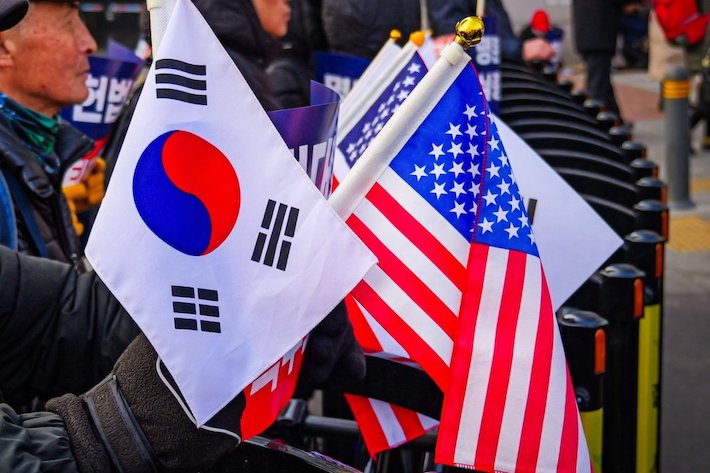
A landmark agreement between the United States and South Korea is poised to reshape trade flows and strategic investments, with significant implications for the global energy sector. South Korea has committed to a staggering $450 billion package of investments in US projects, encompassing shipbuilding, nuclear power, chips, and a substantial allocation for energy products. In return, the US has agreed to impose a 15% tariff on imports from South Korea, a notable reduction from the initially threatened 25%. This diplomatic victory for newly inaugurated South Korean President Lee Jae Myung not only eases tensions with a key Asian ally but also presents a compelling new demand signal for American energy producers, warranting close scrutiny from investors.
The $100 Billion Energy Commitment: A Lifeline for US Producers?
South Korea’s commitment to purchase $100 billion in US energy products stands as a cornerstone of this expansive trade deal, offering a substantial potential boost to American upstream and midstream operators. This substantial capital infusion arrives at a critical juncture for crude markets. As of today, Brent crude trades at $90.38 per barrel, marking a significant 9.07% decline within the day, with a range between $86.08 and $98.97. WTI crude similarly saw a steep drop, trading at $82.59, down 9.41%, within a day range of $78.97 to $90.34. This recent volatility extends a broader trend, with Brent having fallen over $20 per barrel, an 18.5% drop, from $112.78 on March 30 to $91.87 just yesterday.
For investors keenly asking what the price of oil per barrel will be by the end of 2026, a commitment of this scale from a major industrialized economy like South Korea introduces a notable bullish factor. This deal could significantly shore up demand for US crude, liquefied natural gas (LNG), and refined petroleum products. While the specifics of which energy products and over what timeframe these purchases will occur are still emerging, the sheer volume suggests a long-term strategic alignment. US LNG exporters, in particular, could see enhanced contract opportunities, further solidifying America’s position as a global energy supplier, especially as South Korea seeks to diversify its energy import sources.
Beyond Fossil Fuels: Nuclear, Chips, and Strategic Depth
Beyond the immediate energy product purchases, the broader $450 billion package includes a $200 billion allocation towards nuclear power, chips, batteries, and biotechnology, alongside $150 billion for a shipbuilding partnership. The nuclear component holds particular long-term interest for the energy sector. As global economies increasingly pivot towards decarbonization and energy security, investments in advanced nuclear technologies in the US, supported by Korean capital and expertise, could accelerate the development and deployment of next-generation reactors. This diversification aligns with strategic goals for both nations, enhancing energy resilience and reducing reliance on volatile fossil fuel markets over the long haul.
The $150 billion dedicated to a shipbuilding partnership, while not directly oil and gas, has indirect implications. A robust shipbuilding industry supports the construction of specialized vessels, including LNG carriers, which are critical for transporting natural gas to international markets. Furthermore, the energy-intensive nature of shipbuilding itself means increased demand for power and fuel. For investors, these broader strategic investments signal a deepening economic and technological partnership that could foster long-term stability and growth across various industrial sectors, indirectly benefiting the energy complex through increased industrial demand and infrastructure development.
Navigating Trade Winds: Tariffs and Market Dynamics
The headline 15% tariff rate, a significant reduction from the threatened 25%, represents a diplomatic win for South Korea’s new President Lee Jae Myung. This lower rate allows Seoul to largely maintain its competitive stance compared to major trading blocs like Japan and the European Union, which Citi economist Kim Jin-wook noted keeps South Korea’s tariff rate on par with its competitors. While a 15% tariff still presents an added cost for US exporters, it significantly improves the economics of trade compared to the proposed higher rate. This move could encourage greater volumes of US crude, LNG, and petrochemicals to flow to South Korea, enhancing market access for American producers and making US exports more attractive.
This tariff relief comes amidst a flurry of trade policy activity, with many nations scrambling to finalize deals ahead of a looming August 1 deadline for new tariff implementations. For investors, understanding these nuanced trade agreements is crucial, as they directly impact the profitability and competitiveness of US energy exports in key Asian markets. The agreement’s details, particularly Seoul’s success in defending its non-tariff barriers related to food regulations, further demonstrate the complex interplay of trade negotiations and national interests. While readers are often focused on questions like “What are OPEC+ current production quotas?”, this US-Korea deal highlights how bilateral trade agreements can also significantly influence global energy demand and export dynamics.
The Road Ahead: Implementation, Uncertainty, and Upcoming Catalysts
Despite the positive headlines and the monumental figures involved, critical details regarding the $450 billion investment package remain largely undefined. The lack of clarity on specific projects, financing mechanisms, implementation timelines, and binding terms introduces a degree of uncertainty that investors must carefully consider. As former South Korean trade minister Cheong In-kyo cautioned, opinions about the deal could change if the investment is not well spent. Investors will be keenly watching for concrete project announcements and timelines before fully pricing in the impact of this monumental agreement.
The coming weeks will be pivotal for gaining further insight. Key industry events such as the upcoming OPEC+ Joint Ministerial Monitoring Committee (JMMC) and the Full Ministerial Meetings on April 18th and 19th, respectively, could provide further directional cues for global supply. While these meetings will primarily focus on production quotas, any signals about the global demand outlooks, especially with a new major demand commitment from Korea, could influence their decisions. Closer to home, the API Weekly Crude Inventory reports on April 21st and 28th, followed by the EIA Weekly Petroleum Status Reports on April 22nd and 29th, will offer crucial snapshots of US supply-demand balances. These reports, alongside the Baker Hughes Rig Count on April 24th and May 1st, will be essential in assessing the US’s capacity to absorb and fulfill this new, substantial Korean energy demand over the long term, and whether domestic production is poised to ramp up in response.