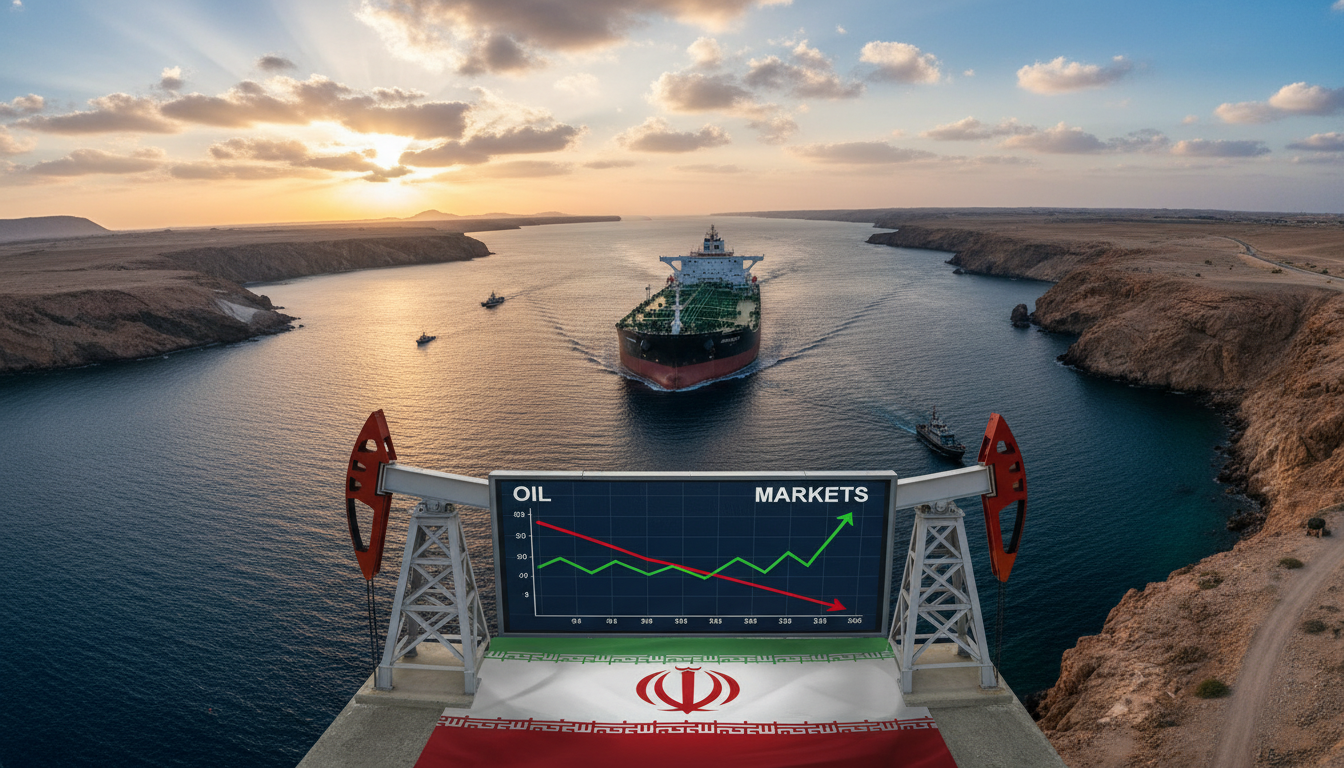
Strait of Hormuz Reopens, Oil Prices Plunge as Markets Rally
Global financial markets experienced a significant upswing, with major US and European indices posting gains, following Iran’s unexpected announcement that the critical Strait of Hormuz had been fully reopened. This pivotal development, signaling a potential de-escalation of regional tensions, immediately impacted crude oil benchmarks, sending prices spiraling downward by over 10% to trade below $90 per barrel.
The news broke via a post on social media platform X from Iran’s Foreign Minister, Abbas Araghchi, who confirmed unrestricted passage for commercial vessels through the vital chokepoint. This announcement was made “in line with the ceasefire in Lebanon” and outlined a “coordinated route” for transit. US President Donald Trump promptly acknowledged the development, expressing gratitude on Truth Social, stating, “IRAN HAS JUST ANNOUNCED THAT THE STRAIT OF IRAN IS FULLY OPEN AND READY FOR FULL PASSAGE. THANK YOU!”
However, the celebratory tone was tempered by President Trump’s subsequent clarification. He affirmed that while the Strait’s commercial traffic would resume, the United States naval blockade on Iranian ports would remain firmly in place. This measure, he indicated, would persist until a comprehensive peace agreement with Iran is “100% complete,” though he optimistically added that this process should “go very quickly” given that “most of the points are already negotiated.” Investors in the energy sector are now closely monitoring the delicate balance between eased transit and persistent sanctions, understanding that true stability remains elusive until a full resolution is achieved.
Geopolitical Risks Persist Amid Market Optimism
The immediate market reaction was overwhelmingly positive. The Dow Jones Industrial Average soared by more than 700 points, marking a 1.5% increase. The S&P 500 climbed 0.8%, breaching the 7,100 mark for the first time in history, while the Nasdaq advanced by 1% to reach new intraday record highs. Sectors previously hit hard by the Strait’s closure, such as aviation and leisure travel, saw their valuations rebound sharply, with major players like Boeing and cruise line operators experiencing significant gains.
For crude oil investors, the implications were direct and immediate. Easing fears of widespread supply disruptions in the Persian Gulf triggered a steep sell-off. US West Texas Intermediate (WTI) crude futures dropped to $84 per barrel, while international benchmark Brent crude traded at $88 per barrel as of 14:29 GMT. This sharp decline underscores the market’s sensitivity to geopolitical stability in the Middle East, particularly concerning key oil transit routes.
Despite the initial wave of market relief, seasoned analysts caution that a multitude of complex issues still demand resolution. Experts highlight the need to prevent Iran’s Revolutionary Guards from potentially imposing unauthorized tolls on vessels navigating the Strait, a practice that would undermine the long-standing Traffic Separation Scheme (TSS) effectively utilized since 1968. Furthermore, the broader regional context, including the cessation of Israeli attacks on Hezbollah in Lebanon and the contentious issue of Iran’s nuclear enrichment program, remain critical points of negotiation. The continuation of the US naval blockade on Iranian ports serves as a tangible reminder that significant hurdles remain before a complete normalization of relations and full stability in the region’s energy landscape.
International Coalition Forms for Maritime Security
In response to the volatile situation, European leaders convened in Paris, outlining a coordinated effort to safeguard freedom of navigation in the Strait of Hormuz. UK Prime Minister Keith Starmer announced that Britain and France would spearhead a multinational mission aimed at protecting commercial shipping. Over a dozen countries have pledged naval assets, reinforcing the international community’s commitment to ensuring unimpeded passage and preventing any reintroduction of illicit tolls.
French President Emmanuel Macron lauded the ceasefires in both Iran and Lebanon, acknowledging the “very severe” global economic repercussions of the Strait’s previous closure. Italian Prime Minister Georgia Meloni confirmed Italy’s contribution of naval units to the security mission, emphatically stressing the “vital” necessity for Iran to abandon its pursuit of nuclear weapons. German Chancellor Friedrich Merz expressed Germany’s willingness to support freedom of navigation and participate in mine clearance operations within the Strait, contingent on United Nations approval and German parliamentary consent. Merz also underscored the “desirable” involvement of the United States in this crucial European initiative.
The formation of this robust international coalition sends a strong signal to global energy markets about the collective resolve to maintain the free flow of oil and gas through this strategic waterway. For investors, this provides a layer of reassurance regarding the security of supply lines, even as underlying geopolitical tensions continue to simmer.
Shipping Sector Remains Cautious Amid Residual Concerns
While the official declaration of the Strait’s reopening has calmed market anxieties, the shipping industry itself remains highly cautious. Maritime authorities and major shipping companies are closely monitoring the evolving situation, resulting in a noticeably limited number of vessels immediately seeking passage. Concerns about the potential presence of sea mines and the enduring uncertainty over whether the region will revert to the internationally recognized Traffic Separation Scheme (TSS) are central to this apprehension.
An anonymous oil and gas tanker operator articulated this sentiment, remarking that the Iranian statement “doesn’t change anything” for their current operational posture. “We don’t feel like we need to be taking unnecessary risks, and our company approach is that we won’t be the first to go through the strait,” the operator stated, reflecting a broader industry reluctance to rush into potentially hazardous waters. Iran currently mandates the use of a specific “coordinated route” near Larak Island, adding another layer of complexity for shipowners and their insurers who are actively assessing residual mine threats in other parts of the waterway.
President Trump’s assurances that Iran “has removed, or is removing, all sea mines” and his directive that “Israel will not be bombing Lebanon any longer” offer some relief, yet the practical realities of clearing a major maritime route and enforcing regional peace are immense. Investors tracking the crude oil market and associated shipping logistics should remain vigilant, as the full restoration of normal, risk-free transit through the Strait of Hormuz may still unfold over an extended period, with any renewed incident capable of sending shockwaves through the global energy complex.