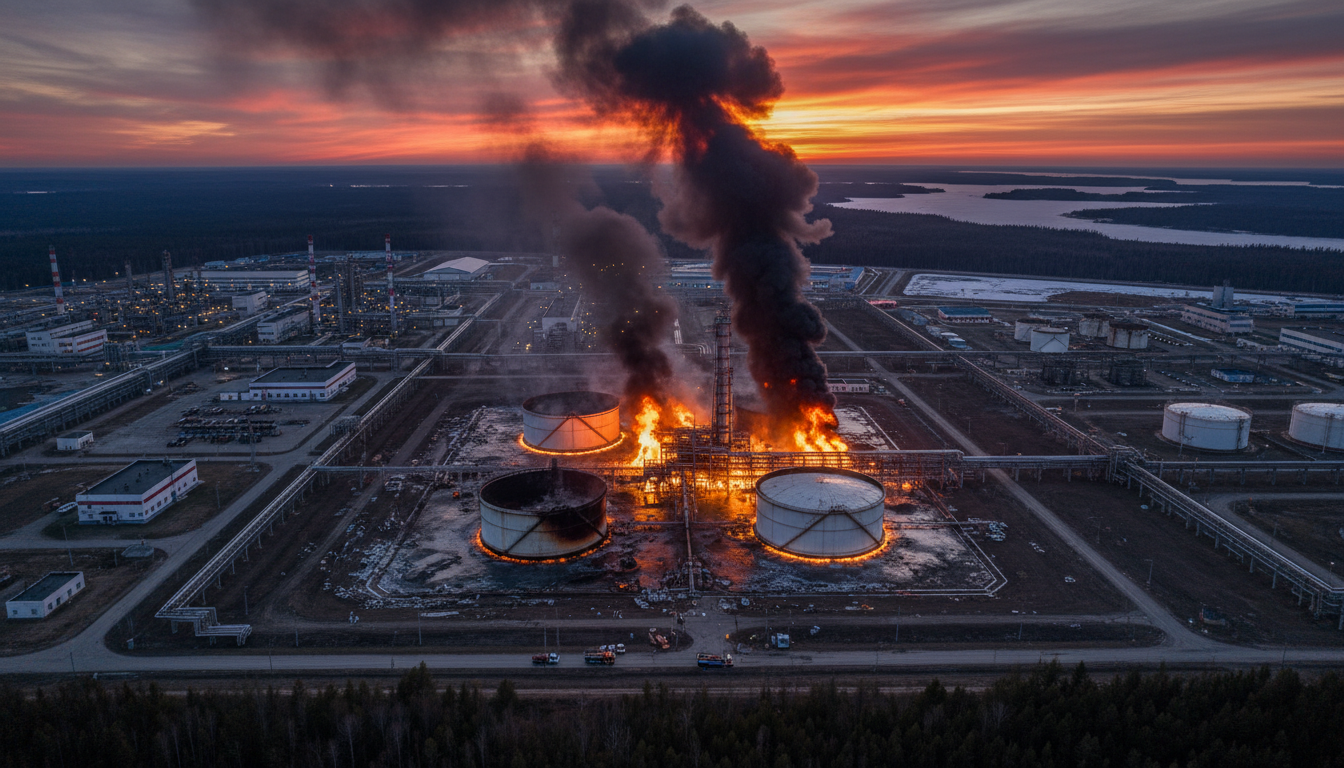
In a significant development echoing the escalating geopolitical tensions impacting global energy markets, a major Russian oil refinery, the Kirishi facility, reportedly experienced a fire early on Tuesday following overnight drone incursions. This incident, affecting a refinery with a substantial processing capacity of 400,000 barrels per day (bpd), immediately captured the attention of oil and gas investors monitoring supply chain vulnerabilities and geopolitical risk premiums across the energy sector.
Located southeast of St. Petersburg in Russia’s Leningrad region, the Kirishi refinery is a critical asset owned by oil producer Surgutneftegas. Initial reports, supported by satellite imagery from NASA’s Fire Information for Resource Management System, indicated heating anomalies in the vicinity of the industrial complex. These thermal signatures are often indicative of fires, prompting swift concern regarding potential disruptions to Russian fuel production and refining capabilities. Such events underscore the inherent volatility in crude oil prices and the constant need for robust geopolitical risk assessment in energy investment strategies.
Local authorities were quick to address the situation, with Alexander Drozdenko, the governor of the Leningrad region, confirming via Telegram that a fire within the Kirishi industrial zone had been localized. Governor Drozdenko’s statement acknowledged the refinery as the primary target of the drone attacks that occurred overnight. However, it’s crucial for energy investors to note that official communications did not definitively confirm a direct hit on the refinery infrastructure itself, only that it was the intended objective. This distinction is vital for accurately assessing immediate supply impacts.
Adding another layer of complexity to the incident, it has come to light that the Kirishi refinery has not been operational since the close of March, a consequence of an earlier strike. This critical piece of information, revealed by sources familiar with the facility’s status, significantly alters the immediate market reaction. While the drone attack itself is a serious escalation of hostilities against Russia’s energy infrastructure, the prior non-operational state of the 400,000 bpd plant means that Tuesday’s event did not immediately remove active refined product supply from the market. For oil and gas investors, this highlights the importance of discerning between perceived and actual supply disruptions when evaluating the impact on crude oil prices and refined product margins.
Escalating Drone Campaign Targets Russian Oil Infrastructure
The latest incident at Kirishi fits a broader pattern of intensified drone attacks by Ukraine on Russia’s vital oil infrastructure. These concerted efforts are strategically designed to cripple Russian fuel production capacity and restrict the nation’s oil exports. The timing of these attacks is particularly noteworthy, occurring against a backdrop of elevated international crude prices. These soaring prices, driven by global supply concerns and geopolitical instability in other regions, have paradoxically bolstered the Kremlin’s revenues, providing substantial funds to sustain its ongoing conflict. By targeting key facilities, Ukraine aims to directly undermine Russia’s economic lifeline, thereby influencing the global energy balance and investor outlook on Russian energy assets.
The strategic scope of these operations extends beyond individual refineries to encompass critical export terminals. For instance, Russia’s Black Sea port of Tuapse has been subjected to a relentless barrage, suffering four separate Ukrainian drone strikes within a single week. Such sustained targeting of export gateways demonstrates a clear intent to disrupt the flow of Russian crude oil and refined products to international markets. For energy investors, this introduces considerable uncertainty regarding the reliability of Russian supply, potentially impacting tanker rates, insurance premiums, and the overall stability of global oil supply chains.
The campaign has been widespread, touching multiple crucial nodes in Russia’s hydrocarbon export network. Besides Tuapse, the port of Novorossiysk on the Black Sea has also faced repeated assaults. Similarly, on the Baltic Sea, the key terminals of Ust-Luga and Primorsk have been targeted multiple times in recent weeks. This geographical breadth illustrates a sophisticated and persistent effort to exert pressure on Russia’s capacity to capitalize on favorable market conditions, particularly the surge in crude oil prices. Investors in global shipping, commodities, and energy security are closely monitoring these developments, understanding that such attacks can introduce significant volatility into crude oil prices and associated derivative markets.
Global Market Dynamics and Russian Revenue Streams
The geopolitical landscape of global crude oil markets has seen significant shifts, particularly following the escalation of conflicts in the Middle East. This instability has been a primary catalyst for the recent surge in international crude oil prices, which, despite widespread sanctions, has ironically benefited Russia. Beyond the general price increase, a specific market dynamic has also contributed to Russia’s robust oil revenues: a U.S. waiver pertaining to sales of Russian crude already loaded onto tankers. This waiver effectively made Russian oil more appealing to key buyers like India, circumventing some of the immediate pressures from sanctions and maintaining a strong demand channel for Moscow’s exports.
For investors, understanding this intricate interplay of sanctions, waivers, and market demand is crucial. Russia’s ability to continue exporting substantial volumes of oil, even with geopolitical headwinds, has direct implications for global supply-demand balances and the effectiveness of international sanctions regimes. Ukraine’s drone campaign can thus be viewed as an attempt to directly counter these revenue streams by physically impairing Russia’s ability to produce and transport crude oil and refined products. Each successful strike, or even the threat of one, adds a layer of risk premium to crude oil prices, affecting trading strategies and long-term investment decisions in the energy sector.
The ongoing targeting of Russian energy infrastructure highlights a persistent and evolving risk for the global oil and gas industry. While the immediate supply impact of the Kirishi fire might be mitigated by its pre-existing non-operational status, the broader pattern of attacks maintains a strong undercurrent of geopolitical risk in energy markets. Investors must continuously evaluate these evolving dynamics, considering how such events influence global crude oil supply, demand forecasts, and the long-term viability of energy investments in regions subject to intense geopolitical pressures. The future trajectory of crude oil prices will undoubtedly reflect these escalating tensions and the resilience of global energy supply chains against these sophisticated threats.


