Porsche’s Strategic Pivot: A Prudent Reassessment Amidst Energy Transition Volatility
In a series of decisive maneuvers signaling a significant strategic recalibration, luxury automaker Porsche AG is aggressively streamlining its portfolio, raising critical questions about the pace and capital intensity of the automotive sector’s energy transition. For investors tracking the broader energy market and the future of fuel demand, these moves by a titan of engineering offer profound insights into the evolving landscape of sustainable mobility and the enduring role of diversified powertrain strategies.
The most striking development involves Cellforce Group, a venture initially lauded as Porsche’s direct conduit into high-performance electric vehicle (EV) battery cell development. Conceived as a joint venture with Customcells, Cellforce was slated to produce bespoke battery solutions tailored specifically for Porsche’s demanding electric sports cars. While Porsche expanded its control to full ownership in 2023, signaling increased commitment, this ambitious trajectory has now reversed dramatically. By April 2025, the company made an unexpected U-turn, moving to almost entirely halt Cellforce’s operations by August 2025. This rapid de-escalation initially led to significant workforce reductions, with 200 out of 290 employees made redundant, while remaining staff were offered transfers to Volkswagen subsidiary PowerCo in Salzgitter.
Deeper Cuts and a Clearer Focus
The strategic retrenchment at Cellforce has deepened since the initial announcement. Porsche confirms that the workforce has further dwindled, with only 50 employees now remaining. The rationale for this definitive closure is unambiguous: “As part of Porsche AG’s strategic realignment and its technology-open powertrain strategy, Cellforce GmbH no longer has a sufficiently viable long-term perspective.” This statement underscores a shift away from an exclusive focus on proprietary EV battery development, suggesting a more pragmatic approach to capital allocation and technology sourcing within a highly competitive and capital-intensive battery market. Management is now set to engage with the works council to finalize the company’s dissolution.
This decision is not an isolated incident but rather part of a broader corporate realignment. Just days before the Cellforce announcement, Porsche concluded a major divestment, selling its stake in the Croatian Rimac Group and its joint venture, Bugatti Rimac. A consortium spearheaded by financial investor HOF Capital, with backing from the influential Egyptian billionaire Sawiris family, acquired the stake. Porsche CEO Michael Leiters articulated the reasoning behind this divestment as a necessity to “focus on its core business.”
Leiters has consistently reinforced this message, explicitly stating that the imperative to “refocus on its core business” forms the “indispensable foundation for a successful strategic realignment.” He acknowledged the painful nature of these decisions, noting that such an overhaul “forces us to make painful cuts — including our subsidiaries.” For energy investors, this signals a more disciplined approach to capital expenditure, potentially re-prioritizing proven technologies and profitable segments over speculative ventures in nascent markets, thereby indirectly supporting continued demand for established energy sources.
Beyond Batteries: Sweeping Portfolio Rationalization
The strategic pruning extends far beyond Cellforce. Porsche eBike Performance GmbH, a subsidiary employing 350 people, is also slated for winding down. This move is attributed to “fundamentally changed market conditions” in the e-bike sector, impacting its two sites in Ottobrunn and Zagreb. This closure further untangles Porsche’s ties with Rimac, given that Porsche eBike Performance had previously absorbed Greyp, the e-bike manufacturer founded by Mate Rimac. The rapid shift in market dynamics for discretionary goods like e-bikes provides a cautionary tale for investors in any burgeoning sector, highlighting the volatility and often over-enthusiastic projections for new technologies.
Compounding these closures is the cessation of operations at Cetitec, Porsche’s software subsidiary located in Pforzheim. Cetitec specialized in developing sophisticated software for data communication, serving not only Porsche but the entire Volkswagen Group. Here too, the company cites a shifting market environment and the relocation of development scopes as reasons for the shutdown. Approximately 60 employees in Germany and 30 in Croatia are affected. This indicates a potential move towards either consolidating software development internally within the larger VW Group or outsourcing to more specialized external partners, again underscoring efficiency and focused resource allocation.
Implications for Energy Investors: A Pragmatic Turn?
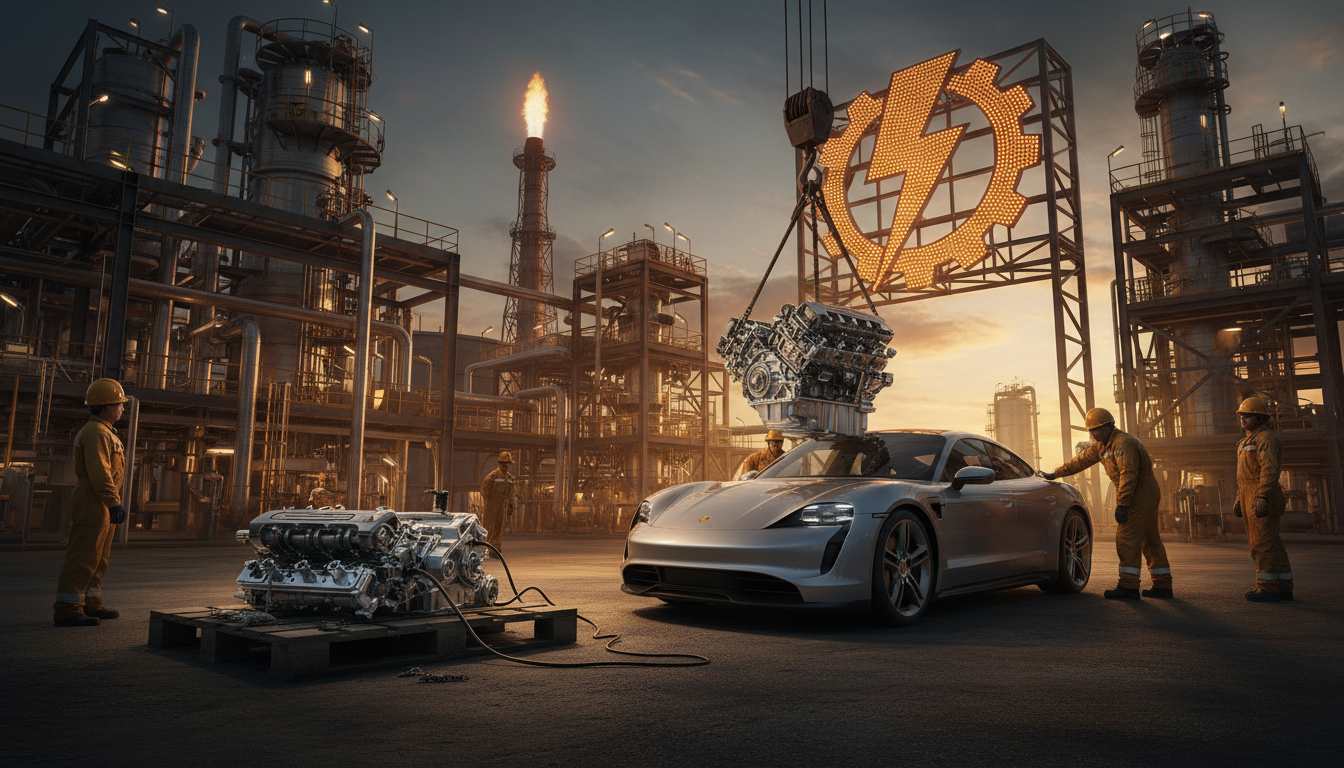
Porsche’s comprehensive strategic realignment offers crucial insights for investors in the oil and gas sector. The shift towards a “technology-open powertrain strategy” suggests a potential diversification away from an exclusive, all-in bet on pure battery electric vehicles. This pragmatism could imply a prolonged emphasis on highly efficient internal combustion engines (ICEs), advanced hybrid solutions, and perhaps synthetic fuels, which remain relevant to Porsche’s luxury and performance-oriented core business. Such a stance has direct implications for the long-term demand for refined petroleum products and the energy infrastructure supporting both traditional and transitional fuels.
The aggressive divesting from ventures like Cellforce and Rimac, coupled with the closure of e-bike and software subsidiaries, reflects a disciplined focus on capital efficiency. In a global economic climate marked by volatility and inflation, companies are increasingly scrutinizing where shareholder capital delivers the best returns. Over-investing in speculative or capital-intensive early-stage technologies, even those aligned with future energy trends, can dilute resources from core, profitable segments. For oil and gas investors, this reinforces the value of established assets and robust cash flows, even as the broader energy landscape continues to evolve.
Moreover, the acknowledgment of “fundamentally changed market conditions” for e-bikes highlights the susceptibility of new energy-related markets to broader macroeconomic headwinds and shifts in consumer sentiment. This serves as a vital reminder that the energy transition is not a linear, uninterrupted progression but rather a dynamic process influenced by economic cycles, technological maturity, and capital availability. Porsche’s actions suggest a more cautious, measured pace for certain aspects of electrification, potentially extending the demand horizon for conventional energy sources while companies strategically adapt to evolving market realities.
Ultimately, Porsche’s sweeping strategic adjustments present a powerful case study in corporate adaptation amidst the energy transition. By shedding non-core assets and re-focusing capital on what it defines as its indispensable foundation, Porsche aims to fortify its financial position and long-term viability. For savvy energy investors, this signals a pivot towards pragmatism, where innovation is balanced with profitability, and the future of mobility might be more diverse and less exclusively electric than some initial projections suggested.