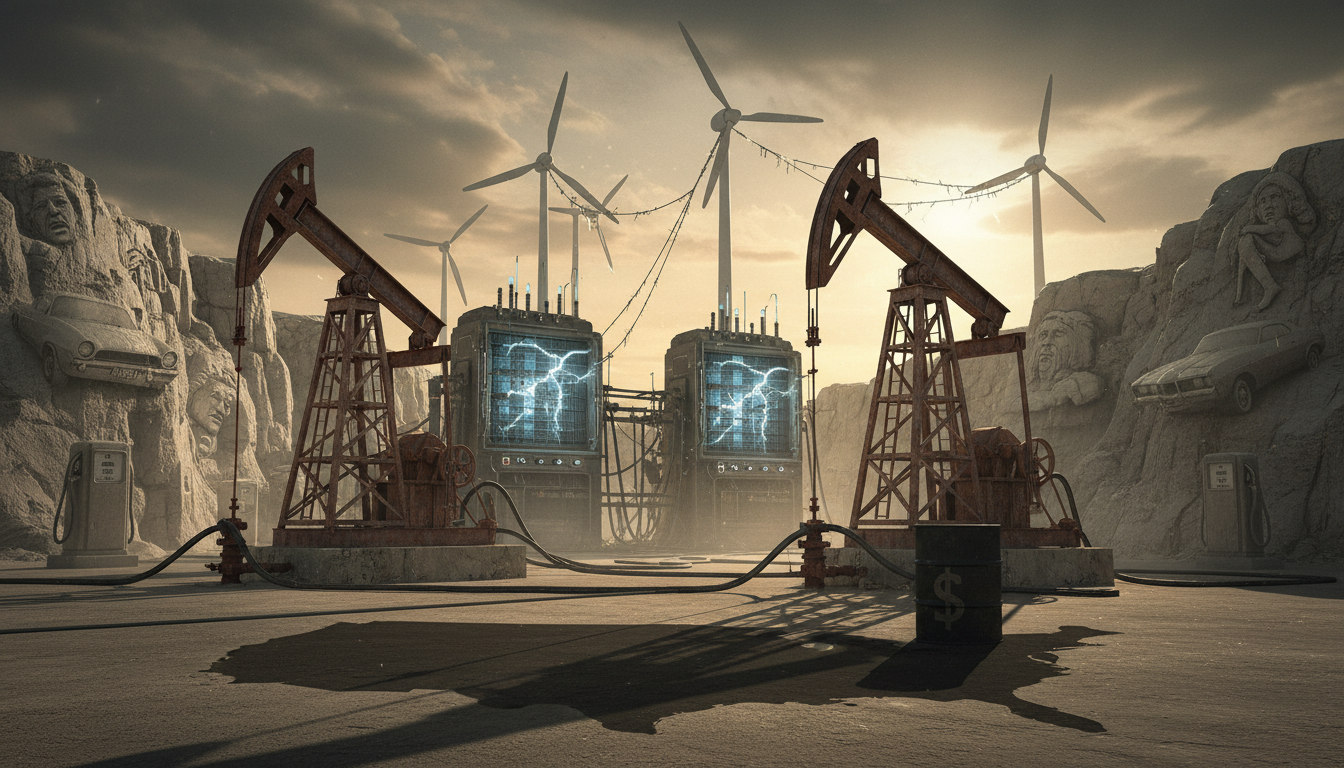
The contemporary American energy infrastructure, particularly its oil and gas sector, did not emerge from a period of stability. Instead, its fundamental architecture was forged in an crucible of economic upheaval, including widespread gasoline rationing, cascading bank failures, and profound geopolitical shifts that fundamentally reordered the global flow of petroleum and international power dynamics.
The Intertwined Crises: 1973, Iran, and the 1980s Collapse
Analysts frequently frame the 1973 oil embargo and the dramatic crude oil price crash of the 1980s as distinct, bookending events of a turbulent era. However, this perspective overlooks their intrinsic connection, with the Iranian Revolution serving as the pivotal event linking these two seismic shocks. This political rupture, paradoxically enabled by surging oil revenues, permanently reshaped U.S. foreign policy, global energy markets, and the very concept of energy security. The strategic challenges confronting policymakers today are not novel; rather, they represent the unresolved legacies of this tumultuous period.
America’s Unforeseen Vulnerability in the 1970s
As the United States entered the 1970s, it operated from a position of profound, yet largely unrecognized, vulnerability. Domestic crude oil production had peaked in 1970 at approximately 9.6 million barrels per day. By 1973, this output had begun a steady decline, even as national consumption continued its ascent. Imports subsequently surged past six million barrels per day, fulfilling roughly one-third of America’s total oil demand. Government price controls, intended to stabilize the market, inadvertently masked the growing scarcity, disincentivized crucial domestic investment, and simultaneously stimulated demand. Crucially, the Texas Railroad Commission, historically a swing producer, no longer held sufficient spare capacity to influence global markets. The United States had silently transitioned from a dominant oil producer to a structurally import-dependent nation.
The Embargo’s Immediate Impact on Main Street
The Arab oil embargo, initiated in October 1973, translated into an immediate and tangible crisis for ordinary Americans, far removed from abstract balance sheets or diplomatic communiqués. Motorists faced extensive gasoline lines stretching for city blocks, and many filling stations depleted their supplies by midday. States implemented odd-even license plate rationing schemes, and individuals resorted to sleeping in their vehicles to secure fuel. The widespread panic even led to a surge in gas theft, popularizing the sale of locking gas caps. This shortage was not merely a physical deficit but a systemic institutional failure, where allocation rules, price controls, and refining bottlenecks transformed a supply shock into a national crisis, marking the first time since World War II that energy scarcity directly threatened daily life.
Oil as a Macroeconomic Lever and Inflationary Force
By the mid-1970s, burgeoning oil imports had become a primary driver of the U.S. trade deficit, diverting tens of billions of dollars overseas annually. While these “petrodollars” recycled into global financial markets, they simultaneously eroded domestic purchasing power. The relentless rise in energy prices directly fueled inflation, contributed to industrial decline, and exacerbated wage stagnation. Crude oil was no longer merely a fuel source; it had evolved into a direct conduit for widespread economic instability.
Iran: When Oil Wealth Fuels Instability
At the heart of this volatile era stood Iran, then one of the world’s largest oil producers and a critical pillar of U.S. strategy in the Persian Gulf. After the substantial price hikes of 1973, Iran, under the Shah, embarked on an ambitious program of rapid modernization, military expansion, and centralized control, almost entirely financed by its burgeoning petroleum exports. However, this influx of oil wealth profoundly distorted Iran’s political economy. Revenue disproportionately flowed to the state apparatus, bypassing the general population. Inflation soared, economic inequality widened, and traditional social institutions were increasingly marginalized. To quell the dissent arising from a society transforming too rapidly, the regime became increasingly repressive. Far from stabilizing Iran, its immense oil wealth paradoxically accelerated its internal fracturing.
The Iranian Revolution’s Supply Shock
The fall of the Shah in 1979 precipitated an immediate and drastic collapse in Iranian oil production, plummeting from an estimated five to six million barrels per day to virtually zero within months. This was not an orchestrated embargo but a profound political implosion. The resultant supply shock triggered the second major global oil crisis, sending prices dramatically higher and entrenching the pervasive belief that energy scarcity was an enduring reality. For the United States, the lesson was stark and brutal: a single, politically unstable producing nation, flush with oil cash, possessed the power to disrupt the entire global economy without firing a single shot.
The Hostage Crisis: Fusing Energy and National Security
The seizure of the U.S. Embassy in Tehran and the subsequent 444-day hostage crisis fundamentally transformed Iran from a regional ally into a formidable adversary. This crisis solidified a new geopolitical reality: immense oil wealth could now finance regimes openly hostile to U.S. interests, insulating them from traditional economic pressures due to their control over strategic energy resources. From this critical juncture onward, U.S. energy policy and its Middle East policy became inextricably linked. The Carter Doctrine explicitly declared the free flow of Persian Gulf oil as integral to American national security, committing military force to protect vital supply routes. Energy had unequivocally become a casus belli, a cause for war.
The Boom and Bust Cycle: High Prices and Reckless Lending
Throughout the late 1970s and into 1981, crude oil prices remained exceptionally high, peaking above $35 per barrel. Some oil receipts even reflected prices as high as $44 per barrel. This sustained period of high prices convinced many market participants that scarcity was destiny, leading to the belief that the boom would never end. Consequently, an unprecedented deluge of capital flooded into domestic drilling ventures. Financial institutions aggressively expanded their reserve-based lending portfolios, treating energy loans as inherently safe and structurally sound. The prevailing sentiment encouraged widespread investment, epitomized by advertisements from figures like Eddie Chiles urging individuals to “get an oil well” in the 1970s. Domestic production did indeed rise, but this expansion was accompanied by soaring leverage, rampant cost inflation, and widespread operational excess, setting the stage for an inevitable reckoning.
Demand Destruction and Global Supply Resurgence
Concurrently, market forces were rapidly destroying oil demand. Vehicle fuel efficiency dramatically improved, and oil-fired power generation largely ceased as utilities shifted to other sources. Furthermore, non-OPEC oil supply surged globally. The global energy system, while seemingly securing independence through increased production, was inadvertently building towards a catastrophic collapse.
The 1980s Oil Crash: Financial Contagion
When oil prices abruptly collapsed in 1986, plummeting below $10 per barrel, the shockwaves reverberated through both U.S. production and its financial system. Domestic crude output contracted by more than one million barrels per day in the first half of the decade, rendering marginal wells uneconomic and forcing widespread shutdowns across entire regions. Banks and savings institutions, heavily exposed to the energy sector, followed producers into widespread failure. Between 1980 and the mid-1990s, over 1,600 banks and more than 1,000 savings and loan institutions were either resolved or closed, representing hundreds of billions of dollars in lost assets. While energy lending was not the sole catalyst, it served as a central accelerant, particularly in oil-producing states.
Penn Square: A Symbol of Systemic Risk
Penn Square Bank in Oklahoma City became the infamous emblem of this oil-driven financial contagion. The institution aggressively originated highly speculative oil and gas loans, subsequently selling participations nationwide. Its collapse in 1982, triggered by falling oil prices, sent a cascade of losses through major financial institutions, including Continental Illinois, which ultimately required federal intervention. Oklahoma alone witnessed roughly 139 bank failures during that tumultuous decade. The era starkly demonstrated how extreme oil price volatility could directly translate into systemic financial risk, impacting investors far beyond the energy sector.
A Disciplined Industry Forged in Adversity
The crash obliterated scores of independent producers, led to massive employment losses, and hollowed out entire oil towns. What survived was an industry that was leaner, inherently capital-disciplined, and deeply wary of excessive leverage. Future projects were rigorously evaluated for profitability even at low price points. Cost control evolved from a strategic objective into a fundamental cultural tenet. Innovation shifted its focus from sheer scale to operational efficiency, laying the groundwork for advancements like horizontal drilling, hydraulic fracturing, and the modernization of oilfield services. The eventual shale revolution, therefore, was not born from boundless optimism but was rather forged in the crucible of fear and financial necessity.
Iran’s Enduring Geopolitical Playbook
While the U.S. energy industry retrenched and reorganized, Iran embarked on an entirely different trajectory. The Islamic Republic consolidated its control over vast oil revenues, systematically deploying them to project regional influence, fund proxy groups, and erect a formidable shield against international sanctions. The very oil wealth that once destabilized the Shah’s regime now served to entrench a new political order, one that continues to confront U.S. interests today. Energy had completed its transformation from a mere commodity to a potent geopolitical weapon.
Lessons for Today’s Energy Investor
These transformative decades imparted two contrasting yet critical lessons to the United States and global energy investors. The 1970s unequivocally taught that import dependence carries inherent dangers and strategic vulnerabilities. The 1980s, conversely, demonstrated that unchecked excess and speculative lending can be financially lethal. Iran’s experience vividly illustrated that immense oil wealth possesses the paradoxical capacity to destabilize allies while simultaneously empowering adversaries.
Today’s ongoing debates surrounding Strategic Petroleum Reserve releases, U.S. oil export policy, the imperative of capital discipline within the industry, the efficacy of sanctions, and continued Middle East engagement are not new strategic discussions. Rather, they represent the unresolved consequences of the past. The enduring mission to mitigate import dependence, stabilize global energy supplies, and neutralize hostile petrostates remains the same monumental project initiated over fifty years ago. For astute oil and gas investors, understanding these historical cycles is not merely an academic exercise; it provides essential context for navigating the present, as these same fundamental dynamics continue to unfold in real time, shaping market opportunities and risks.