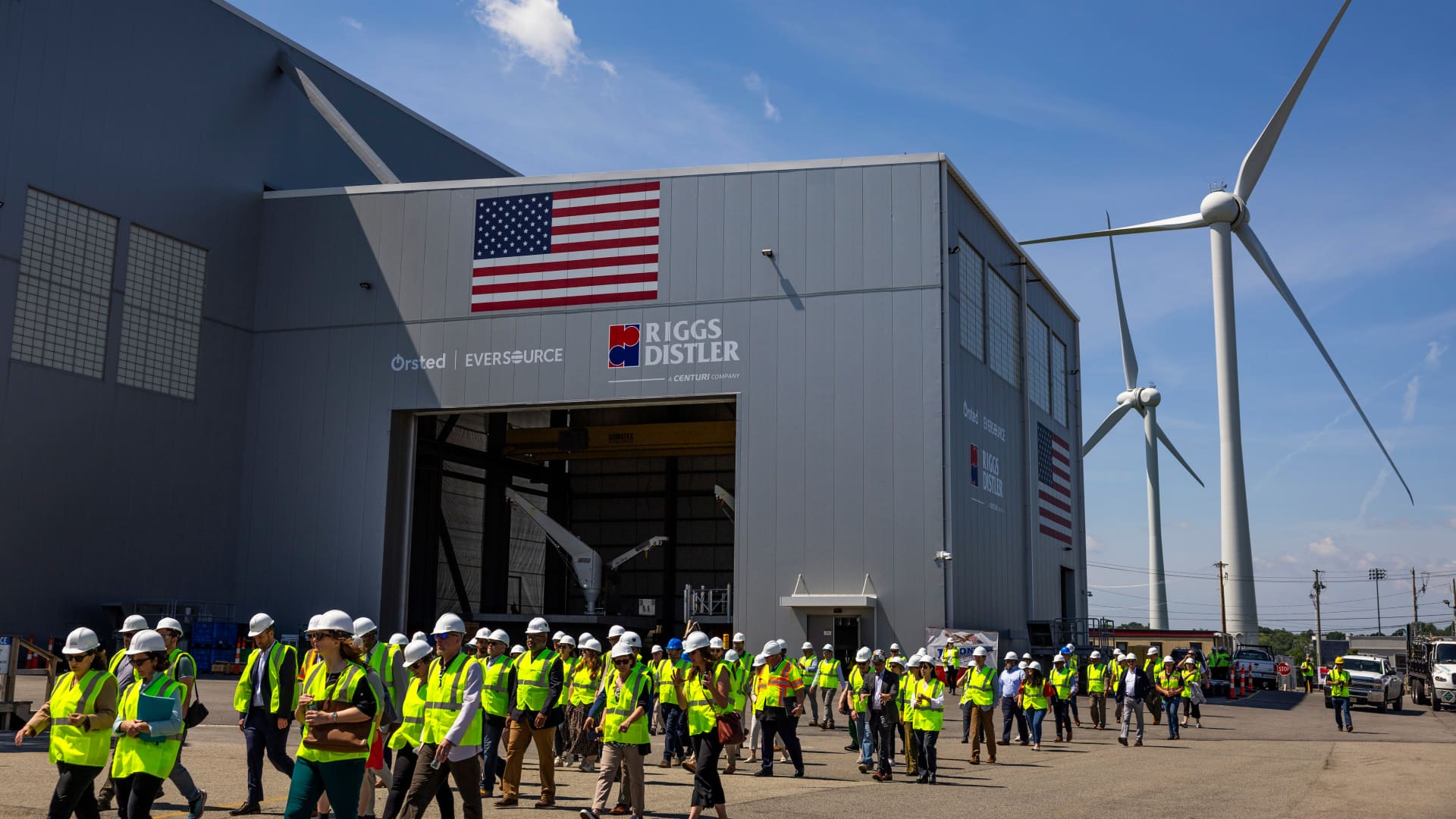
The recent federal court decision allowing Danish energy giant Orsted to resume construction on its Revolution Wind project marks a pivotal moment for the burgeoning U.S. offshore wind industry. This ruling, overturning a Trump administration halt order from August 22, clears a significant hurdle for a project that is already 80% complete and poised to power over 350,000 homes in Rhode Island and Connecticut. For energy investors, this development signals a complex interplay between judicial intervention, shifting political winds, and the fundamental economics of the energy transition. While the green light for Revolution Wind offers a glimmer of stability for renewable infrastructure, it unfolds against a backdrop of volatile crude markets and ongoing policy uncertainty, demanding a nuanced investment strategy.
Judicial Intervention Brings Clarity to Offshore Wind Prospects
The federal judge’s decision to allow Orsted and its partner Skyborn Renewables to proceed with Revolution Wind construction represents a crucial victory not just for the developers, but for the entire U.S. offshore wind sector. The project, already fully permitted and nearing completion off the coast of Rhode Island and Connecticut, had been caught in a regulatory quagmire following an Interior Department stop-work order. This judicial intervention underscores the legal protections afforded to duly permitted projects, potentially setting a precedent that could mitigate political risk for other ventures in the pipeline. For investors eyeing renewable energy, the ability of legal frameworks to push back against politically motivated delays is a vital signal, suggesting that capital deployed into well-vetted projects might find a more stable path to realization than previously feared. This ruling could unlock investor confidence, encouraging further allocation towards large-scale renewable infrastructure, even as political rhetoric remains charged.
Navigating Policy Headwinds and Investor Concerns
Despite the positive judicial outcome for Revolution Wind, the broader policy environment for offshore wind remains contentious, a key concern reflected in the questions our readers are posing. Investors are actively seeking clarity on the long-term viability of energy projects amidst political shifts, exemplified by inquiries into specific company performance like “How well do you think Repsol will end in April 2026.” The Trump administration’s stance, articulated by Interior Secretary Doug Burgum at the Gastech conference in Milan, Italy on September 11, unequivocally stated that offshore wind is perceived as “too expensive and not reliable enough” under his administration, posing an existential threat to the industry. Such statements create significant policy risk, turning every project into a potential political battleground. This uncertainty directly impacts investor appetite, as capital seeks predictable regulatory environments. While Revolution Wind benefits from a court order, the underlying political rhetoric suggests that future projects, particularly those not yet under construction or fully permitted, may still face substantial headwinds. Investors must weigh the potential for judicial overrides against the continued threat of administrative hurdles.
Market Dynamics: Crude Volatility vs. Renewable Stability
The context for this offshore wind development is further shaped by the broader energy market. As of today, Brent crude trades at $90.38, reflecting a significant downturn of 9.07% within the day’s range of $86.08 to $98.97. Similarly, WTI crude stands at $82.59, marking a 9.41% drop, fluctuating between $78.97 and $90.34. This acute daily volatility is part of a larger trend, with Brent crude having fallen by 18.5% from $112.78 on March 30, 2026, to $91.87 on April 17, 2026. Gasoline prices also reflect this bearish sentiment, currently at $2.93, down 5.18%. Our readers frequently ask, “what do you predict the price of oil per barrel will be by end of 2026?” highlighting the intense focus on crude market direction. Lower and more volatile crude prices can, paradoxically, make the economic case for higher-cost renewable projects more challenging, especially when policy support is wavering. Investors must weigh the long-term sustainability and environmental mandates driving renewables against the immediate cost-competitiveness influenced by traditional fossil fuel prices. The Revolution Wind restart offers a counter-narrative of progress in renewables, but its economic viability is always benchmarked against the fluctuating cost of conventional energy.
Forward Outlook: Policy Battles and Global Energy Shifts
Looking ahead, the Revolution Wind ruling will undoubtedly embolden proponents of offshore wind, but the path forward remains fraught with policy battles. Interior Secretary Burgum’s stated intention to “take a deep look” at five other offshore wind projects currently under construction suggests that the fight for the industry’s future is far from over. This judicial decision might influence the administration’s approach to these reviews, potentially forcing a more cautious stance given the precedent. Beyond U.S. domestic policy, the global energy landscape will continue to be shaped by critical events. Investors should closely monitor the upcoming OPEC+ Joint Ministerial Monitoring Committee (JMMC) meeting on April 18, 2026, and the full Ministerial Meeting on April 19, 2026, as these will directly impact global crude supply and price stability. Subsequent API and EIA weekly inventory reports, starting April 21, 2026, will provide further insights into market fundamentals. These traditional energy market drivers, combined with the ongoing Baker Hughes Rig Count reports on April 24, 2026, and May 1, 2026, will determine the broader economic backdrop against which renewable energy investments like Orsted’s Revolution Wind must compete. The question for investors is whether the momentum from this legal victory can sustain the offshore wind sector against persistent political opposition and the inherent volatility of the global energy market, especially as the industry matures and seeks to scale further.