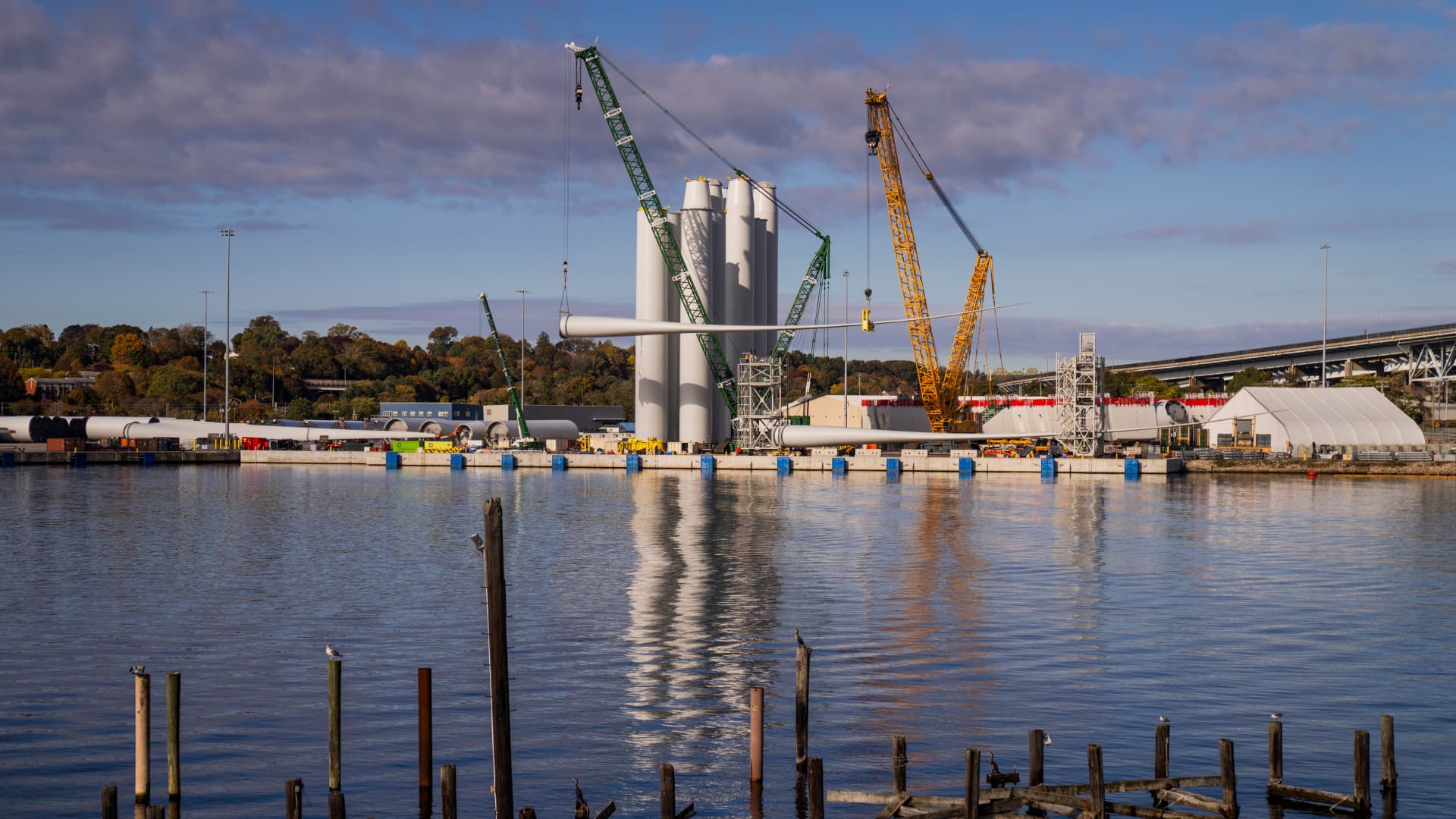
The global energy transition, while inevitable, is rarely a smooth journey, and Danish renewables giant Orsted’s recent third-quarter financial results underscore the complex interplay between ambitious green initiatives and persistent political headwinds. The world’s largest offshore wind farm developer reported a net loss of 1.7 billion Danish kroner (approximately $261.8 million) for the July-September period, a stark contrast to the 5.17 billion Danish kroner profit recorded in the same quarter last year. This significant downturn, attributed in part to impairment costs nearing 1.8 billion Danish kroner, highlights the tangible financial impact of what the company describes as ongoing battles against “anti-wind policies” in key markets, specifically referencing concerted efforts from the White House to halt developments and suspend new licensing. While the reported loss was marginally better than analysts had projected, and the company reiterated its full-year EBITDA guidance of 24-27 billion Danish kroner (excluding new partnerships and cancellation fees), the underlying challenges present a crucial case study for investors navigating the evolving energy landscape.
Political Turbulence Rocks Offshore Wind Investments
Orsted’s Q3 performance serves as a potent reminder that even market leaders in the renewable sector are not immune to geopolitical shifts and policy uncertainty. The reported net loss of 1.7 billion DKK, alongside nearly 1.8 billion DKK in impairment costs, directly reflects the financial strain of stalled projects and regulatory hurdles. While the company’s CEO, Rasmus Errboe, expressed satisfaction with construction progress and operational performance, the broader market has reacted to the escalating political interference. Orsted’s share price has experienced a significant decline this year, largely in response to the perceived risks emanating from the U.S. political environment. Investors are increasingly weighing the long-term growth potential of offshore wind against the immediate volatility introduced by regulatory unpredictability and shifting political priorities. This environment demands a nuanced approach, discerning between temporary operational snags and more fundamental, policy-driven challenges that can delay or even derail multi-billion-dollar infrastructure projects.
Navigating Volatile Markets and Investor Concerns
The challenges facing Orsted unfold against a backdrop of dynamic and often volatile global energy markets. As of today, Brent crude trades at $87.41, reflecting a notable decline of 12.05% within the day, with its range spanning $87.15-$98.97. Similarly, WTI crude stands at $80.33, down 11.89%, moving between $80.16-$90.34. This recent market movement follows a broader trend, with Brent having fallen from $112.57 on March 27th to $98.57 on April 16th, representing a 12.4% drop over two weeks. Such significant fluctuations in traditional energy prices naturally prompt questions from investors, many of whom are asking about the predicted price of oil per barrel by the end of 2026, or seeking insights into the current OPEC+ production quotas. While Orsted operates in the renewable space, the prevailing sentiment in the broader energy market inevitably influences capital allocation. A sustained period of lower crude prices could, in theory, lessen the immediate economic urgency for some renewable projects, potentially intensifying the scrutiny on projects facing political headwinds. Investors are therefore carefully balancing the long-term decarbonization imperative with the short-term economics and political risks across the entire energy spectrum.
Strategic Resilience Amidst Policy Uncertainty: A Forward Look
Despite the Q3 loss, Orsted is not merely weathering the storm; it is actively adapting its strategy. The recent announcement of a $6 billion deal to sell a 50% stake in its Hornsea 3 offshore wind farm in the U.K. to Apollo Global Management exemplifies a proactive approach to de-risk its portfolio and free up capital. This strategic divestment allows Orsted to maintain its global leadership position and continue investing in its extensive construction pipeline, particularly in Europe where regulatory stability appears more robust. Looking ahead, the broader energy market will be shaped by several critical upcoming events. The OPEC+ Joint Ministerial Monitoring Committee (JMMC) meeting today, April 17th, followed by the full Ministerial meeting on April 18th, will be closely watched for any shifts in production policy that could further impact global crude prices. Subsequent API and EIA weekly inventory reports on April 21st and 22nd will provide crucial insights into supply-demand dynamics. While these events directly pertain to the oil market, their outcomes ripple across the entire energy investment landscape, influencing investor sentiment and capital flows towards both traditional and renewable energy ventures. For offshore wind, the ability to secure financing and execute projects efficiently will depend not only on technological prowess but increasingly on navigating the complex political and regulatory currents that will be shaped by the broader energy discourse.
Investment Implications: Balancing Risk and Opportunity
Orsted’s experience highlights a critical dimension for energy investors: the increasing relevance of political and regulatory risk, particularly in capital-intensive, long-duration projects like offshore wind. While the fundamental drivers for renewable energy adoption remain strong, the path to execution is fraught with potential pitfalls. The company’s reiterated full-year EBITDA guidance, despite the quarterly loss, suggests underlying operational strength and management’s confidence in its core business plan. For savvy investors, this situation presents a dual perspective: a potentially undervalued opportunity for a market leader in a growth sector, offset by significant near-term policy uncertainty. The Hornsea 3 divestment demonstrates a strategic pivot towards managing financial exposure while maintaining project momentum. Investors must carefully assess the long-term commitment of governments to renewable targets versus the short-term political cycles that can impact project timelines and profitability. The ability to identify companies that can strategically navigate these political crosscurrents, while maintaining a robust project pipeline and financial discipline, will be paramount for success in the evolving global energy investment landscape.