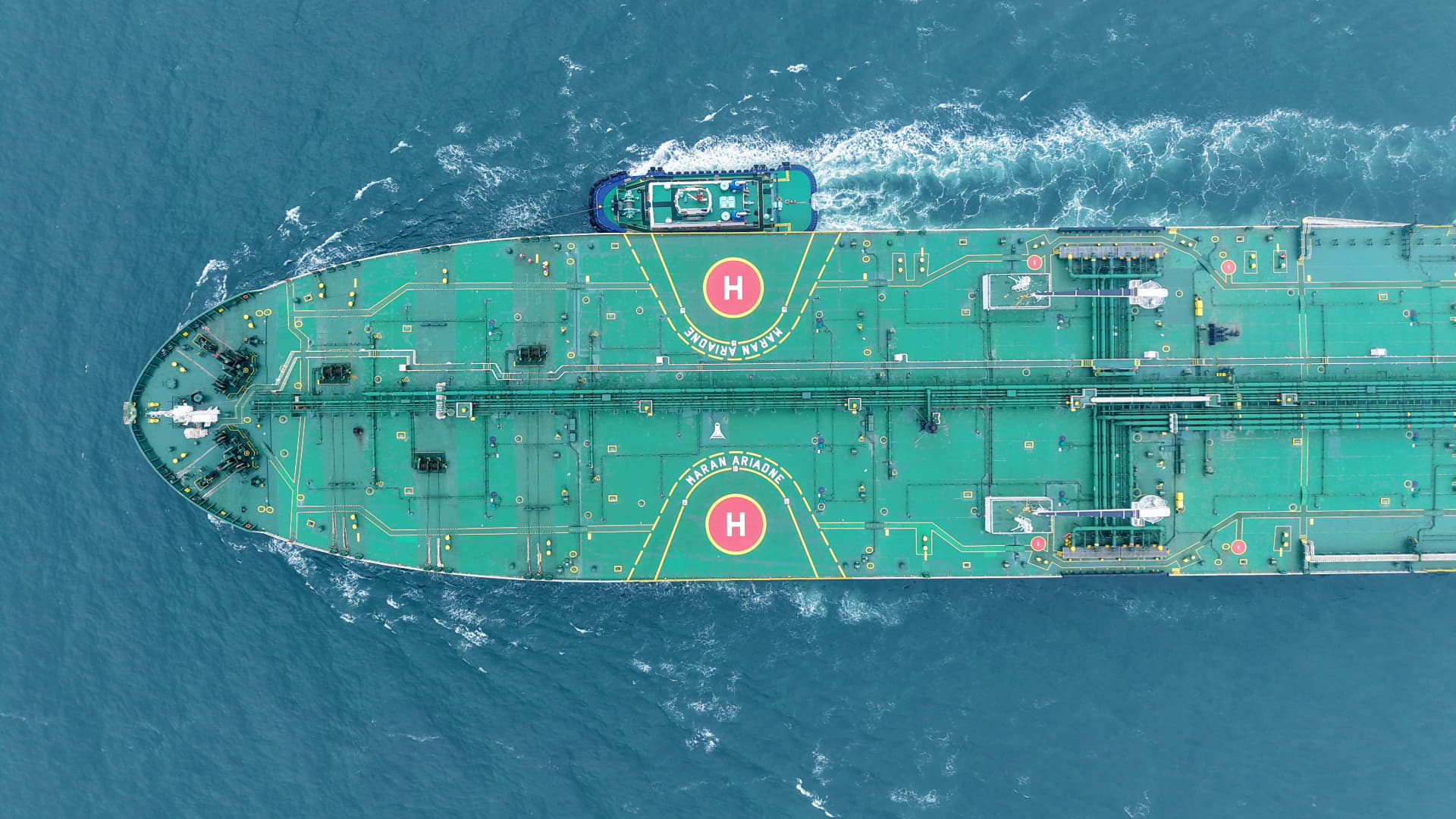
The global oil and gas investment landscape is currently being reshaped by an escalating crisis in the Middle East, leading to an unprecedented surge in supertanker freight rates. Geopolitical tensions, stemming from recent U.S. and Israeli actions against Iran, have introduced significant uncertainty into the vital Strait of Hormuz, threatening a key artery for global energy flows. This volatility has not only sent Very Large Crude Carrier (VLCC) daily rates soaring to historic highs but also injects a new layer of complexity for investors grappling with supply chain resilience, insurance costs, and the delicate balance of crude oil markets. As OilMarketCap’s proprietary data reveals, the immediate market reaction is a mixed bag, with implications that demand careful scrutiny from energy investors.
Supertanker Rates Hit All-Time High Amid Hormuz Disruption
The most immediate and dramatic impact of the recent escalation in the Middle East is seen in the shipping sector. The benchmark freight rate for VLCCs, capable of transporting two million barrels of crude, rocketed to an all-time high of $423,736 per day on Monday. This staggering figure represents an increase of more than 94% from Friday’s close, reflecting the sudden and severe disruption to maritime operations in the Persian Gulf. This spike is directly attributed to major marine war risk providers, including prominent names like the New York-based American Club, Norway’s Gard and Skuld, Britain’s NorthStandard, and the London P&I Club, initiating a widespread withdrawal of war risk coverage for vessels operating in the region. Despite U.S. military denials, a senior Iranian Revolutionary Guards official’s claim of closing the Strait of Hormuz, coupled with reports of attacks on multiple ships, has created an environment of extreme risk aversion among shipowners and charterers.
While the immediate focus is on the skyrocketing shipping costs, it’s essential to contextualize this within the broader crude market. As of today, Brent Crude trades at $93.9, marking a modest daily gain of 0.71%, with WTI Crude at $90.38, up 0.79%. This contrasts with the source article’s suggestion of a “significant jump in oil and gas prices” alongside the tanker rate surge. In fact, our proprietary 14-day Brent trend data shows a substantial decline from $118.35 on March 31 to $94.86 on April 20, representing a nearly 20% drop just prior to this latest geopolitical shock. This suggests that while the current conflict is driving up the cost of transport, the underlying crude price reaction is still absorbing a period of downward pressure, indicating that the market may not yet be fully pricing in a prolonged or severe supply disruption from the Strait of Hormuz closure, or other market fundamentals are exerting counter-pressure.
The Strait of Hormuz: A Chokepoint Under Pressure
The strategic importance of the Strait of Hormuz cannot be overstated. It is estimated that roughly one-third of all seaborne crude oil trade, alongside 19% of global liquefied natural gas (LNG) flows and 14% of global refined products trade, navigates this narrow waterway. The effective halt of shipping traffic, even if unofficial and disputed, creates a formidable challenge for global energy supply chains. Oil producers in the Middle East, while maintaining operational ports in the UAE, Oman, and Kuwait, face the critical hurdle of finding willing and insured vessels to transport their output. The withdrawal of war risk coverage means that even if ports remain open, the cost and risk profile for transiting the region become prohibitively high, effectively creating a bottleneck regardless of official closure status.
For investors, this situation elevates the risk profile across the entire energy value chain. Companies with significant exposure to Middle Eastern crude production or LNG exports face potential disruptions to their loading schedules and increased operational costs. Furthermore, refiners and consumers globally could see higher delivered prices for crude and refined products, and a tightening in LNG markets, as longer, alternative routes are explored or supply is constrained. The situation underscores the fragility of global energy flows when key chokepoints are threatened by geopolitical instability.
Investor Questions and Forward-Looking Catalysts
Our proprietary reader intent data reveals a palpable sense of uncertainty among investors this week, with common questions revolving around the direction of WTI crude and end-of-year oil price predictions. This anxiety is understandable given the current volatility. The dramatic spike in supertanker rates, while indicating immediate supply chain stress, doesn’t automatically translate into a sustained oil price rally if underlying demand remains weak or if alternative supplies can be quickly secured.
Looking ahead, several upcoming calendar events could provide crucial insights into how this situation evolves. The **OPEC+ JMMC Meeting on April 21 (Tuesday)** will be critical. Any pronouncements regarding production policy or supply responses to the regional instability will be closely watched. Subsequent **EIA Weekly Petroleum Status Reports on April 22 (Wednesday) and April 29 (Wednesday)**, along with **API Weekly Crude Inventory data on April 28 (Tuesday) and May 5 (Tuesday)**, will offer real-time indicators of inventory levels and potential supply disruptions. Furthermore, the **EIA Short-Term Energy Outlook on May 2 (Saturday)** will provide updated forecasts that will undoubtedly factor in the heightened geopolitical risk. Investors should pay close attention to these data points, as they will help distinguish between short-term market jitters and more fundamental shifts in supply-demand dynamics.
Navigating Investment Risks and Opportunities
The current environment presents both heightened risks and potential opportunities for astute energy investors. The immediate risk lies in the potential for sustained disruption to shipping through the Strait of Hormuz, which could lead to a more significant and prolonged impact on crude, LNG, and refined product prices. Companies with robust logistics networks outside the immediate conflict zone, or those with diversified energy sources, may prove more resilient. Investors should also consider the potential for increased demand for alternative shipping routes or for crude from non-Middle Eastern sources.
While the geopolitical premium on crude prices might seem modest today given the previous two-week decline, the cost of moving oil has demonstrably surged. This cost increase will ultimately feed into consumer prices. Investors should analyze companies’ exposure to maritime insurance costs and their ability to absorb or pass on higher freight rates. Beyond the immediate crisis, the situation reinforces the long-term importance of energy security and diversification. As the market grapples with these complexities, monitoring our proprietary data streams and upcoming energy events will be essential for making informed investment decisions in these turbulent times.