The Geopolitical Premium Returns: Mideast Tensions Reignite Crude Volatility
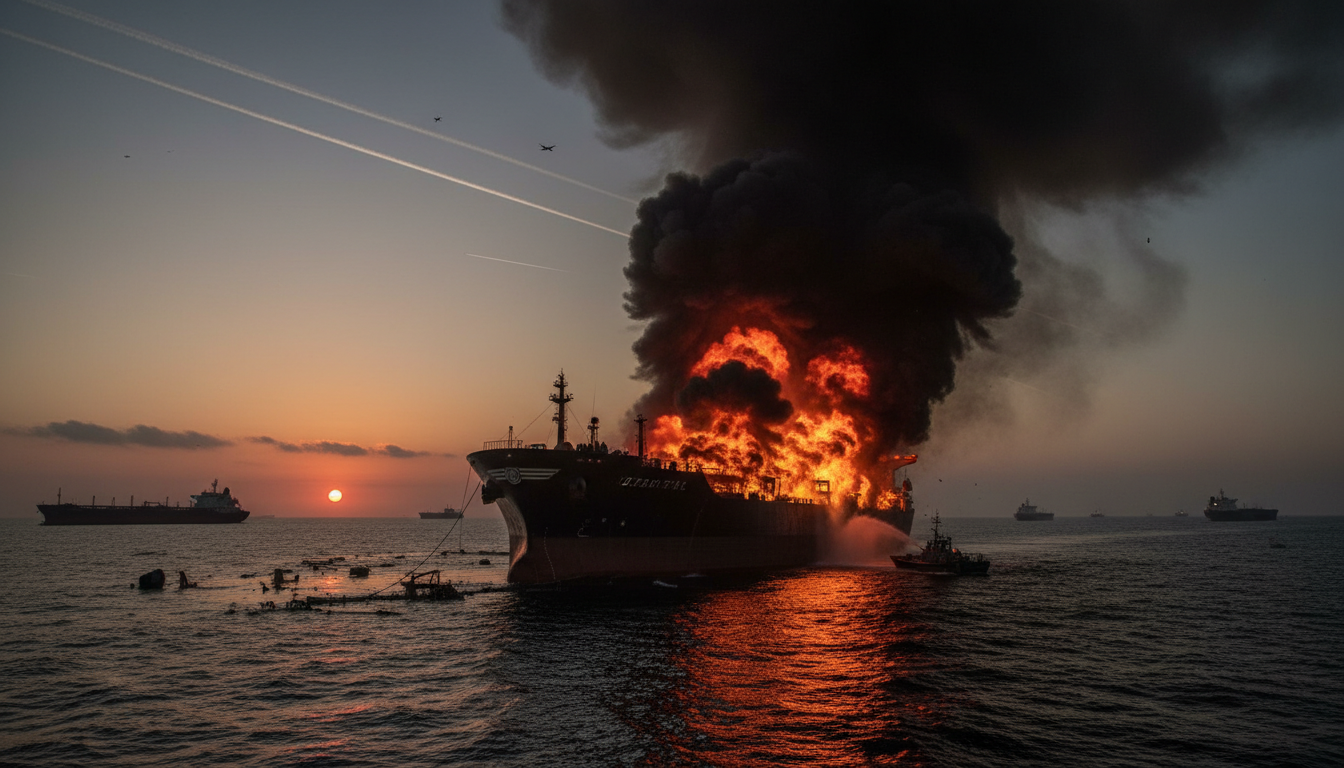
Global crude oil markets are once again grappling with a significant geopolitical premium, as escalating tensions in the Middle East directly threaten critical shipping lanes and energy infrastructure. A recent attack on a fully-loaded crude oil tanker anchored off Dubai Port served as an immediate catalyst, sending benchmarks sharply higher. This incident, attributed to Iranian actions, underscores the persistent vulnerability of global energy supplies originating from one of the world’s most vital transit zones. For investors, this translates into renewed focus on supply risk, potential price upside, and the intricate dynamics of regional stability impacting global energy security.
Market Reacts Swiftly as Supply Fears Re-emerge
The market’s immediate reaction to the tanker attack was decisive, with crude benchmarks surging. As of today, Brent crude trades at $94.95, marking a significant 5.06% increase, while WTI sits at $87.27, up 5.67%. This abrupt upward movement stands in stark contrast to the recent 14-day trend, which saw Brent decline by nearly 20%, from $112.78 on March 30th to $90.38 just last week. The sharp reversal highlights the market’s extreme sensitivity to any disruption in the Persian Gulf, a region pivotal for global oil flows. The Kuwait-flagged Al-Salmi tanker, reportedly set ablaze and sustaining hull damage, not only represents a direct threat to supply but also raises concerns about a significant oil spill – an environmental and economic hazard that further compounds investor anxiety. Dubai authorities swiftly deployed firefighting teams, and fortunately, all 24 crew members were secured without injury, but the incident’s broader implications for operational risk remain a primary concern for stakeholders.
Escalating Maritime Risks Elevate Operational Costs and Supply Vulnerability
The strike on the Al-Salmi is far from an isolated event; it represents the latest in a troubling pattern of aggressions targeting merchant vessels navigating the Gulf and the strategic Strait of Hormuz. Since a critical incident involving the U.S. and Israel on February 28th, the region has witnessed a series of assaults employing missiles and both aerial and sea-based explosive drones. This persistent threat matrix presents a formidable challenge for maritime insurance costs, shipping schedules, and ultimately, the predictable delivery of global energy supplies. Lloyd’s List Intelligence data indicates that Kuwait Petroleum Corp (KPC), the parent entity of the Al-Salmi’s registered owner, has initiated a comprehensive damage assessment. This evaluation will be crucial in determining the tanker’s operational status and the broader financial implications for its stakeholders. Furthermore, an earlier incident on the same Monday involving a Greek-owned container ship off Saudi Arabia’s Ras Tanura, where unidentified projectiles impacted the water near the vessel, underscores the pervasive nature of these maritime risks. For investors in the oil and gas sector, these developments translate directly into increased operational risks for transport and potential upside for crude prices due to constrained supply perceptions and higher shipping premiums.
Navigating Uncertainty: Investor Sentiment and Upcoming Catalysts
The recent volatility has left many investors grappling with directional uncertainty, as evidenced by questions in our proprietary data asking, “is WTI going up or down?” While the immediate sentiment is undeniably bullish on supply fears, the coming weeks will offer critical data points and events that could shape the trajectory of crude prices. Upcoming energy events on our calendar are particularly relevant. The OPEC+ Joint Ministerial Monitoring Committee (JMMC) Meeting on April 20th, followed by the full OPEC+ Ministerial Meeting on April 25th, will be paramount. These meetings provide the consortium an opportunity to re-evaluate production quotas in light of increased geopolitical risk and market tightness, or to maintain current cuts to further support prices. Any signals regarding supply adjustments will have a profound impact on market sentiment. Furthermore, weekly data releases such as the API Crude Inventory (April 21st, April 28th) and the EIA Weekly Petroleum Status Report (April 22nd, April 29th) will offer crucial insights into short-term supply and demand dynamics in the U.S., which will interact with the overarching geopolitical narrative. The Baker Hughes Rig Count on April 24th and May 1st will also provide indicators on future supply capabilities.
Strategic Implications: A Persistent Geopolitical Risk Premium
Beyond the immediate price movements, these escalating tensions in the Middle East signal a return to a persistent geopolitical risk premium in crude oil. This isn’t merely about single incidents but rather a broader pattern of regional aggression that fundamentally alters the risk profile of investing in the energy sector. Companies with significant exposure to Gulf shipping lanes or regional production may face sustained higher insurance costs and operational complexities. Investors should consider how this impacts the long-term energy security strategies of importing nations and the potential for increased investment in diversified supply sources or alternative transport routes, such as pipelines that bypass maritime chokepoints. For integrated oil and gas majors, the diversity of their global asset base may offer some insulation, while smaller, regionally-focused producers and shippers will feel the brunt of these increased risks most directly. As the situation evolves, monitoring both the diplomatic efforts and military postures in the region will be as crucial as tracking traditional supply and demand fundamentals for making informed investment decisions in the coming months.


