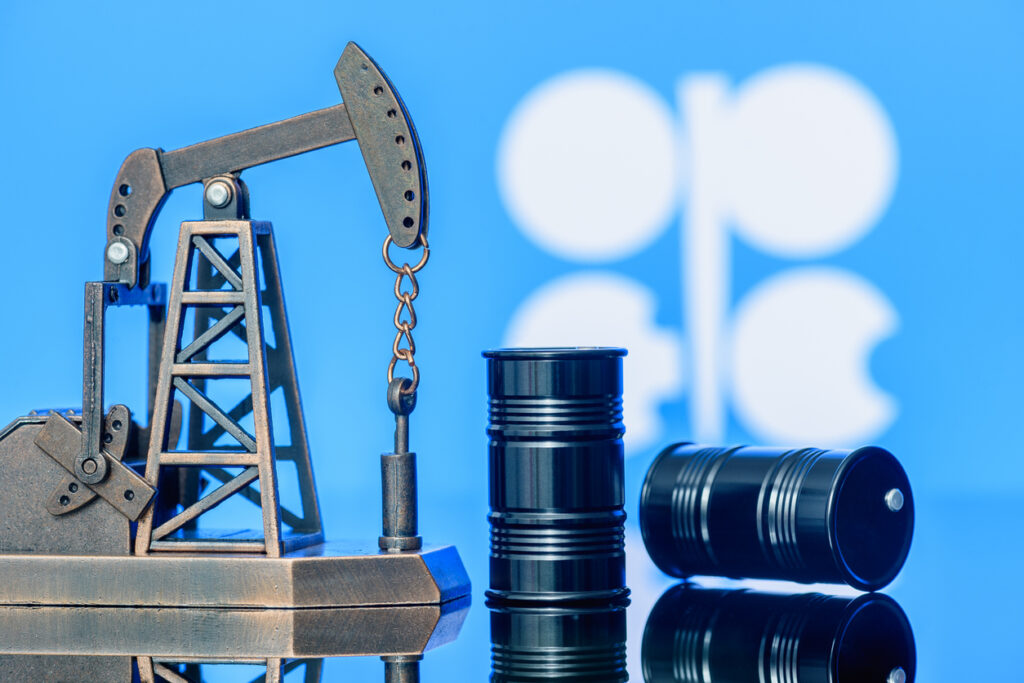
Crude oil markets are navigating a treacherous path, marking their third consecutive monthly decline as a confluence of bearish factors weighs heavily on investor sentiment. This sustained downward pressure has pushed prices significantly lower, challenging previous assumptions about supply-demand balances and prompting a reassessment of investment strategies. From weakening global demand signals to anticipated supply boosts and geopolitical realignments, the market is signaling a shift that demands close attention from energy investors.
The Current Market Reality: A Sharp Reversal in Crude Fortunes
The recent trajectory of oil prices reflects a stark shift in market dynamics. As of today, Brent crude trades at $90.38 per barrel, registering a substantial 9.07% decline within the trading day and marking a nearly 20% drop from its $112.78 perch just two weeks prior. West Texas Intermediate (WTI) crude mirrors this trend, currently priced at $82.59 per barrel, down 9.41% today. This aggressive sell-off follows a pattern of monthly declines, driven by concerns over global economic health, particularly in key consuming nations, and the prospect of increased supply.
A key contributor to this bearish sentiment is the sustained strength of the U.S. dollar, which makes dollar-denominated commodities like oil more expensive for international buyers. Simultaneously, preliminary data from the U.S. Energy Information Administration indicates robust non-OPEC supply growth, with U.S. crude output reportedly reaching 13.6 million barrels daily in the week leading up to October 24th. This surge in production from outside the OPEC+ alliance naturally adds downward pressure on prices, even as global inventories remain a focus for traders.
OPEC+ at a Crossroads: Navigating Future Supply and Geopolitics
All eyes are now firmly fixed on the upcoming OPEC+ meetings, with the Joint Ministerial Monitoring Committee (JMMC) scheduled for April 19th, followed by the full Ministerial Meeting on April 20th. These meetings are critical as the market widely anticipates discussions around potentially adding more barrels to production. Reports suggest OPEC+ could agree on an additional 137,000 barrels per day (bpd) production boost for December 2026, a move designed to stabilize markets and potentially mitigate any perceived supply risks. Investors are keenly asking about OPEC+’s current production quotas and how any adjustments will impact global supply balances, especially given the current price environment.
The alliance faces a delicate balancing act. While U.S. sanctions targeting Russian oil companies introduce potential supply risks, the market’s reaction suggests skepticism about their actual impact on global flows. Discussions between President Trump and President Xi regarding broader trade, which did not explicitly involve Russian oil flows to China, further reinforced market conviction that significant Russian supply disruptions are unlikely. China remains a crucial buyer for Russian oil, and its stance significantly influences the effectiveness of such sanctions. The decision by OPEC+ in the coming days will be pivotal in shaping short-to-medium term price expectations, particularly as non-OPEC supply continues its ascent.
Demand Headwinds: China’s Economic Pulse and Global Implications
Beyond supply considerations, a significant demand-side shock has emanated from China, the world’s largest oil importer. Recent data indicated that factory activity in China contracted more than analysts expected in October, with the Purchasing Managers’ Index (PMI) reading falling to 49.0 against an anticipated 49.6. This marks the lowest point in six months and signals a pronounced slowdown in the industrial engine of the global economy. Such a contraction in manufacturing directly translates to reduced energy consumption, casting a long shadow over the demand outlook for crude oil.
This weakening economic pulse in China, combined with the aforementioned strengthening U.S. dollar, creates a formidable headwind for oil prices. Investors are increasingly concerned about the potential for a broader global economic slowdown, which could further erode demand for petroleum products. The implications are significant, as China’s appetite for energy has historically been a primary driver of global oil demand growth. Any sustained weakness there will require a fundamental re-evaluation of demand forecasts for the remainder of 2026 and beyond.
Navigating Volatility: Investor Outlook and Key Market Indicators
The current market environment presents both challenges and opportunities for oil and gas investors, many of whom are asking critical questions such as, “What do you predict the price of oil per barrel will be by end of 2026?” While precise price predictions are inherently difficult given the multitude of variables at play, the immediate focus for investors should be on key market indicators and upcoming events. The OPEC+ decisions this weekend will set the tone for supply expectations, but regular inventory data will provide insights into real-time demand and storage levels.
Investors should closely monitor the API Weekly Crude Inventory reports on April 21st and 28th, followed by the official EIA Weekly Petroleum Status Reports on April 22nd and 29th. These releases offer crucial glimpses into U.S. crude stockpiles, production, and product demand. Additionally, the Baker Hughes Rig Count, scheduled for April 24th and May 1st, will provide an indication of drilling activity and future supply potential from North American producers. Understanding these data points, alongside broader macroeconomic trends and geopolitical developments, is essential for positioning portfolios in a market characterized by high volatility and shifting fundamentals. For companies like Repsol, which some investors are tracking closely, their performance will be heavily influenced by these overarching market dynamics and their ability to adapt to a lower-price environment.