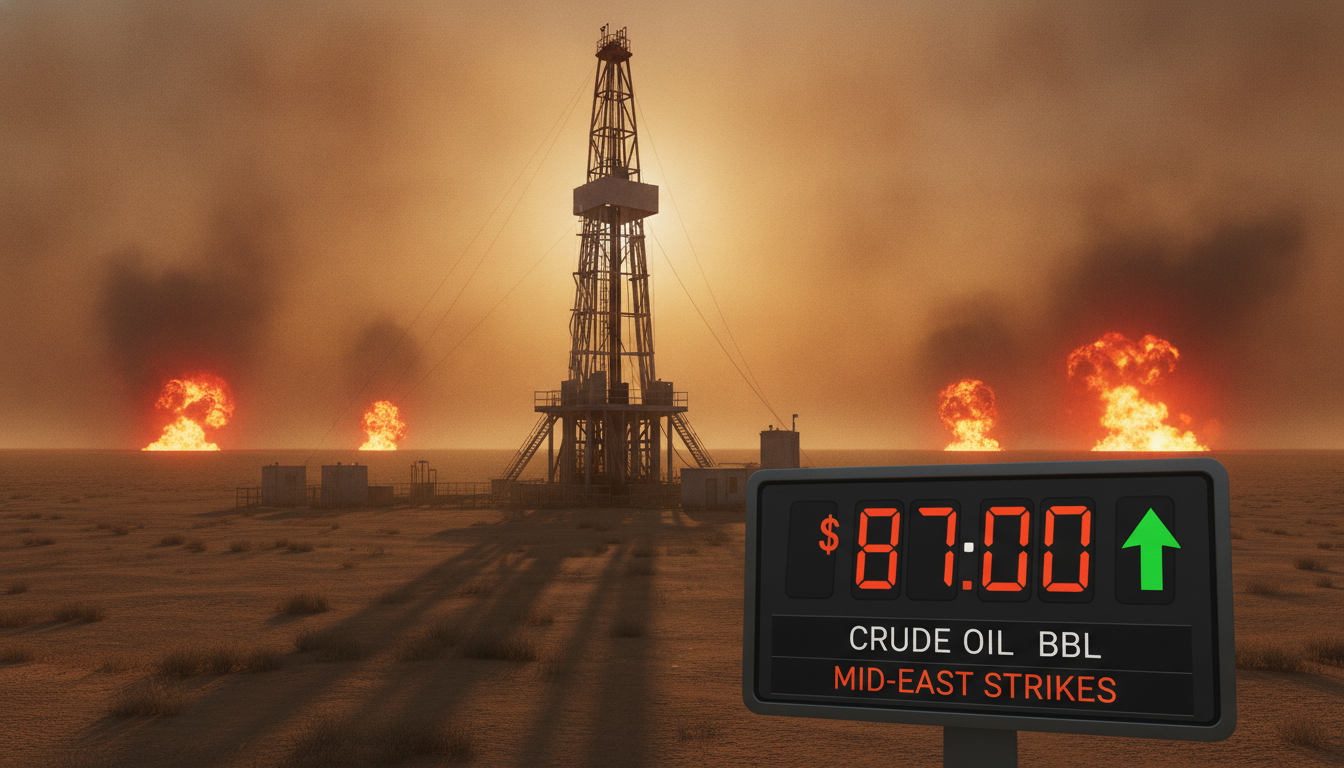
Geopolitical Volatility Fuels Sharp Oil Price Rally
Global oil markets experienced a significant upward surge on Monday, with crude benchmarks climbing by over $2 per barrel. This sharp increase reflects a renewed wave of geopolitical tension in the Middle East, specifically triggered by Israel’s latest military actions against Lebanon over the weekend. The strikes effectively extinguished nascent hopes for a broader de-escalation in regional conflicts and, critically, dimmed prospects for the vital Strait of Hormuz to see unrestricted crude flows return, leaving investors to grapple with tighter supply concerns.
Crude Benchmarks Rebound Aggressively
For energy investors, the market reaction was immediate and pronounced. U.S. West Texas Intermediate (WTI) crude futures advanced by $2.10, representing a 2.32 percent gain, to settle at $92.64 per barrel as of 0013 GMT. Concurrently, the international benchmark, Brent crude futures, saw an even more robust increase of $2.33, or 2.5 percent, pushing prices to $95.42 a barrel. This rapid appreciation effectively erased the majority of losses incurred on Friday, which had been driven by earlier, more optimistic assessments of a potential easing in the U.S.-Iran standoff—a flashpoint that originated with joint U.S. and Israeli military operations against Iranian targets in February.
The Persistent Threat to the Strait of Hormuz
The latest Israeli operations, launched on Sunday despite a previously negotiated truce with Lebanon, have introduced substantial new obstacles to any meaningful peace settlement between Washington and Tehran. Iran has consistently reiterated that a full ceasefire with Lebanon remains a prerequisite for any peace accord with the United States, underscoring the interconnected nature of regional stability. Following the Israeli strikes in Beirut, which reportedly targeted the Iran-backed Hezbollah group, Iran responded by launching missiles toward Israel. In an attempt to prevent an uncontrolled escalation, U.S. President Donald Trump indicated his intention to advise Israeli Prime Minister Benjamin Netanyahu against any further retaliatory actions against Iran.
This cycle of aggression directly impacts the global energy landscape, particularly concerning the Strait of Hormuz. The wider regional conflict, which had observed a period of relative calm since U.S. and Israeli attacks on Iran ceased in early April, has seen Tehran maintain significant restrictions on most shipping through this critical maritime artery. The Strait of Hormuz serves as the world’s most crucial choke point for oil and gas shipments, and its sustained disruption continues to fuel an underlying global supply crisis. Israel’s initial invasion of Lebanon in March, provoked by cross-border rocket and drone attacks from Hezbollah, laid the groundwork for the current volatile environment, with efforts toward peace consistently faltering despite agreements.
Indeed, while Lebanon and Israel had announced a ceasefire agreement on June 3 following negotiations facilitated in Washington, and even an earlier cessation of hostilities in April, the recent violence regrettably demonstrates the fragility of these accords. The inability to secure lasting peace and normalize shipping through Hormuz keeps a substantial geopolitical risk premium embedded in oil prices, directly impacting investor confidence and supply expectations.
OPEC+’s Output Hike Drowned Out by Supply Realities
Against this backdrop of escalating tensions and persistent supply concerns, the OPEC+ alliance convened on Sunday and agreed to implement its fourth consecutive monthly increase in oil production. However, market analysts were quick to dismiss the immediate practical impact of this decision. Experts widely contend that the physical realization of such an output boost will likely be negligible in the current market climate. Many OPEC+ member nations already struggle significantly to meet their existing production quotas, a challenge exacerbated either by the severe operational constraints imposed by the Hormuz closure or, in the case of Russia, by ongoing infrastructure damage that has steadily eroded its production capacity.
Jorge Leon, head of geopolitical analysis at Rystad Energy, articulated this sentiment clearly in a recent note to clients, stating, “In the current market, the physical impact of such a decision would be close to zero.” This expert assessment underscores a critical reality for investors: while the cartel may officially announce production increases, the tangible supply reaching the global market remains heavily constrained by both regional instability and practical limitations faced by producers. This disconnect between announced policy and actual market impact highlights the deep structural challenges confronting global oil supply amidst the Middle East’s geopolitical quagmire.
Investor Outlook: Navigating Persistent Volatility
For investors focused on the energy sector, the current volatile environment unequivocally signals the enduring and significant geopolitical risk premium now firmly embedded in crude oil prices. While the OPEC+ alliance continues its attempts to stabilize markets through supply management, the practical limitations on its members and the relentless regional instability remain the dominant forces dictating global supply realities. The Strait of Hormuz stands as the singular most critical choke point, its operational status directly influencing international energy security and, consequently, crude valuations. Market participants must maintain heightened vigilance regarding developments across the Middle East, as these events possess the immediate and profound capacity to redefine oil’s price trajectory, often overshadowing conventional supply-demand fundamentals and even the interventions of major producing cartels. Long-term strategies must factor in this heightened geopolitical uncertainty as a permanent fixture in the oil market landscape.


