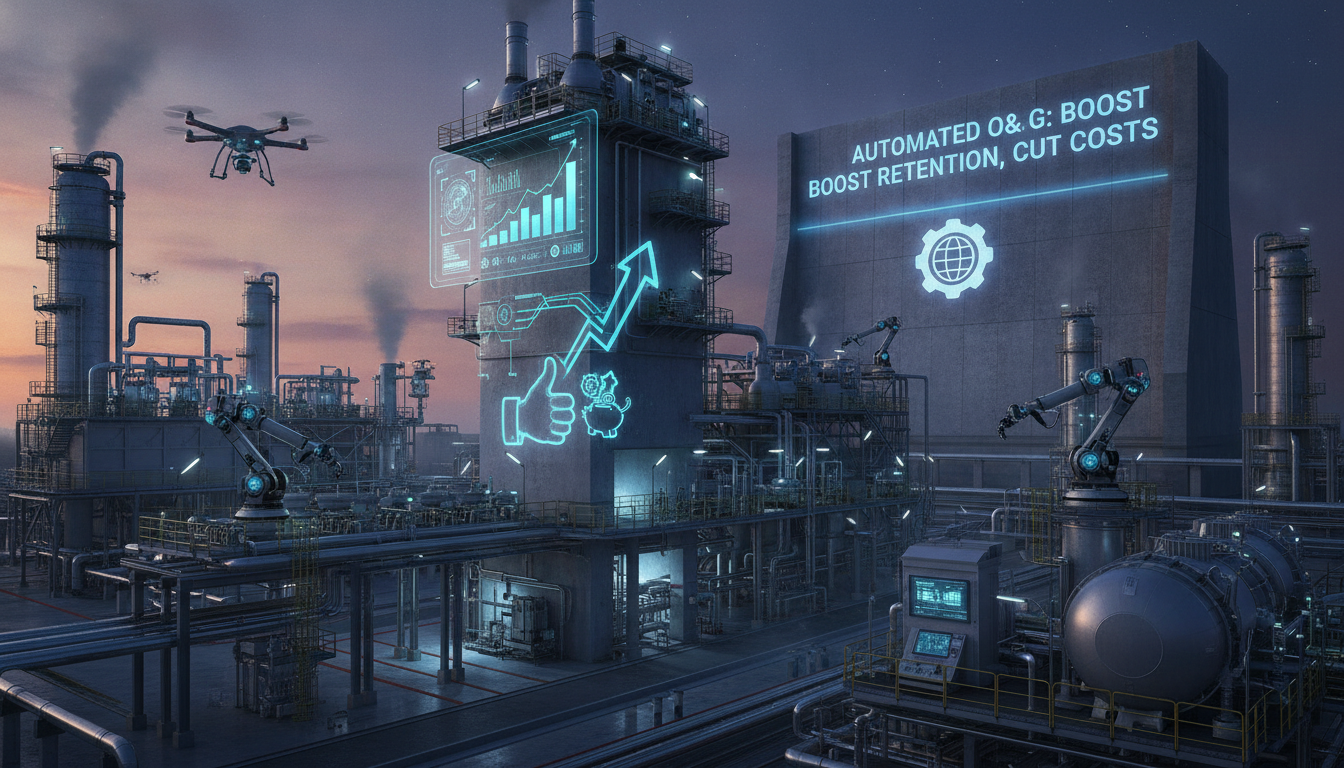
Revolutionizing Oil & Gas: The Pragmatic Path to Robotic Efficiency
For investors keenly observing the energy landscape, the promise of automation continues to reshape operational paradigms. While much of Silicon Valley chases the ambitious vision of general-purpose humanoid robots, a more grounded, immediate transformation is taking hold, focusing on specialized, task-specific robotics. This pragmatic approach offers tangible pathways to enhanced efficiency, improved safety, and optimized labor allocation across the demanding oil and gas sector.
Felipe Chavez, co-founder and CEO of a leading automation firm, champions a future where robotics liberates human potential from the mundane. His vision isn’t about mechanical overlords but rather a harmonious ecosystem where machines handle the unappealing, repetitive physical tasks, allowing human talent to focus on more complex, value-added endeavors. This philosophy directly addresses critical challenges within the oil and gas industry, from remote inspections to material handling in hazardous environments.
Targeted Automation: Unlocking Operational Value
Chavez’s journey into automation began with a firsthand understanding of labor intensity. Reflecting on his initial grocery delivery startup in Colombia, the executive personally experienced the exhausting and unstimulating nature of manual work. This insight became the bedrock for his current venture, which initially specialized in campus robot delivery before expanding its focus to a broader suite of automation solutions.
Today, this firm boasts an impressive deployment of over 500 operational robots, having successfully completed more than 2.5 million tasks. While approximately 400 of these currently serve in delivery roles, the company has strategically diversified into crucial areas such as warehousing, food service, and even mobile advertising. For the oil and gas sector, the underlying technology enabling these deployments — robust autonomous navigation, material transport, and precise task execution — represents a significant leap forward for optimizing field operations, logistics, and supply chain management.
The “Two-Finger Rule”: Precision Automation for Complex Industries
Unlike the broad strokes of general-purpose humanoid development, this automation pioneer advocates for an ecosystem of purpose-built robots, each designed for specific functions. Chavez illustrates this with an anecdote from his food-delivery business: as robot deliveries scaled, restaurant staff faced a new, repetitive chore of placing items into the robots. This friction highlighted the need for a “manipulation solution”—a robot capable of grasping and handling items. This experience solidified a key strategic principle: analyze labor by breaking it into discrete tasks to identify prime candidates for robotic intervention.
The company’s future robotics pipeline adheres to a simple yet powerful guideline: “If you can do it with two fingers, very likely we will be able to do it.” This “two-finger rule” offers a clear investment thesis for the oil and gas industry. Consider the vast number of tasks in exploration, production, refining, and distribution that involve precise manipulation, component handling, valve operation, or sample collection. Automating these focused, repetitive actions with specialized robots promises to significantly boost operational efficiency and reduce human error, directly impacting the bottom line.
Beyond Replacement: Enhancing Workforce Satisfaction and Safety
While the allure of a fully automated future dominates headlines, this firm’s vision is far more grounded in near-term, impactful applications within industrial settings. The focus isn’t on replacing the entire workforce but on enhancing job quality and reducing turnover—a critical concern in the oil and gas sector, which often struggles with labor shortages and the retention of skilled personnel. Chavez notes that his current roster of approximately 20 enterprise clients prioritizes improving workforce satisfaction and mitigating the high turnover associated with monotonous or physically demanding roles.
“The people that are working right now are going to feel better,” Chavez explains, envisioning a scenario where employees are freed from repetitive tasks to concentrate on customer-centric experiences or more complex problem-solving, thereby increasing retention beyond the typical seven-month industry average. This aligns with a broader industry trend where automation is seen as a tool for upskilling the human workforce, not displacing it entirely. In the demanding oil and gas environment, this translates to safer operations, fewer incidents caused by fatigue, and a more engaged, highly skilled workforce managing sophisticated robotic assets.
Robotics in Oil & Gas: A Solarpunk Vision for Energy Infrastructure
The pragmatic approach to robotics, focusing on specialized applications and workforce enhancement, resonates deeply with the “solarpunk” movement—a vision that counters dystopian cyberpunk narratives by promoting a future where advanced technology coexists harmoniously with a sustainable environment and empowered human societies. In the context of the oil and gas industry, this translates into a future where robots autonomously inspect pipelines, monitor emissions, transport equipment across sprawling sites, and even assist in maintenance, all while human operators manage, analyze, and innovate.
The vast scale of the oil and gas industry presents immense opportunities for this type of focused automation. Consider the 3.8 million fast-food and counter workers, 3 million material movers, and 2.8 million stockers and order fillers identified by the Bureau of Labor Statistics in 2024. While these statistics relate to broader industries, the underlying types of physical, repetitive tasks are ubiquitous in energy operations. From inventory management in large warehouses to moving heavy equipment on rigs, the potential for specialized robotics to optimize these functions is enormous.
Ultimately, the human element remains central. As Chavez notes, humans will always be essential for maintaining and guiding robotic systems, whether through remote operation or direct training. For oil and gas investors, backing companies that embrace this practical, human-centric approach to automation means investing in a future of safer, more efficient, and more sustainable energy production—a robust investment thesis built on tangible technological advancement rather than speculative hype.


