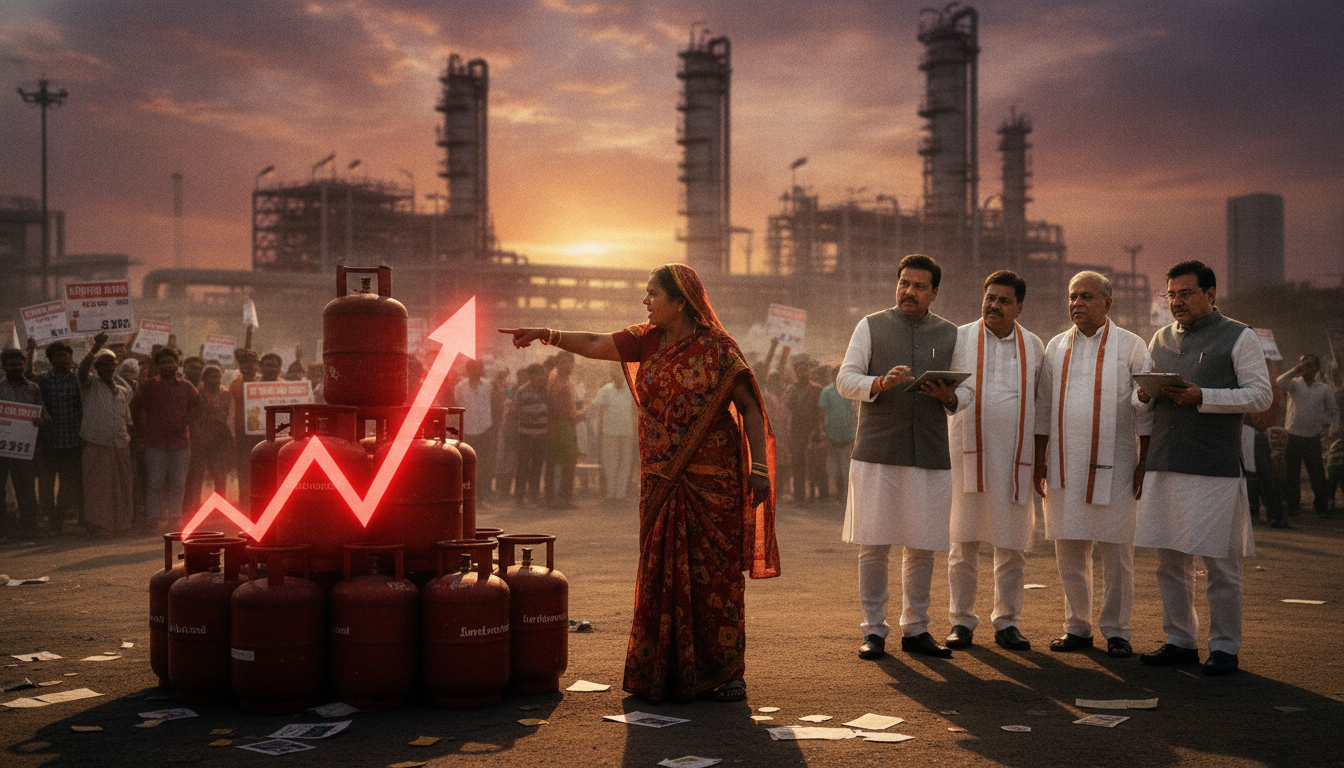
India’s LPG Pricing Dilemma: Geopolitical Pressures Meet Domestic Politics
The Indian energy market is currently navigating a complex confluence of global commodity volatility and intense domestic political scrutiny, highlighted by the recent adjustment in liquefied petroleum gas (LPG) prices. Investors closely monitoring India’s energy landscape are observing the government’s delicate balancing act between absorbing international price surges and shielding its vast consumer base from inflationary pressures. This dynamic creates both challenges and opportunities within the nation’s rapidly expanding energy sector.
Effective recently, the price of a standard 14.2-kilogram domestic LPG cylinder in Delhi increased to ₹942 from its previous ₹913. While this revision directly impacts millions of households, the government has maintained a subsidy mechanism for beneficiaries of the Pradhan Mantri Ujjwala Yojana (PMUY). These households continue to receive an effective price of ₹642 per cylinder, thanks to a ₹300 per refill subsidy. However, a notable policy shift limits this subsidy to the first four refills annually, a reduction from the nine refills previously offered, signaling a potential move towards more targeted or constrained fiscal support.
Global Headwinds Drive Domestic Price Revisions
The government’s justification for the price adjustment centers on the significant uptick in international LPG benchmarks. Global LPG prices have reportedly surged by nearly 46% since February alone, primarily driven by supply disruptions and heightened geopolitical tensions in West Asia and the crucial Strait of Hormuz. This steep rise has pushed the cost of supplying a domestic LPG cylinder in India to over ₹1,600, according to official statements. India, being a substantial importer of LPG, remains susceptible to these international market fluctuations.
Despite the recent increases, the government asserts that Indian households still benefit from some of the most competitive cooking gas prices globally. Comparative data indicates that India’s domestic LPG prices are lower than those in neighboring countries such as Pakistan, Nepal, Bangladesh, and Sri Lanka. Furthermore, they remain significantly below prices observed in advanced economies, including the United States, Australia, and Canada, underscoring the extent of government intervention in modulating consumer costs.
Opposition Mounts Criticism Over Inflationary Impact
The latest price hike has ignited a fierce political debate, with opposition parties vociferously criticizing the Modi government. Congress President Mallikarjun Kharge highlighted a ₹89 increase in domestic LPG cylinder prices over the last four months alone, and a staggering ₹530 increase over the past 12 years. He questioned the government’s claims of diversifying fuel sources in response to the West Asia conflict, arguing that ordinary citizens continue to bear the brunt of rising costs.
NCP (SP) chief Sharad Pawar warned of a “political price” for frequent hikes in essential commodities, emphasizing the cumulative impact of incremental increases on household budgets. Leaders from the Kerala Assembly, Shiv Sena (UBT), Aam Aadmi Party (AAP), and PMK have echoed these sentiments, alleging that international events are being used as an excuse to burden citizens and demanding an immediate rollback of the “anti-people” decision. Critics like Aaditya Thackeray further point out the disparity between comparing India’s fuel prices with other nations without considering per capita income differences.
Navigating Geopolitical Risks and Ensuring Supply Security
Union Minister Pralhad Joshi acknowledged the regret over price increases but stressed the severity of the global crisis, particularly the limited sources for LPG supply. From an energy security perspective, India has demonstrated resilience in maintaining an uninterrupted flow of energy shipments through the Strait of Hormuz during the recent crisis, a testament to its robust supply chain management and strategic foresight. The nation has also proactively ramped up domestic LPG production and diversified its sourcing arrangements to safeguard availability.
The BJP, defending the government’s position, pointed out that global LPG prices have surged significantly, and the government has shielded consumers from the full impact. Amit Malviya, head of BJP’s IT department, reiterated that Indian households continue to access cooking gas at some of the lowest prices worldwide, emphasizing the government’s role in moderating consumer prices despite linking petroleum products to international market rates.
Investor Outlook: Balancing Policy and Market Forces
For investors, India’s LPG pricing dynamics present a multi-faceted risk and opportunity profile. The government’s commitment to modulating consumer prices, while beneficial for social stability, implies ongoing fiscal expenditures through subsidies, which can impact broader economic planning. The reliance on international markets for a significant portion of LPG supply means that global commodity price volatility will remain a key determinant of domestic pricing policy and government support mechanisms.
The political sensitivity surrounding fuel prices, particularly in the run-up to elections, suggests that government intervention will likely remain a significant factor in the Indian energy market. Investors should closely monitor geopolitical developments in West Asia, global supply-demand balances for LPG, and the evolving domestic policy landscape regarding energy subsidies. India’s strategic efforts to diversify energy sources and enhance domestic production offer long-term stability, but the immediate future will likely see a continued tension between market economics and political imperatives in the world’s third-largest energy consumer.


