The global oil market is grappling with significant bearish pressure, as crude futures experience a sharp decline driven by a complex interplay of geopolitical developments and shifting economic sentiment. Investors are currently weighing the immediate impact of peace talks on sanctions against Russia with the broader implications of central bank policy, all while anticipating critical supply-side signals.
Geopolitical Dynamics Drive Crude Lower
The most prominent headwind for crude oil prices remains the ongoing diplomatic efforts surrounding Ukraine. Reports of a revised agreement, with a deadline set for Thursday, are fueling speculation about a potential de-escalation of hostilities and, crucially, an easing of sanctions on Russia. As a major global energy producer, Russia’s potential return to full market capacity without significant export restrictions is a powerful bearish signal. Unlike typical market reactions where fresh sanctions on entities like Rosneft or Lukoil might provide a floor for prices, traders are now fixated on the prospect of existing sanctions being rolled back. This sentiment suggests that the long-term strategic implications of a peace treaty and the overall U.S. economic backdrop are outweighing immediate, smaller-scale supply disruptions.
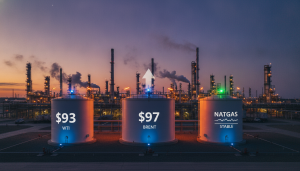
As of today, Brent crude trades at $90.61, marking a significant 8.83% decline within the trading day, with prices ranging from $86.08 to $98.97. Similarly, West Texas Intermediate (WTI) crude has fallen to $83.11, also down 8.84%, after touching lows of $78.97. This steep intraday drop is a clear indicator of the market’s immediate reaction to the perceived reduction in geopolitical risk premium.
Monetary Policy & Fading Demand Optimism
Adding another layer of complexity is the evolving outlook for monetary policy. While comments from the New York Fed have hinted at a potential willingness to ease rates later in the year, sparking some marginal increase in overall risk appetite, this has proven insufficient to reverse crude’s downward trajectory. Investors are interpreting these signals more as a counterbalance to negative economic news rather than a genuine catalyst for sustained demand growth. The broader economic picture, coupled with the potential for increased global supply, is keeping a lid on any significant upside.
This macro uncertainty compounds the pressure on oil. The current gasoline price, for example, sits at $2.94, a 4.85% drop today, indicating softening downstream demand expectations that ripple through the entire energy complex. This general weakness in refined products often precedes or accompanies broader crude price declines, reflecting a more cautious consumer and industrial outlook.
Investor Focus on Long-Term Value Amidst Short-Term Pain
Despite today’s sharp declines, crude oil has already experienced a significant correction this year, with prices down roughly 17% from their highs. Historically, such pronounced drops often trigger bargain hunting from value-oriented investors. However, the current market dynamic suggests that while interest is certainly present, large-scale buying has yet to materialize. Our proprietary data on investor intent reveals a strong forward-looking perspective, with numerous queries such as “what do you predict the price of oil per barrel will be by end of 2026?” and “How well do you think Repsol will end in April 2026.” This indicates that while short-term volatility dominates headlines, a significant segment of our readership is actively assessing longer-term value propositions, suggesting that current price levels are beginning to look attractive for strategic plays, even if conviction is still building.
The 14-day trend for Brent crude further illustrates this prolonged pressure, having fallen from $112.57 on March 27th to $98.57 by April 16th, a decline of over 12% before today’s accelerated sell-off. This consistent downward momentum suggests that technical selling pressure remains dominant, overriding tentative dips in for speculative buying.
Upcoming Catalysts: OPEC+ and Inventory Data on the Horizon
Looking forward, the next two weeks are packed with critical events that could significantly influence the trajectory of crude prices. The market’s attention is squarely focused on the upcoming OPEC+ Joint Ministerial Monitoring Committee (JMMC) meeting on April 17th, followed by the Full Ministerial meeting on April 18th. Our internal analytics show a marked increase in investor questions regarding “OPEC+ current production quotas,” highlighting the intense interest in how the cartel will respond to current market conditions. Any signals regarding production cuts, adherence to existing quotas, or even a potential shift in strategy could provide a powerful catalyst, either reinforcing bearish sentiment or offering much-needed support.
Beyond OPEC+, a steady stream of U.S. supply and demand data will offer crucial insights. The API Weekly Crude Inventory reports on April 21st and 28th, alongside the EIA Weekly Petroleum Status Reports on April 22nd and 29th, will provide real-time snapshots of U.S. crude stockpiles, refining activity, and product demand. Furthermore, the Baker Hughes Rig Count on April 24th and May 1st will shed light on North American production trends. Any surprises in these reports – particularly significant builds or draws in inventories – could trigger sharp price movements. Investors should closely monitor these data points for indications of underlying market health and potential shifts in the supply-demand balance, which will undoubtedly shape the narrative for the remainder of the second quarter.
In summary, while geopolitical hopes of easing sanctions are currently driving significant downside in crude, the market remains on high alert for signals from OPEC+ and forthcoming inventory data. The current price levels are certainly attracting long-term investors, but the lack of decisive buying suggests that conviction awaits clearer direction from both geopolitical developments and fundamental supply-demand shifts.