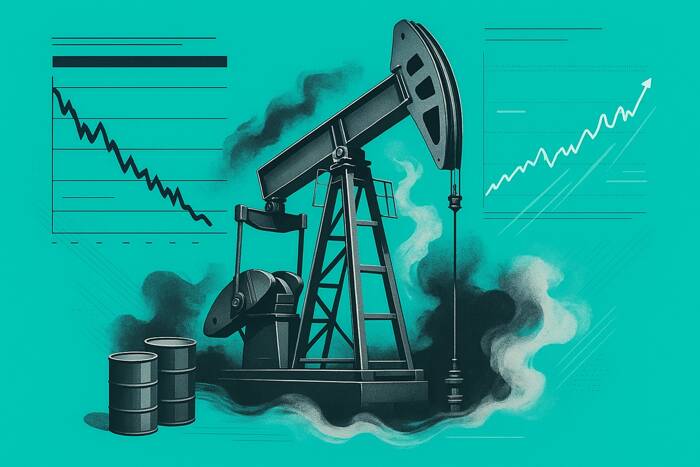
The global oil market is experiencing a significant re-pricing event, as crude futures have plunged following news of a Gaza ceasefire agreement. Investors are quickly unwinding the geopolitical risk premium that has underpinned prices for months, shifting focus back to fundamental supply and demand dynamics. This sudden pivot has led to a dramatic daily decline, challenging recent support levels and forcing a reassessment of short-term market direction.
Geopolitical Premium Evaporates: A Market Reset
The most immediate and impactful driver behind the current market downturn is the easing of Middle East tensions. A U.S.-backed ceasefire agreement between Israel and Hamas, which includes a partial Israeli withdrawal from Gaza in exchange for hostage and prisoner releases, has provided a significant sigh of relief for energy traders. The perceived threat to critical shipping lanes in the Red Sea and Suez Canal, which had acted as a substantial tailwind for crude prices, has diminished almost overnight. As of today, Brent crude has plummeted to $90.38, a sharp 9.07% decline within the trading session, while WTI crude trades at $82.59, down 9.41%. This significant daily move comes on the heels of a broader retreat, with Brent having shed $22.4, or nearly 20%, from its high of $112.78 just two weeks ago. This rapid unwinding of geopolitical risk premium, which had been baked into crude pricing since late 2023, underscores the market’s sensitivity to regional stability and its impact on global crude flows. The current market action clearly signals that investors are no longer willing to pay a premium for potential supply disruptions stemming from the conflict.
Technical Breakdown and Shifting Investor Sentiment
The sharp price declines witnessed today represent more than just a fundamental shift; they trigger significant technical implications for crude oil. While specific price targets from earlier analyses may now be outdated given the velocity of this move, the principle remains: a substantial daily drop like today’s often breaches established support levels, potentially initiating further downside momentum. The bearish crossover, where the 50-day moving average dips below the 200-day moving average, is a classic technical signal that suggests growing downside risk. This alignment indicates that short-term price strength is weakening relative to the longer-term trend, often preceding further declines if resistance holds firm. For many investors, this volatility raises critical questions. We’ve seen a surge in inquiries this week, with many readers asking about the trajectory of oil prices by the end of 2026. While predicting an exact future price is challenging, the current technical breakdown, combined with the geopolitical de-escalation, suggests that the path of least resistance for crude prices in the immediate term may be downwards, as psychological support levels are tested and broken. The market’s focus will now be on finding new, stable support amidst this re-pricing.
OPEC+ Takes Center Stage: Supply Fundamentals Regain Focus
With the geopolitical noise subsiding, the market’s attention is rapidly returning to the foundational elements of supply and demand. The spotlight now falls squarely on OPEC+ and its production policies. Many of our readers are asking about OPEC+’s current production quotas and how they might evolve. Historically, OPEC+ has played a crucial role in balancing global supply, and their upcoming decisions will be paramount. Investors will be closely watching the upcoming OPEC+ Joint Ministerial Monitoring Committee (JMMC) meeting on April 19th, followed by the full Ministerial Meeting on April 20th. These meetings are critical as the cartel will assess market conditions, evaluate compliance with existing cuts, and potentially discuss future production levels. While an earlier, smaller-than-expected output hike for November had helped mitigate oversupply concerns, the current environment demands a fresh assessment. If the market perceives an oversupply developing in the absence of geopolitical risk premium, pressure will mount on OPEC+ to maintain or even deepen production cuts to stabilize prices. The cartel’s ability to manage global crude inventories will be a key determinant of price stability in the coming months, especially now that the “war premium” is largely gone.
The Road Ahead: Navigating Supply, Demand, and Residual Risks
Looking forward, the oil market faces a complex interplay of factors beyond the immediate geopolitical calm. While the Gaza ceasefire has removed a significant layer of uncertainty, other elements could still influence price trajectory. On the demand side, concerns about global economic activity persist. Reports of potential U.S. political risks, such as a prolonged government shutdown, could weigh on energy demand by dampening economic sentiment and activity. Moreover, the broader macroeconomic landscape, including global inflation trends and central bank interest rate policies, will continue to impact industrial output and consumer spending, directly affecting oil consumption. On the supply front, while OPEC+ decisions are crucial, non-OPEC production, particularly from the U.S. shale sector, will also contribute to the overall balance. Investors should monitor weekly data releases like the API and EIA inventory reports (scheduled for April 21st/22nd and April 28th/29th) and the Baker Hughes Rig Count (April 24th and May 1st) for real-time insights into U.S. supply dynamics. While the immediate crisis in the Middle East has de-escalated, the region remains inherently volatile, meaning geopolitical risks could re-emerge quickly. For oil and gas investors, this dynamic environment necessitates vigilance and an adaptable strategy, focusing on both fundamental shifts and technical signals to navigate what promises to be a highly dynamic second quarter.


