NYC Microhubs Signal Shifting Tides for Urban Fuel Demand
The urban logistics landscape in New York City is undergoing a significant transformation, one that holds tangible implications for investors tracking the trajectory of refined petroleum product demand. The recent inauguration of several delivery microhubs across the city offers a localized yet potent indicator of evolving last-mile delivery strategies, potentially reshaping the consumption patterns for gasoline and diesel in dense metropolitan environments.
NYC’s Microhub Initiative: A Direct Challenge to Traditional Fuel Consumption
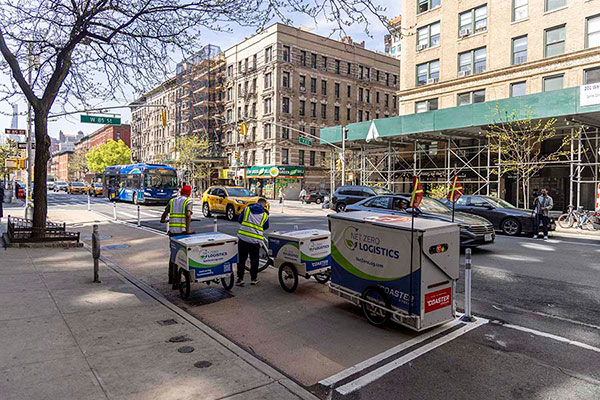
New York City has officially activated its initial microhub locations, establishing strategic transshipment points where larger delivery vehicles can offload packages. These parcels are then transferred to smaller, often human-powered, modes of transport such as cargo bikes and hand carts for the final leg of their journey. This innovative approach directly confronts the escalating challenges presented by the e-commerce boom: mitigating severe traffic congestion, eliminating pervasive double-parking incidents, and significantly curbing exhaust emissions from conventional delivery trucks that predominantly rely on diesel or gasoline.
Operations have commenced at three pioneering microhub sites situated on the Upper West Side: one at Amsterdam Avenue and West 73rd Street, another at Amsterdam Avenue and West 85th Street, and a third at Broadway and West 77th Street. Prominent logistics giants, including Amazon, UPS, and Net Zero Logistics, are among the early adopters leveraging these new facilities. This initiative forms a crucial component of the NYC Department of Transportation’s Smart Curbs program, signaling a clear governmental intent to fundamentally alter urban delivery dynamics and, by extension, directly impact the fuel consumption footprint of commercial logistics fleets.
E-commerce Growth and Its Energy Implications for Investors
The impetus driving the implementation of these microhubs stems from a dramatic and persistent shift in consumer purchasing habits. A striking statistic reveals that one in five New Yorkers now receives package deliveries on four or more days each week. This sustained surge in online shopping has inevitably led to a corresponding escalation in delivery vehicle traffic throughout the city. Current projections indicate that the sheer volume of truck deliveries across New York City could expand by as much as 70% over the next two decades. While this forecast might suggest robust economic activity, it simultaneously flags a substantial potential increase in urban fuel demand for logistics if current, fuel-intensive delivery methods remain unchecked.
City officials view these microhubs as a critical, albeit foundational, step in a much broader strategy to accommodate this projected growth in a more sustainable and safer manner. The vision articulated by the NYC DOT Commissioner explicitly emphasizes reducing the total number of truck trips on the city’s already congested streets, thereby directly addressing both traffic bottlenecks and the associated air pollution. From an oil and gas investment perspective, this initiative directly translates to a potential deceleration, or even a tangible reduction, in the growth rate of urban diesel and gasoline demand, particularly within the crucial commercial transport segment.
Broader Implications for Oil & Gas Investment Portfolios
While the immediate impact of the initial three microhubs may appear localized, and even the planned expansion to 36 locations over an unspecified timeframe represents a fraction of the city’s vast logistics network, the strategic significance for oil and gas investors cannot be overstated. This initiative serves as a bellwether, demonstrating a concrete commitment by a major global city to decarbonize its last-mile delivery infrastructure. Such models, proven effective in dense urban environments, are highly susceptible to replication in other major metropolitan areas globally facing similar challenges of congestion and emissions. Investors must consider this not as an isolated event, but as a potential blueprint for a systemic shift in urban logistics that could erode demand for refined products over the long term.
The commercial transport sector, heavily reliant on diesel and to a lesser extent gasoline, has historically been a bedrock of consistent fuel demand. Initiatives like NYC’s microhubs, which actively displace traditional internal combustion engine (ICE) vehicles with electric cargo bikes or even human-powered solutions, represent a direct threat to this demand stability. For downstream refiners and fuel distributors, a widespread adoption of such models could necessitate a re-evaluation of future throughput and distribution network investments. Upstream producers, while perhaps less immediately affected, should view these developments as part of a larger mosaic of demand destruction signals stemming from the global energy transition.
Navigating the Future: Investor Takeaways in a Changing Urban Landscape
The shift towards microhubs underscores a broader trend towards electrifying and de-fossilizing urban transport. While the transition for heavy-duty, long-haul trucking remains a significant challenge, the last-mile segment is proving far more amenable to rapid change. Battery electric vehicles, e-cargo bikes, and even drones are poised to capture an increasing share of urban delivery, incrementally chipping away at the demand for traditional fuels. Oil and gas investors should closely monitor policy developments in other major cities, evaluate the pace of adoption of similar logistics models, and assess their portfolio’s exposure to metropolitan fuel markets.
The long-term health of the oil and gas sector will increasingly depend on its ability to adapt to these evolving demand patterns. Diversification into renewable energy infrastructure, advanced biofuels, or carbon capture technologies may become not just an ESG imperative, but a core strategy for mitigating risks posed by initiatives like NYC’s microhubs. Ignoring these localized shifts risks misjudging the cumulative impact on global fuel consumption. Investors are encouraged to integrate these urban logistics transformations into their comprehensive market analyses, recognizing that the future of fuel demand is being reshaped, one package delivery at a time.